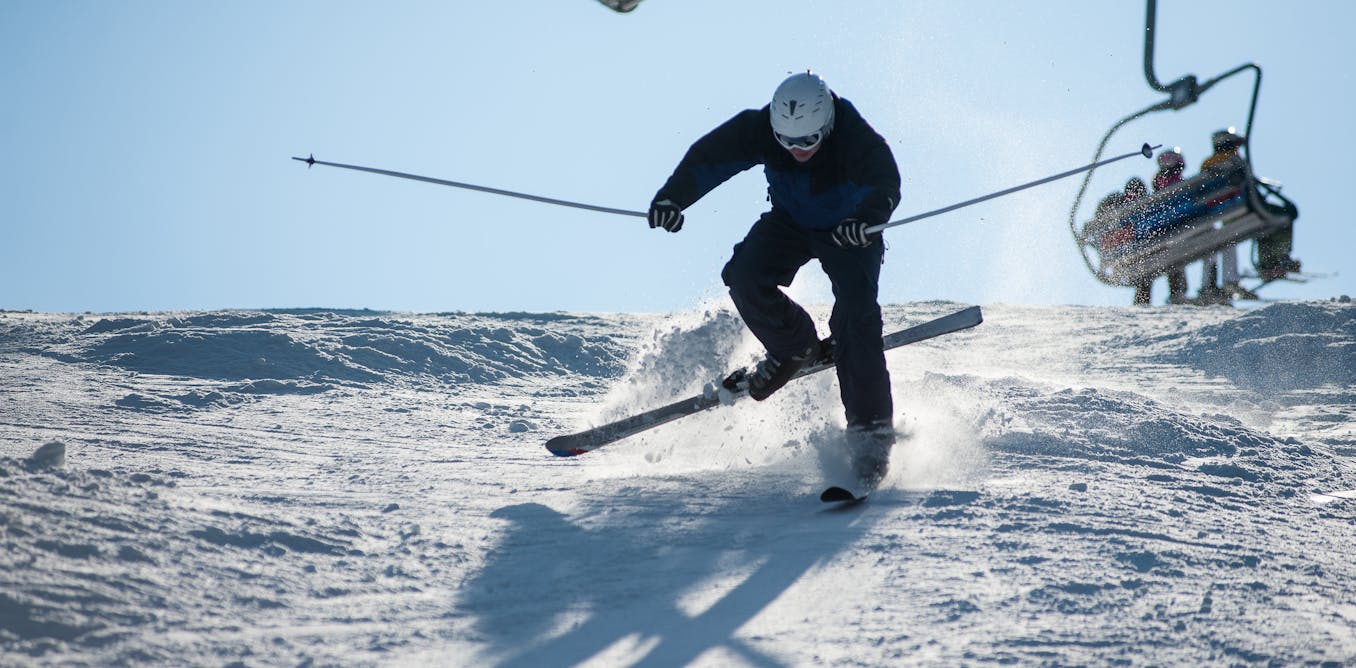
Ski season is well underway, and those in search of Alpine air and exhilaration will be taking to the slopes. But while skiing is a pastime many enjoy, it’s also fraught with injury.
These range considerably in their severity, from broken limbs and concussions to minor sprains and ACL injuries.
This isn’t to say you need to be fearful of skiing. But having an awareness of some of the common skiing injuries before you hit the slopes might help reduce the chances of one happening.
Skier’s thumb
This condition’s medical name is actually ulnar collateral ligament (UCL) injury – though skier’s thumb rolls off the tongue more easily. The UCL is a tiny little ligament with critical importance in stabilising the thumb, allowing it to create a strong grip, or pinch action. You find it at the base of the thumb where it joins the hand.
Skier’s thumb can occur when the thumb is wrenched backwards and outwards by the ski pole – causing the UCL to become overstretched, leading to strain, or even a tear. It can also happen if you fall on your outstretched hand.
You’ll probably notice pain and tenderness at the base of the thumb, near the web-space between thumb and index finger. It may also appear swollen or bruised.
Loss of function in the ligament will affect your ability to grip objects, so even simple actions such as holding a pen or turning a key in a lock become difficult. The thumb can feel altogether looser, sometimes unstable.
Depending on the severity of the damage, skier’s thumb can persist for a few weeks to months on end while the ligament heals.
To prevent skier’s thumb happening in the first place, correct use of ski poles is crucial. Namely, this involves keeping hands in a safe position, letting go of the poles if you fall and being wary of the attached straps which can also wrench the thumb. Good grip technique and well-fitting gloves can also help here.
Shin splints
I’ve noticed complaints of shin splints seem to hit my case list more frequently in the winter months as experienced and avid skiers return from their holidays.
Shin splints refer to pain felt at the front of the legs, during or after exercise. Skiing is just one of the causes. Running, dancing and other sports which involve leaping and jumping (such as basketball) can cause shin splints, too.
This injury is typically the result of repeated stress and overuse which damages the hard and soft tissues. Since you need to use the muscles in the calf and shin regions to control the skis, long days on the slopes can overload them – especially in beginners, or those with poor muscle conditioning.

Pressmaster/ Shutterstock
They can also arise from poorly-fitted equipment – such as loose or tight-fitting boots that rub or stress the shin, especially if you’re spending a lot of time leaning backwards to stay upright. Aggressive skiing, particularly on hard packed snow, can also be an irritant.
Shin splints may also be a symptom of a bigger problem, including small stress reactions (in the shin bone), a build up of pressure in the tissues, or inflammation of the bone lining. But it’s often difficult to determine which of these is the underlying cause.
Should you start noticing shin splints, powering through them can make the problem worse. Instead ease off for the day – check your boots, find some softer snow to ski on, or stop altogether. Some gentle stretching at the ankle joint can also help.
Snow blindness
Even your eyes can be at risk of injury when skiing. The condition I’m referring to is photokeratitis – also know as “snow blindness” or “arc eye.”
This condition occurs when the cornea – the clear layer of the eye that covers the pupil and iris – becomes inflamed. The cornea has the important role of refracting and transmitting light to the retina. Arc eye is caused by exposure to ultraviolet (UV) light. Think of it as a sort of eye-related sunburn.
On the slopes, there’s very little cover and there can be lots of sun exposure. The snow also tends to reflect the sun’s light back at us. All of this UV exposure can result in a painful, watery eye – sometimes accompanied by a twitching eyelid. You may also have redness and difficulty looking at bright lights.
Since the condition can be really painful, you’ll need to cover your eye and see a doctor to confirm the diagnosis. They may prescribe some eye drops to help relax and lubricate the eye to reduce symptoms, and antibiotics to prevent infection. Simple pain relief (such as paracetamol), can also help. Luckily most cases resolve within one to two days.
Wearing UV-protective ski goggles, particularly those that are tinted and well-fitting, can also help prevent snow blindness.
Read more:
Polar penis: the hazards of winter sports
Tens of thousands of injuries are attributed to skiing each year. So to avoid getting hurt the next time you’re on the slopes, it’s key to invest in the correct kit and not move onto more difficult slopes until you’re comfortable and capable enough.
Most importantly, don’t ignore pain and attempt to get back onto the slopes for fear of missing out. And if you do suffer an injury of any kind, be sure to visit the ski resort’s medical team – they’re there for a reason.

Dan Baumgardt does not work for, consult, own shares in or receive funding from any company or organisation that would benefit from this article, and has disclosed no relevant affiliations beyond their academic appointment.