President Donald Trump’s economic agenda took a major hit when the Supreme Court struck down many of his most sweeping tariffs. While Trump has options to restore some of the tariffs, he’s losing his most powerful tool to impose them almost at will as a bargaining chip with other countries.
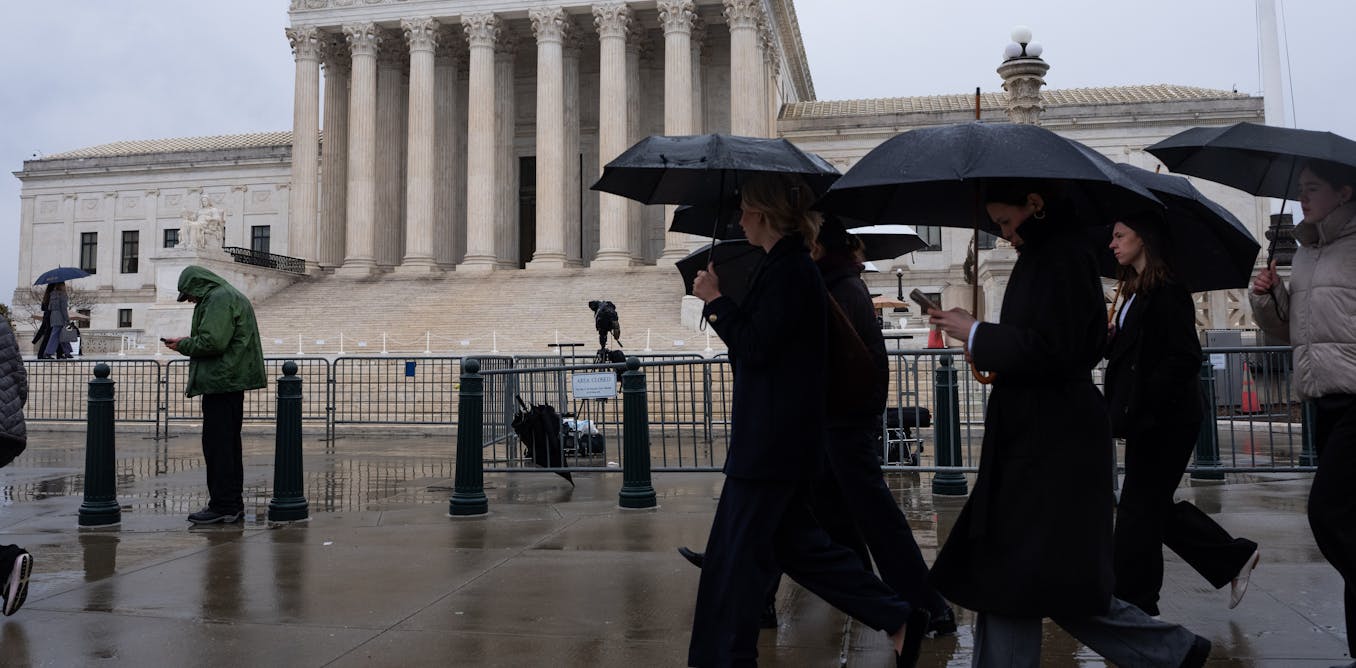
In a 6-3 decision on Feb. 20, 2026, the court ruled that Trump’s use of the International Emergency Economic Powers Act of 1977 to unilaterally impose tariffs on other countries was unconstitutional. Since January 2025, Trump has used the act to impose tariffs on nearly every other country.
As a trade economist, I wasn’t particularly surprised by the ruling. In the oral arguments, several justices were openly skeptical about the president’s ability to claim virtually unlimited powers to set tariffs without specific congressional language to authorize them. While the ruling answers some questions about the legality of Trump’s tariffs, it leaves many others unanswered.
What are the tariffs the court ruled against?
The tariffs that the court ruled are illegal include the “reciprocal” tariffs Trump imposed to match the value of trade barriers set by other countries. They ranged from 34% on China to a baseline of 10% for the rest of the world.
They also include a 25% tariff on some goods from Canada, China and Mexico over those countries’ supposed failure to curb the flow of fentanyl into the U.S.
By striking down these tariffs, the Supreme Court will presumably force U.S. tariff schedules to revert to the status quo before they were imposed on April 2, 2025, or “liberation day,” as Trump called it.
Why did the Supreme Court rule against the tariffs?
Most of the tariffs Trump has imposed used the International Emergency Economic Powers Act to provide legal justification. While the law allows the president to respond to economic emergencies with measures such as embargoes and asset seizures, it does not specifically authorize the use of tariffs imposed unilaterally.
This was a major point made in the Supreme Court decision. In every other statute available to the president to use tariffs, there is specific language stating the way in which tariffs can be imposed, language that is absent in the International Emergency Economic Powers Act statute.
The majority decision, in which the court’s liberal justices were joined by three of its conservatives, determined that the president overreached his powers to set tariffs, based on Article 1, Section 8, of the U.S Constitution. Any delegation of tariff-making powers in an emergency to the president must be consistent with this provision.
It is also noteworthy that Trump openly declared that one of the benefits of the tariffs was how much revenue they bring in. But the majority decision noted that this represented an unauthorized presidential power to tax, which is also governed by the Article 1, Section 8, provision that assigns this power exclusively to Congress.
AP Photo/Evan Vucci
What does this mean for Trump’s trade policy?
Trump used the International Emergency Economic Powers Act tariffs as leverage to negotiate numerous bilateral deals with U.S. trading partners. Now that the tariffs have been declared unconstitutional, many countries may demand that the deals be renegotiated.
The decision does not cover all of the administration’s tariffs, including national security tariffs imposed under Section 232 for specific industries such as autos, steel and aluminum, and Section 301, a statute that allows the president to impose tariffs against individual countries if they have imposed unfair or discriminatory trade actions against the U.S. This covers some of the tariffs on imports from China.
What other options does Trump have to achieve similar results?
Trump has often used or threatened to use International Emergency Economic Powers Act tariffs for political reasons, including against Brazil over its prosecution of a former president, Mexico over immigration and Canada over its plans to sign a trade deal with China, and other reasons.
The Supreme Court decision will make it more difficult for Trump to use tariffs and tariff threats in that way. One outcome is that constitutional limits the justices set on presidential tariff-making powers should constrain the justification of tariffs for political reasons.
The main avenues for new tariffs in response to the Supreme Court decision are sections 232 and 301. The president could potentially try to get Congress to pass new legislation expanding his tariff powers, but that seems unlikely in an election year.
However, it is important to understand that he chose to use the International Emergency Economic Powers Act as the mainspring of his trade policy because he interpreted it as providing him with full discretion in the unlimited power to impose tariffs without further congressional constraints.
In order to impose similar tariffs under Section 232, for example, each tariff order must be focused on a single industry, and the Commerce Department must issue a report documenting the emergency as it applies to that industry. Presumably, Trump will be preparing to use Section 232 for a large numbers of industries in addition to those currently covered by that statute.
For at least some of the countries with which Trump has already negotiated bilateral trade deals, many of their exports would not be covered by Section 232 tariffs, hence the likelihood that those countries will demand a renegotiation.
Will US companies get refunds for the tariffs they’ve already paid?
The Supreme Court decision appears not to address the question of tariff rebates, but many companies have already indicated that they will demand them.
In principle, any U.S. company in possession of tariff receipts documenting their payment of tariffs would be eligible for a refund if the Supreme Court approves this remedy.
What are the political consequences of this decision?
Since public opinion about Trump’s tariffs is already negative, the president will have to deal with a likely backlash against any attempts to replace the rejected tariffs with new ones.
It will be interesting to see how Republicans in Congress react to Trump’s tariff strategy in view of the upcoming midterm elections. For example, Republicans from states that border Canada may push back against further efforts to curb trade with their northern neighbor.
This may impose a further constraint on Trump’s tariff policy.