COPENHAGEN/DUBAI — The maritime “cold war” in the Persian Gulf turned into a logistical freeze on Friday, March 6, 2026, as Danish shipping giant A.P. Moller-Maersk announced the immediate suspension of two primary services linking the Middle East to Asia and Europe. The decision, cited as a “precautionary measure” following a fresh risk assessment, is the latest sign that the U.S.-Israeli conflict with Iran is effectively severing one of the world’s most vital commercial arteries.
The suspension targets the FM1 service, a critical link between the Far East and the Middle East, and the ME11 service, which connects the Gulf to European markets.
Securing the “Shattered” Corridor
Maersk’s retreat comes as the Strait of Hormuz remains at a near-standstill. With Iranian Revolutionary Guard signals warning that “no ship is allowed to pass” and reports of multiple tanker explosions, the world’s largest container carrier is prioritizing crew safety over schedule integrity.
- Port Bypass: In a significant blow to regional trade, Maersk confirmed that its ME1 service (Middle East to Northern Europe) will now drop its scheduled call at Jebel Ali in the UAE—the busiest container hub outside of Asia.
- The African Detour: Following the lead of Mediterranean Shipping Co (MSC) and Hapag-Lloyd, Maersk has officially rerouted all Trans-Suez sailings around the Cape of Good Hope. This 10-day detour is expected to spike fuel consumption and further tighten global vessel capacity.
- Booking Freeze: Effective immediately, Maersk has suspended all new cargo bookings in and out of the UAE, Oman, Iraq, Kuwait, Qatar, and Bahrain. Exceptions are being made only for “life-essential” goods, such as medicine and food supplies.
The “War Premium” Hits Global Trade
The disruption is no longer contained within the Gulf. Industry analysts warn that the effective closure of the Strait—through which 20% of the world’s oil and nearly all of Qatar’s LNG flows—is triggering a “domino effect” across global supply chains.
- Freight Rate Surge: Short-term container rates are expected to “spike” by as much as $3,000 per unit as carriers implement emergency “War Risk Surcharges” to cover skyrocketing insurance premiums.
- The 147-Ship Traffic Jam: Logistics trackers at Kpler and Clarksons report that approximately 147 container ships are currently “idling” or trapped inside the Gulf, unable to exit the Hormuz choke point safely.
- Energy Crunch: The halt in shipping has forced several Asian refineries to declare force majeure as crude and naphtha feedstock deliveries fail to arrive, threatening to push global gas prices to historic highs.
A Precarious Horizon
“This is a systemic shock,” noted a senior analyst at Xeneta. “We are seeing the further weaponization of trade. One week of direct impact in the Gulf can translate into months of structural disruption, from equipment imbalances to port congestion in Europe and Asia.”
For Maersk, the suspension is an indefinite one. The carrier stated it will only resume Middle Eastern rotations once “security conditions permit,” leaving global retailers and energy markets to navigate a fractured map with no clear end in sight.
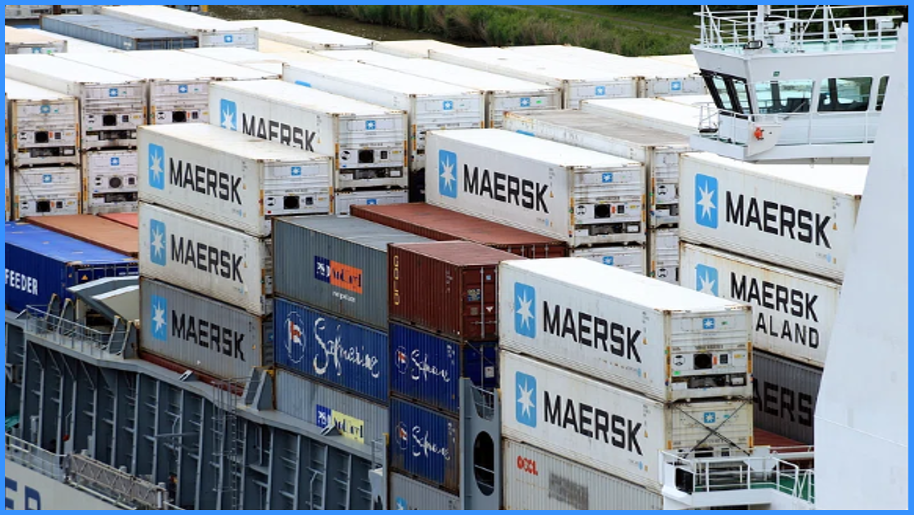
Maersk shipping containers Picture from rawpixel