SANTA CLARA, CA — Intel has officially crossed its most critical technological rubicon, launching the first silicon built on its ambitious 18A (1.8nm-class) process node. The debut of the Xeon 6+ CPU, a 288-core “multi-chip monster” designed for the AI-driven data center, marks a high-stakes attempt by CEO Pat Gelsinger to reclaim the world’s manufacturing crown from TSMC and secure the company’s long-term viability.
The 18A process is widely regarded as Intel’s “make-or-break” moment. It introduces two foundational shifts in transistor architecture: PowerVia (backside power delivery) and RibbonFET (gate-all-around transistors), technologies Intel believes will deliver a definitive lead in performance-per-watt.
The Architecture of a Behemoth
The new Xeon 6+ isn’t just a processor; it is a masterclass in advanced packaging. By utilizing Foveros Direct 3D—a copper-to-copper bonding technique—Intel has achieved record-breaking interconnect density, allowing various “chiplets” to communicate as if they were a single piece of silicon.
- Massive Core Density: Packing 288 Efficiency-cores (E-cores) into a single socket, the Xeon 6+ is aimed squarely at cloud providers managing high-density microservices and vast AI data pipelines.
- Memory Breakthrough: To feed this many cores, Intel has equipped the platform with 12 channels of DDR5-8000 support, providing the massive bandwidth necessary to prevent data bottlenecks in generative AI workloads.
- Thermal Efficiency: Early benchmarks suggest that the 18A node delivers a 15% to 20% improvement in power efficiency over the previous Intel 3 node, a critical metric for data centers currently struggling with rising electricity costs.
A High-Stakes Gamble for Foundry Leadership
The launch of 18A is about more than just a single CPU; it is an advertisement for Intel Foundry Services (IFS). Intel is betting its future on becoming the world’s second-largest foundry by 2030, and the successful “first light” of Xeon 6+ serves as a proof of concept for potential customers like Microsoft and Amazon.
However, the road ahead remains treacherous. While the silicon is impressive, Intel must prove it can achieve high manufacturing yields at scale—something that has plagued the company in previous node transitions. If 18A succeeds, it marks the end of Intel’s “stuttering” era; if it falters, it may signal an irreversible shift in the semiconductor balance of power.
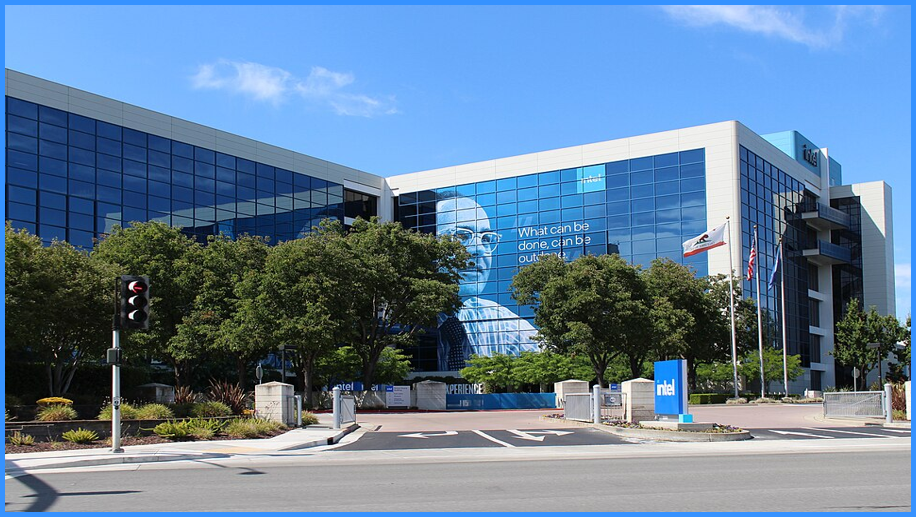
Intel Hq, Santa Clara, California by Coolcaesar