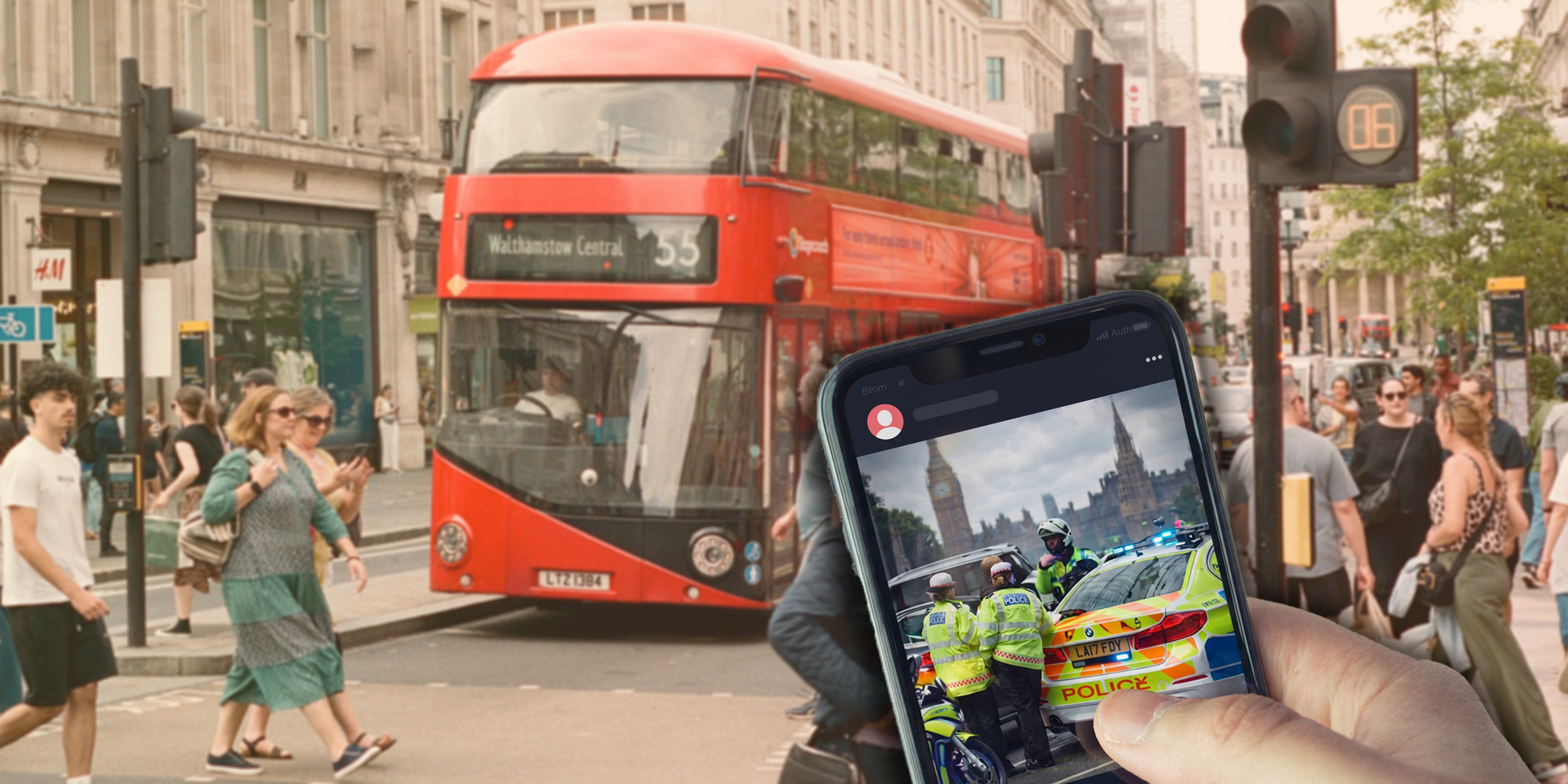
How dangerous is London really? Violent videos and posts about ‘London crime’ dominate social media, reinforcing the image of the British capital – a narrative that is exploited politically by right-wing politicians. According to surveys, more and more Britons therefore consider London to be unsafe. But the figures tell a different story: violent crime has fallen in recent years, and the murder rate is at its lowest level in almost three decades. What’s more, the overwhelming majority of Londoners feel safe in their city. This example shows how social media, algorithms and political exaggeration can shift perceptions – even when the statistical reality tells a different story.
On TikTok, there is a widely used hashtag called ‘London simulator’. If you search for it, you quickly get a very specific image: many clips show video game scenes in which characters with knives or blades roam a gloomy city. Such motifs often shape the image of London on social networks. Platforms repeatedly play up highly polarising content. This constant repetition creates the impression that London is primarily a hotspot for violence and knife crime.
Right-wing populist politicians pick up on such images and reinforce them. Right-wing politician Rupert Lowe wrote on X that London was ‘increasingly resembling the Third World’ and was ‘not safe for women’. The post received more than 2.3 million views. At the same time, Nigel Farage’s right-wing Reform UK party is gaining ground in the polls and is currently in first place in the latest surveys.
Violent crime continues to decline in London
Violent crime in London has been declining for years. Another positive sign comes from hospitals: in 2024, the number of people admitted to hospital for knife-related injuries was the lowest it has been in at least a decade.
The figures for homicides also do not support the alarmist view. With 1.1 homicides per 100,000 inhabitants, London has the lowest rate since records began (1997). By comparison, Paris has 1.3 and Berlin 1.4. New York City, a city of similar size, has almost three times as many (2.8).
That does not mean that London has no problems. Visitors are warned about mobile phone thefts, with perpetrators striking on e-bikes. Shoplifting has also risen sharply. Nevertheless, this does not explain why the impression often dominates online that the city is primarily characterised by serious violence. There is therefore an obvious gap between what the figures show and the dominant narrative on social media, which focuses on violence.
@theeconomist
Economist analysis shows how social media shifts perceptions
Why does the idea of an ‘increasingly dangerous’ city persist when the figures point in the opposite direction? The British magazine The Economist evaluated all posts on X (formerly Twitter) from 2020 to 2025 in which ‘London’ appeared together with keywords related to violent crime.
The result: in 2025, the number of these posts was twice as high as the annual average between 2020 and 2024. Not only did the volume grow, but the response also increased. In 2025, the average number of likes and retweets per post was almost twice as high as in 2024.
One striking feature is the tone of many of the posts. Some of them blame migrants. The proportion of ‘London crime’ posts that also mention Islam, migration or “race” has doubled since 2023. The term ‘Londonistan’ also appears more frequently, a buzzword from right-wing circles that laments the alleged Islamisation of the capital. Posts containing this term have doubled since 2020.
This shifts the debate away from security issues and towards identity politics. Violence is not only portrayed as a crime problem, but as evidence of cultural decline. And although the figures suggest otherwise, this online discourse pushes the mood in a political direction that is easy to mobilise.
When politics and money fuel the mood
Outrage can also pay off financially. X now remunerates posts according to the engagement they generate. This creates an incentive to formulate content in as provocative a manner as possible. Jon Roozenbeek of the University of Cambridge told The Economist that this has led to the creation of accounts that deliberately post inflammatory content because it pays off financially.
It remains unclear how much external manipulation is involved. According to the analysis, it is difficult to quantify how much viral content comes from bots or foreign actors. However, the most influential accounts appeared to be genuine users from the UK. Bots accounted for around 20 per cent of posts about crime in London, but received comparatively little attention.
Misinformation online fuels a distorted public mood
A survey illustrates how strongly the online image shapes everyday perceptions. According to a recent YouGov poll, 61 per cent of Britons now consider London to be unsafe. In 2014, this figure stood at 39 per cent. Among voters of Reform UK, it rises to 85 per cent.
This contrasts with the assessment of many people on the ground. Only one third of Londoners agree with the statement that the city is unsafe. A large majority, 81 per cent, say their own area is safe.
The rights to the content remain with the original publisher.
Post Views: 6