Suwan Ji and Guanghui Lv, Xinjiang University, discuss their article: Intraspecific competition drives orthogonal variation in root exudate metabolic and functional traits in seedlings of a dominant species
In plant ecology, competition is a fundamental process regulating population dynamics. While plants appear stationary, they are actively engaging with their environment and neighbours in many ways, including through root exudates—complex mixtures of biochemicals released into the soil. These exudates serve critical roles, from nutrient acquisition to chemical signaling and allelopathy.
Traditionally, researchers have predicted plant responses to competition using “classical” functional traits, such as biomass allocation or specific root length. However, our recent study on the desert shrub Haloxylon ammodendron reveals that these physical traits only tell part of the story. By adapting a trait-based framework to metabolomics, we demonstrate that root chemistry represents a distinct, independent dimension of plant function.

A new framework: Metabolic functional traits
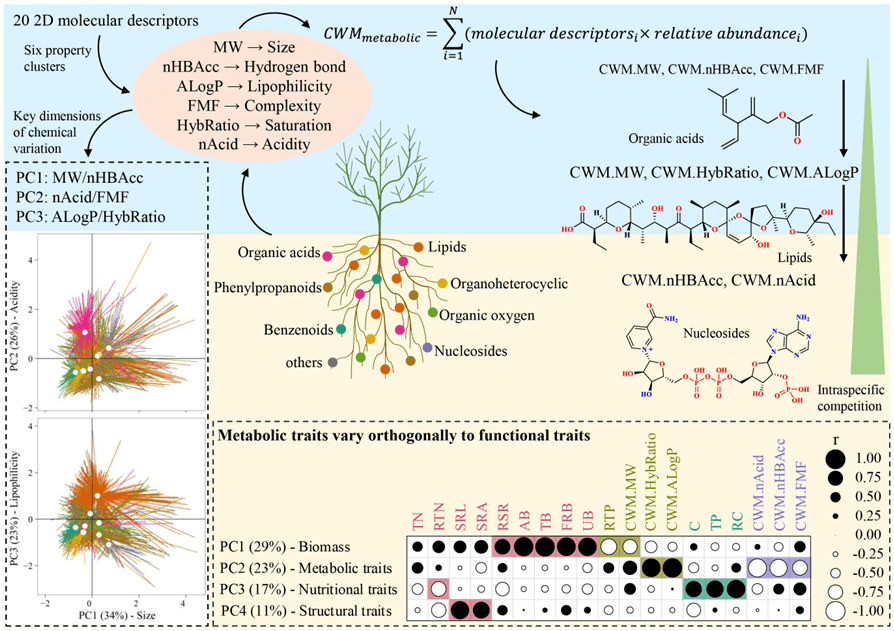
Analysing root exudates is challenging due to the high dimensionality of metabolomic data and the presence of many unidentified compounds. To address this, we adapted the Community-Weighted Mean (CWM) concept from ecology.
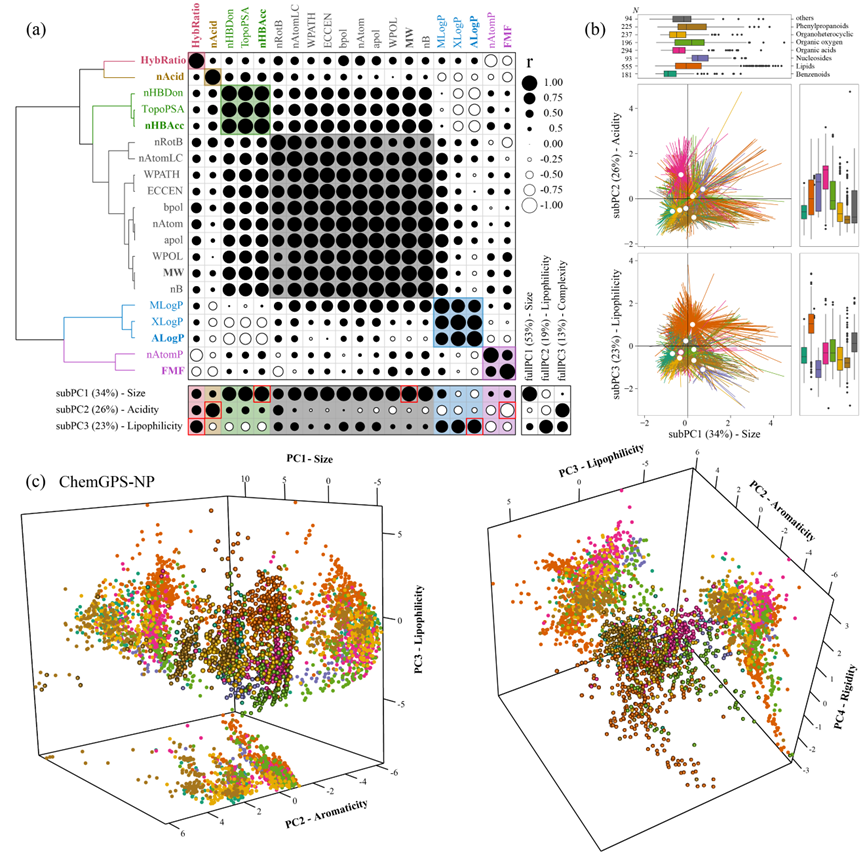
Instead of focusing solely on the identity of individual metabolites, we quantified the “chemical community” based on fundamental molecular properties:
Molecular size (e.g., molecular weight, atom count) & Hydrogen bonding (e.g., polar surface area, donor/acceptor counts): Related to mobility and adsorption in soil.
Acidity (defined by the number of acidic groups) & Complexity (capturing structural intricacy): Linked to nutrient mobilisation versus specific biotic interactions.
Hydrophobicity (indicated by logP values) & Saturation (represented by the ratio of sp3 to sp2 carbons): Mediating soil-matrix partitioning, metabolic persistence, and the efficacy of trans-membrane signaling.
Calculating the CWM of these properties allowed us to derive “metabolic functional traits” for each plant.
Adaptive strategies under competition
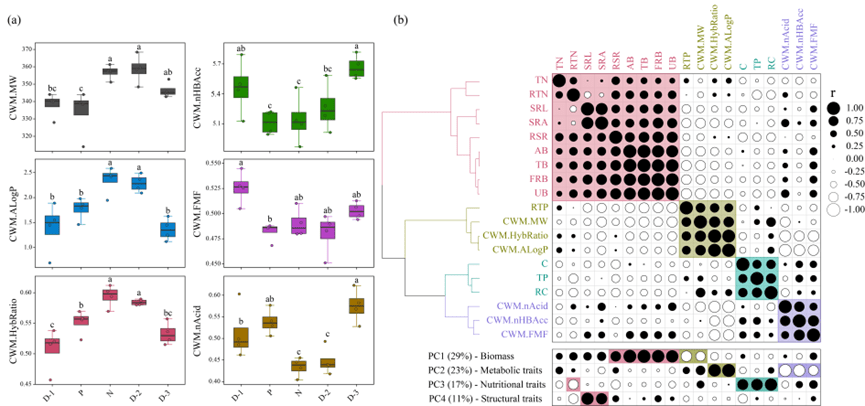
We investigated H. ammodendron seedlings under various competitive scenarios, including density gradients and root segregation (using mesh to allow chemical signaling without physical contact). We found that intraspecific competition significantly reshaped the root exudate metabolome. Specifically, the variation in chemical composition revealed divergent functional strategies depending on the interaction context:
Resource acquisition (solitary conditions): In the absence of competition, plants secreted higher levels of organic acids. These small, acidic molecules are crucial for mobilising soil nutrients and recruiting beneficial microbes, suggesting a strategy focused on rapid resource acquisition.
Stress response and defence (competition): When exposed to neighbours, plants generally downregulated metabolite exudation, likely to conserve resources. However, under chemical interference (mesh treatment), there was an increased abundance of alkaloids and larger, more hydrophobic molecules. This shift suggests an investment in defence or allelopathy rather than general nutrient mobilisation.
The principle of orthogonality
A central finding of our research is the orthogonal relationship between metabolic and classical traits. When we performed correlation analyses and integrated Principal Component Analysis (PCA), we found that metabolic functional traits (such as average molecular weight or acidity) did not correlate significantly with classical traits like biomass or root morphology. They occupied separate axes of variation in multivariate space. This indicates that root exudate chemistry functions as an independent dimension of plant variation. Plants can adjust their biochemical strategies rapidly in response to local cues without necessarily altering their morphological structure. This “decoupling” allows for fine-tuned adaptation in environments where flexibility is key to survival.
Conclusion
Our findings highlight the importance of looking beyond visible physical traits. By incorporating molecular-level metabolic traits, we gain a more comprehensive understanding of phenotypic plasticity and the ecological strategies plants use to navigate competition. This approach offers a powerful tool for future research into plant-soil interactions and ecosystem dynamics.