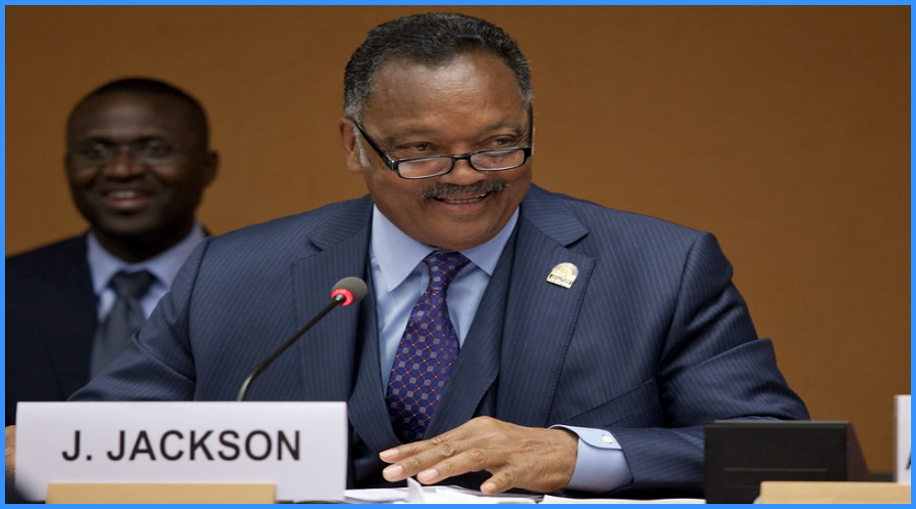
CHICAGO — The Reverend Jesse Jackson, a towering figure of the American Civil Rights Movement whose career spanned more than six decades of activism and two historic runs for the presidency, died Tuesday. He was 84.
His family confirmed his passing in a poignant statement, honoring a man whose “unwavering belief in justice, equality, and love uplifted millions.” Jackson had been living with Parkinson’s disease since his diagnosis in 2017, a battle he fought with the same public resilience that defined his political life.
A Protégé of King and a Voice for the “Rainbow”
Born in Greenville, South Carolina, in 1941, Jesse Louis Jackson Sr. rose to prominence as a young, charismatic lieutenant to Dr. Martin Luther King Jr. He was at the Lorraine Motel in Memphis when Dr. King was assassinated in 1968—a moment that catalyzed Jackson’s transition from a regional activist to a national leader.
In 1971, he founded Operation PUSH (People United to Save Humanity) in Chicago, focusing on economic empowerment and social justice. His philosophy was rooted in the idea that political rights were hollow without economic equity, a theme that would resonate throughout his career.
________________________________
The 1988 Breakthrough: Redefining American Politics
While his 1984 presidential bid broke barriers, it was his 1988 campaign for the Democratic nomination that fundamentally altered the American political landscape. Jackson’s “Rainbow Coalition” sought to unite marginalized groups across racial and economic lines, advocating for:
Universal healthcare
A “war on drugs” focused on treatment rather than incarceration
Aggressive action against South African Apartheid
Though he did not win the nomination, Jackson secured nearly 7 million votes and won several key states, proving that an African American candidate could build a viable, multi-ethnic coalition. His success paved the conceptual and organizational road for the eventual election of Barack Obama twenty years later.
________________________________
A Legacy of Global Diplomacy and Local Activism
Beyond the ballot box, Jackson became a “shadow” diplomat. He famously secured the release of American hostages and political prisoners in Syria, Cuba, and Iraq, often succeeding where traditional State Department efforts had stalled.
Even as Parkinson slowed his physical stride in his later years, Jackson remained a fixture at protests and rallies, from the Flint water crisis to the Black Lives Matter movement. He was the bridge between the non-violent resistance of the 1960s and the digital-age activism of the 21st century.
Tributes Pour In
From the White House to the streets of Chicago, tributes have flooded in for the “Rainbow” leader. Civil rights leaders today credit Jackson with teaching a generation of Black Americans to—in his own iconic words—”Keep Hope Alive.”
With his passing, the United States loses one of its most persistent moral consciences, a man who believed that the American dream was not a finished product, but a work in progress that required constant, noisy, and courageous agitation.
Reverend Jesse Jackson Picture by United States Mission Geneva on Flickr