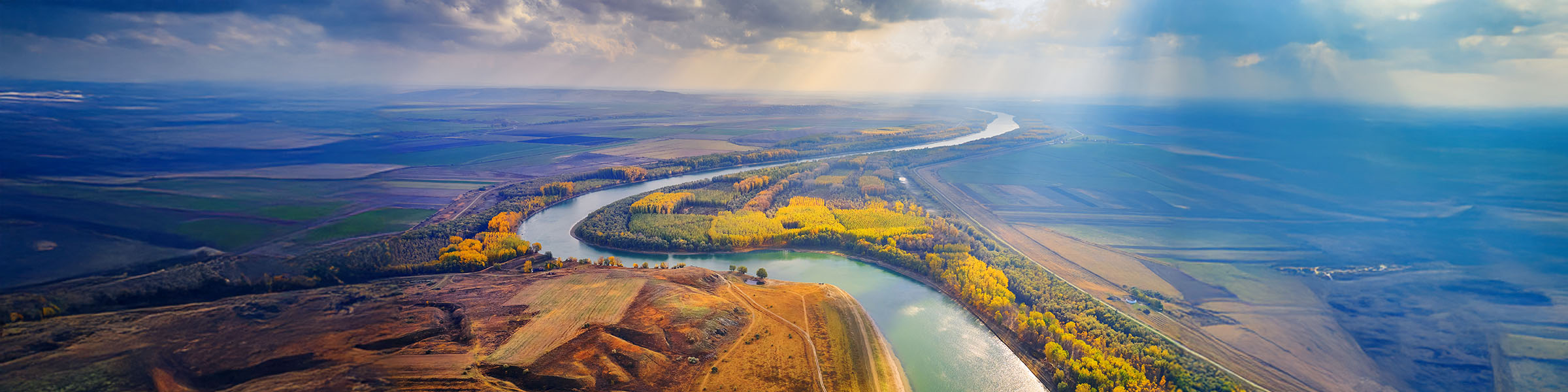
Florian Borgwardt and Tibor Erős, ecologists and life-long freshwater enthusiasts, have set their sights on helping restore the mighty Danube. They are working within an international partnership of scientists, conservationists and local communities to restore the river’s ecosystem and biodiversity.
Flowing through 10 countries and 4 capitals, Europe’s second-longest river is a vital artery for nature and people. Yet decades of human intervention have taken their toll. Dams and barriers fragment its flow, fish species are endangered, wetlands have been drained, and pollution degrades water quality.
As a result, fish populations have declined, ecosystems have weakened, and communities face growing risks from floods and droughts. Climate change is worsening these pressures, further reducing biodiversity and the quality of water.
A challenging river to fix
Restoring a river as vast and shared as the Danube is no small feat. Pressures and priorities shift from one stretch to the next, and from country to country.
That is where the EU-funded DANUBElifelines initiative comes in, bringing together experts from across the river basin to work towards a healthier, more balanced Danube.
“Our project targets depleting stocks of fish species, which migrate to the Danube or within the Danube system in search of stable habitats during their life cycle,” said Borgwardt, who coordinates the research collaboration.
“
Environmental and climate crises are deeply interconnected. Only integrated approaches can address them.
The researchers are focusing on eight demonstration areas along the river system – from Germany and Austria through Slovenia, Slovakia and Hungary, all the way to Romania and Bulgaria.
Here, teams are removing outdated barriers, reconnecting side arms and smaller rivers, and improving habitats to give the river more room to function naturally. Their work contributes to the EU Mission Restore our Ocean and Waters to protect and restore aquatic ecosystems by 2030.
Launched in May 2025, the four-year collaboration focuses in particular on migratory fish and river corridors, reopening blocked migration routes and restoring key habitats along the way.
The partnership brings together universities, research institutes, NGOs and policy organisations, including the World Wildlife Fund (WWF) and Wetlands International.
Charting the Danube’s recovery
The DANUBElifelines researchers are studying fish movement patterns, assessing the quality of the natural habitat and working on solutions with local stakeholders. In one stretch of the river, for example, the team is testing the removal or modification of small barriers so fish can once again move freely between spawning and feeding areas.
Borgwardt is an assistant professor at the Institute of Hydrobiology and Aquatic Ecosystem Management at Vienna’s University of Natural Resources and Life Sciences. He is a strong advocate of using scientific mapping and modelling to guide restoration.
Having grown up near a river, he developed an early interest in river protection and later became passionate about using technology to understand nature from an ecosystems perspective.
Erős, head of the Fish and Conservation Ecology Research Group at the HUN-REN Balaton Limnological Research Institute in Hungary, has a similar background.
He was born and raised in a small village on the Hungarian Danube shores, and the river has been part of his daily life for as long as he can remember. “I was a passionate fisherman who became a passionate fish ecologist.”
Both scientists favour a hands-on, demonstration-based approach. Rather than producing reports that sit on shelves, they intervene in real locations, learn from the outcomes and share the lessons widely.
Restoring the river’s rhythm
The key aspect, Borgwardt said, is interconnectivity: how different parts of the river are linked. “If fish can’t reach certain habitats at the right time, they can’t complete their life cycle. The aim is to get them upstream – and then safely back downstream after spawning.”
Challenges differ along the river. “We have to select the most suitable sites for restoration and conservation purposes,” said Erős. “We then provide scientific evaluations and recommendations to stakeholders, along with proposals for sustainable management.”
Replicating what works
DANUBElifelines is designed to create solutions that can be applied beyond the Danube. Methods tested in the Danube River Basin can support restoration efforts in other European rivers, helping future projects build on existing knowledge rather than start from scratch.
Borgwardt highlighted the importance of shared data. “A common monitoring scheme gives us a clearer picture of how fish use habitats. We can then draw on this knowledge to recommend effective measures.”
Restoration with local allies
Because the Danube crosses so many borders, successful restoration depends on coordination, shared objectives and local support. For Erős, collaboration with a wide range of stakeholders is essential.
“Stakeholders need to be willing to act towards common goals,” he said. “That means finding compromise solutions that take everyone’s needs into account.”
With this in mind, the DANUBElifelines team works with local authorities, national park managers, fishing communities, farmers and regional organisations.
“
We have to select the most suitable sites for restoration and conservation purposes.
“We look at how sustainable management can benefit both the river and local communities,” said Borgwardt. To that end, the team organises workshops to present findings and discuss restoration options.
WWF plays a key role in linking science to conservation practice and policy, while the project also works closely with the International Commission for the Protection of the Danube River (ICPDR), which coordinates the implementation of EU water legislation across the basin.
“We share results from our demonstration sites with regional authorities,” Borgwardt said. “When it comes to nature conservation, dialogue and incentive-based approaches are often the most effective.”
At the same time, the team recognises the need to balance ecological restoration with existing uses of the river such as navigation, hydropower and agriculture.
Looking ahead
Borgwardt remains optimistic. “Environmental and climate crises are deeply interconnected,” he said. “Only integrated approaches can address them. Even though we are still in the early phase of the project, what we’ve put in place is promising.”
The restoration of the Danube River Basin shows how joint action by science, policy and communities can begin to repair damage accumulated over generations, while creating ecosystems that are more resilient to future pressures.
As Europe grapples with biodiversity loss and climate change, initiatives like DANUBElifelines offer both hope and a practical roadmap – demonstrating that restoration is possible, and that lasting change is within reach when communities are engaged as partners.
**The project in this article received funding as part of the EU Mission: Restore our Oceans and Waters. EU Missions are EU‑funded initiatives that mobilise research, policy and citizens to tackle major real-world challenges by 2030.