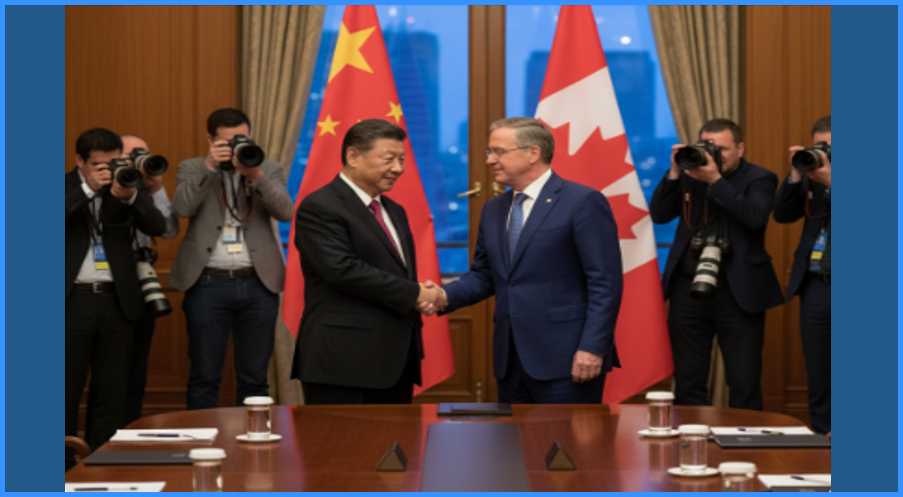
In a high-stakes diplomatic reset, Chinese President Xi Jinping is set to host Canadian Prime Minister Mark Carney this week, marking the first visit by a Canadian head of government to the Chinese capital in eight years. The summit, scheduled to begin Tuesday, January 13, arrives at a critical juncture for both nations as they navigate a volatile global trade landscape and an increasingly assertive “America First” agenda from Washington.
The visit is framed by both Ottawa and Beijing as a “hinge moment.” For Prime Minister Carney—the former central banker who assumed office in March 2025—the trip represents a cornerstone of his “Reliance to Resilience” strategy, an ambitious plan to diversify Canadian exports away from a 76% dependence on the United States.
The Agenda: Trade, Energy, and “Irritants”
The four-day state visit follows an introductory meeting between the two leaders last October on the sidelines of the APEC summit in South Korea. This week’s formal talks aim to elevate cooperation in several key sectors while managing deep-seated friction.
- Economic Complementarity: Discussions are expected to focus on trade in agriculture (specifically canola), energy, and critical minerals. Canada seeks to position itself as a stable alternative for raw materials as global supply chains fragment.
- Reciprocal De-escalation: Both sides will attempt to negotiate a “truce” on recent trade barriers. This includes potential rollbacks on Canadian steel and electric vehicle (EV) tariffs in exchange for the removal of China’s heavy duties on Canadian canola and seafood.
- Security & Sovereignty: Despite the economic focus, Carney has signaled he will not shy away from “tricky topics,” including allegations of foreign interference in Canadian democratic institutions and shifting security dynamics in the Arctic.
Geopolitical Context: The “Trump Factor”
The shadow of U.S. President Donald Trump looms large over the Beijing summit. With Washington’s recent military operations in Venezuela and its aggressive tariff threats against allies, both Canada and China find themselves sharing common ground as targets of U.S. protectionism.
| Strategic Interest | Canada (Carney Govt) | China (Xi Administration) |
| Trade Goal | Diversify away from U.S. markets | Secure reliable energy/resource flows |
| Economic Lever | High-quality oil, LNG, and timber | Massive manufacturing & EV capacity |
| Diplomatic Stance | Pragmatic “Statesman” approach | “Reasonable Adult” in the G-Zero world |
The Bottom Line: A Delicate Balancing Act
For Mark Carney, the visit is a test of his domestic mandate as a “statesman” capable of protecting Canadian interests without alienating traditional security ties or the new trade reality in the Americas. For Xi Jinping, the meeting offers an opportunity to drive a wedge into the G7’s unified front on China while securing the commodities essential for China’s industrial future.
As the two leaders meet in the Great Hall of the People, the outcome will likely define the trajectory of the Canada-China relationship for the remainder of the decade—shifting it from a period of “deep freeze” toward a cautious, pragmatic partnership