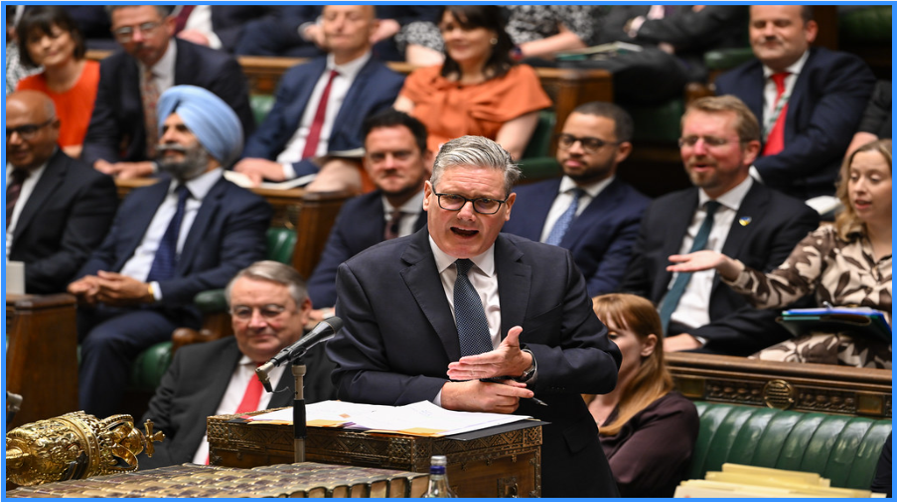
In a carefully calibrated diplomatic tightrope act, British Prime Minister Sir Keir Starmer has stated that it is for the United States to justify its military intervention in Venezuela.2 Speaking on Monday, January 5, 2026, Starmer described the capture of Nicolás Maduro and the subsequent airstrikes in Caracas as “not straightforward,” refusing to join the chorus of international condemnation while simultaneously distancing the UK from the operation.
The Prime Minister’s comments come amid mounting domestic pressure from Labour backbenchers and opposition leaders, who have questioned why the government has not denounced the raid as a breach of international law, given Starmer’s vocal opposition to similar territorial violations by other global powers.3
A Defiance of Condemnation
During an interview with ITV News, Starmer maintained a stance of “strategic patience,” insisting that the UK must wait for all material facts to emerge before passing judgment.4
- The Justification Gap: “International law is the framework, of course it is, and it will be for the US to justify the actions that they have taken,” Starmer said.5 He emphasized that any sovereign state must set out the legal basis for its own decisions.6
- No UK Involvement: The Prime Minister was “absolutely clear” that British forces were neither involved in nor consulted on the tactical operation, focusing instead on the safety of the approximately 500 British nationals currently in Venezuela.7
- The “Illegitimacy” Clause: Despite his caution, Starmer did not mince words regarding the deposed leader. “We mustn’t lose sight of the fact that the president was illegitimate and caused untold misery,” he added, echoing the Foreign Office’s stance that the UK “sheds no tears” for the end of the Maduro regime.8
The Precedent Debate: Labour vs. Starmer
The Prime Minister is facing a burgeoning rebellion from his own party.9 Senior Labour MPs, including Emily Thornberry, have warned that failing to criticize the U.S. action sets a “really bad precedent” that could be exploited by rivals such as Russia or China to justify future incursions into their own spheres of influence.
| Political Actor | Official Stance | Key Quote |
| Keir Starmer | Strategic Neutrality | “Let’s establish the facts and take it from there.” |
| Sir Ed Davey (Lib Dem) | Condemnation | “Illegal action… makes us all less safe.” |
| Emily Thornberry (Labour) | Concern over Precedent | “There is no legal basis for this.” |
| Nigel Farage (Reform UK) | “Unorthodox” Support | “If [it] makes China and Russia think twice, it may be a good thing.” |
A Contrast in Policy: Venezuela vs. Greenland
In a notable shift of tone, Starmer took a far firmer stand against President Trump’s renewed threats to annex Greenland.10 While deferring to the U.S. on Venezuela, the Prime Minister insisted that Greenland’s future is a matter “only” for its people and the Kingdom of Denmark.11
This distinction has led critics to suggest that the UK is engaging in a “geopolitical double standard,” appearing deferential to the White House on active military engagements while standing firm on territorial disputes involving European allies.12
The Diplomatic Horizon
As the UN Security Council convenes to debate a resolution criticizing the intervention, reports suggest that the UK is likely to abstain rather than vote against the U.S. move.13 For Starmer, a former human rights lawyer, the challenge remains reconciling his “lifelong advocacy of international law” with the pragmatic necessity of maintaining a functioning “special relationship” with a newly emboldened Trump administration.
Sir Keir Starmer Flickr Picture by House of Commons