(Nairobi) – An apparent Nigerien military drone strike killed at least 17 civilians, including 4 children, and injured at least 13 others at a crowded market in western Niger on January 6, 2026, Human Rights Watch said today. The strike, which also killed three Islamist fighters, violated laws-of-war prohibitions against indiscriminate attacks and might amount to a war crime.
The attack occurred in the village of Kokoloko in Tillabéri region, about 120 kilometers west of the capital, Niamey, and less than 3 kilometers from the border with Burkina Faso. Residents said the Islamic State in the Sahel (IS Sahel), an Islamist armed group, has been active in Kokoloko and surrounding areas for several years. Islamist armed groups have carried out attacks against the military and civilians in Niger since 2019.
“The Nigerien military attack that killed three Islamist fighters also killed and injured a large number of civilians in a market in violation of the laws of war,” said Ilaria Allegrozzi, senior Sahel researcher at Human Rights Watch “The Nigerien authorities should ensure a transparent and impartial investigation into this attack, appropriately prosecute those responsible, and adequately compensate victims and their families.”
Human Rights Watch interviewed fifteen people by telephone, including six witnesses and nine members of domestic and international nongovernmental organizations, journalists, and residents of the Kokoloko area. Human Rights Watch also analyzed and geolocated three videos posted online showing the aftermath, as well as satellite imagery of the location of the strike.
The Nigerien military junta, which took power in a July 2023 coup, did not issue any public comment following the drone strike. Human Rights Watch sent a letter on January 26 to the junta’s cabinet, sharing its findings and requesting responses to specific questions. Human Rights Watch did not receive a response.
Witnesses said that between 10 a.m. and 1 p.m. on January 6, they saw a drone flying over Kokoloko twice, then drop a munition on the village at about 1:30 p.m., when hundreds of people packed the market.
“I saw the whitish drone flying, then heard something like a whistling before a large explosion,” said a 36-year-old trader who narrowly escaped injury. “The market was hit, and it was full of women and children, women who sell cooked rice, meat soup, and other food; their kids were around, as well as many traders.”
Witnesses also said that at the time of the strike, three IS Sahel fighters without weapons and dressed in civilian clothes with turbans were in the market, while three others were in the village. “That day, at about 9 a.m., I saw six IS Sahel fighters, armed with Kalashnikovs [assault rifles] and a machine gun, arriving in the village and three of them entered the market,” the trader said. “IS Sahel fighters shop in every market of the area, they buy their things and leave.”
Residents said many of the bodies were torn apart and burned. “I counted 17 bodies, mostly women and children,” said a religious leader, 67, who returned to the market at about 6 p.m. that day. “The bodies were charred, making identification very difficult.” They said IS Sahel fighters helped residents collect the bodies which were buried in the village cemetery. “We put the women and children together, in a mass grave, and the men in another grave,” said one man.
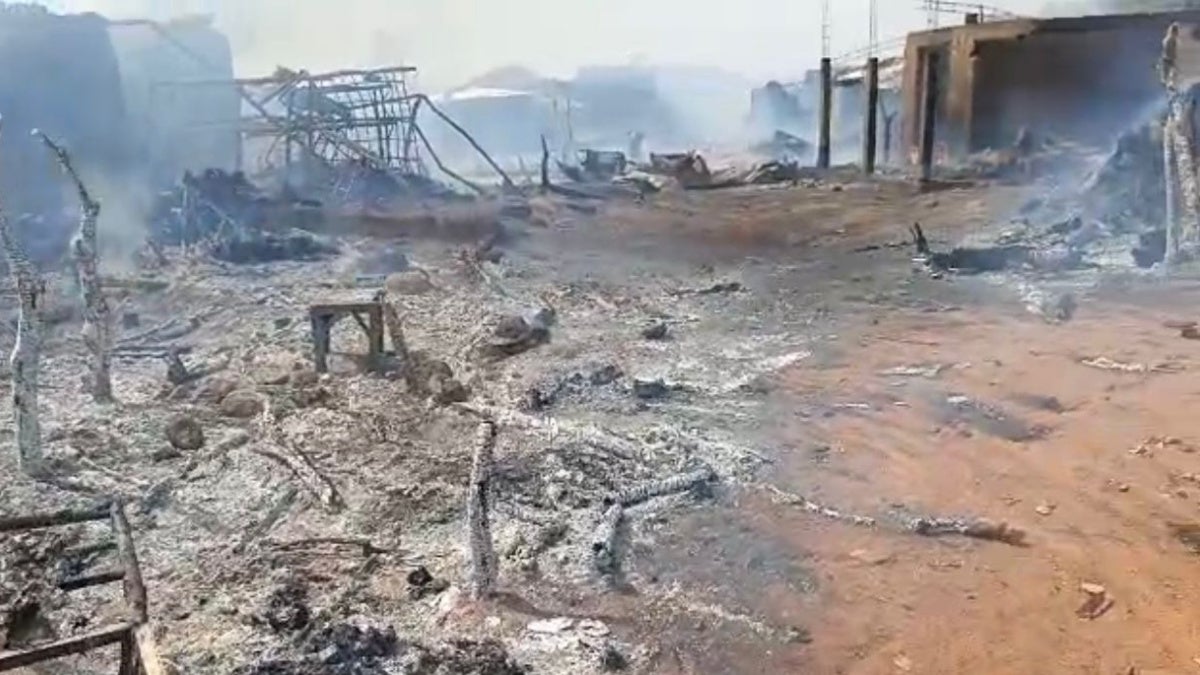
The three videos show scorched earth and extensive fire damage to market stalls, some of them still on fire. Fire detection data provided by NASA’s Fire Information for Resource Management System (FIRMS) captured active fires over Kokoloko on January 6 at 1:31 p.m. local time. Low-resolution satellite imagery from January 7 shows new burn marks over Kokoloko that did not appear on imagery the previous morning.
High-resolution satellite imagery from January 20 shows burned areas in various parts of the village along the main road. Witnesses said the air-dropped munition caused the fire, which was intensified by fuel at the market, as well as by stalls made of wood, which allowed the flames to spread rapidly.
Human Rights Watch was unable to identify the drone or munition used. Since 2022, the Nigerien military has reportedly acquired various types of Turkish-made drones, including Bayraktar TB-2, Karayel-SU, and Aksungur UCAV. These drones can be equipped with sensors that allow for active surveillance with live video feeds and can be equipped with guided munitions.
Videos from the site posted online and reviewed by Human Rights Watch show extensive fire damage to structures that could have been caused by high explosives. Witnesses reported that the wounded had a range of injuries, including burns and wounds from munition fragments.
Following the strike, nearly all of Kokoloko’s 1,200 residents fled to neighboring villages or across the border to Mali. “I spent the first night in a nearby village with my children,” said a woman who lost her cousin, 50, and nephew, 5, in the strike. “Then, we crossed to Mali with almost nothing.”
Human Rights Watch obtained a list compiled by residents with the names of 17 civilians killed and 13 injured. Those killed included 11 women, ages 29 to 50; 2 men, 32 and 55; and 4 children, 5 to 10. Among those injured were 4 women, ages 28 to 45; ;7 men, 23 to 62; and 2 children, 14 and 15.
Witnesses said residents found the bodies of the three fighters and IS Sahel took care of their burial.
Under international humanitarian law, also called the laws of war, parties to an armed conflict must distinguish at all times between combatants and civilians and never target civilians. Attacks that use a means or method of combat whose effects cannot be limited as the laws of war require, and that therefore strike military objectives and civilians without distinction, are unlawfully indiscriminate. Even if several Islamist fighters were present, the drone strike on the crowded market in Kokoloko with at least one explosive weapon was indiscriminate. If those who ordered or carried out the strike did so with criminal intent—that is, deliberately or recklessly—they would be responsible for war crimes.
According to the nongovernmental group Armed Conflict Location and Event Data (ACLED), in 2025 the Tillabéri region recorded the “highest number of fatalities from attacks on civilians” in central Sahel by IS Sahel, the Nigerien military, and the Al Qaeda-linked armed Group for the Support of Islam and Muslims (Jama’at Nusrat al-Islam wa al-Muslimeen, or JNIM).
In September 2025, media reported that Nigerien military airstrikes hit a weekly market in Injar village, Tillabéri region, killing over 30 civilians in an attack on suspected militants. In January 2024, media reported that Nigerien military drone strikes against Islamist armed groups killed several civilians in Tiawa village, also in Tillabéri region.
“Foreign governments supporting Niger’s military should press the authorities to adopt measures to avoid harming local populations,” Allegrozzi said. “The government needs to provide services to help people recover from injuries and trauma and provide adequate compensation to victims and their families.”