(Tokyo) – Myanmar’s military junta has committed widespread repression and abuse in every facet of life in the country since seizing power on February 1, 2021, Amnesty International, Fortify Rights, and Human Rights Watch said today. The military’s atrocities since the coup, which include war crimes and crimes against humanity, escalated over the past year as the junta sought to entrench its rule through abusive military operations and stage-managed elections.
United Nations Security Council members, governments in the region, and other concerned states should better support Myanmar’s people and act to hold the junta accountable for its crimes. The heavily controlled elections, held in three phases between December 28, 2025, and January 25, 2026, have been widely dismissed as fraudulent and organized to ensure the military-backed party’s electoral victory.
“It’s no accident that this election has been made possible through increased human rights abuses, from arbitrary detention to unlawful attacks on civilians, which has been the military’s modus operandi for decades,” said Ejaz Min Khant, human rights specialist at Fortify Rights. “As this crisis stretches into its sixth year, governments should focus on accountability and justice efforts for the many crimes committed by Myanmar’s military, without which the country cannot move forward.”
Since the coup, the junta has systematically banned dozens of political parties and detained more than 30,000 political prisoners. In January, the junta reported that it had taken legal action against more than 400 people under an “election protection” law passed in July criminalizing criticism of the election by banning speech, organizing, or protest that disrupts any part of the electoral process.
The elections have served as a centerpiece for the junta’s attempts to crush all political opposition, derail efforts to restore civilian rule, and entrench the military-controlled state. As expected, and by design, preliminary election results indicate a landslide victory for the military proxy Union Solidarity and Development Party.
China and Russia, the junta’s primary suppliers of aircraft and arms, both sent election observers to the polls. The two countries have long supported the junta while blocking international action on military atrocities at the UN Security Council. Malaysia, last year’s chair of the Association of Southeast Asian Nations, said the bloc has not sent observers to certify the polls.
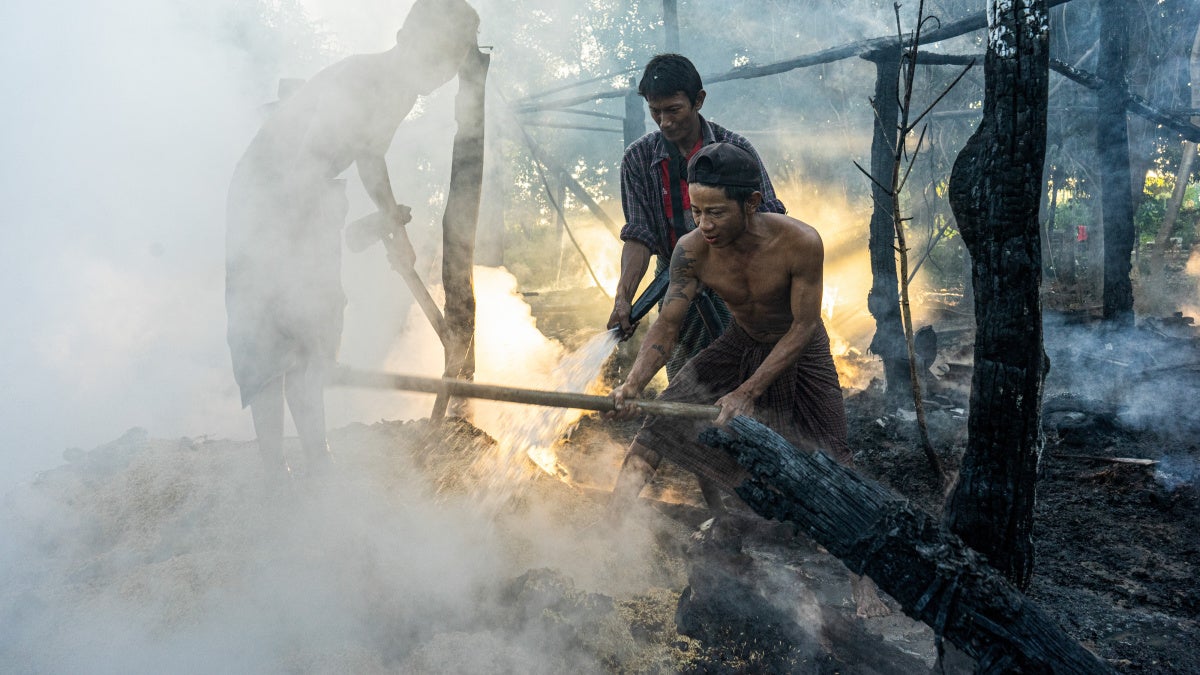
In expanded military operations ahead of the elections, the junta in 2025 ramped up its use of airstrikes, including deliberate and indiscriminate attacks on civilians and civilian infrastructure in violation of international humanitarian law. Airstrikes have hit schools, hospitals, religious sites, and camps for displaced people, killing thousands over the past year.
The military has also increasingly used armed drones, paramotors, and gyrocopters in unlawful attacks, creating new threats to civilians. On October 6, a military paramotor attack on a Buddhist festival in Sagaing Region killed at least 24 people, including three children. More than 135 paramotor attacks have been reported since December 2024. Myanmar is one of very few countries that continue to use internationally banned cluster munitions and antipersonnel landmines.
“The past five years are a bleak illustration of the Myanmar military’s failed strategy to assert control by killing and terrorizing civilians,” said Joe Freeman, Myanmar researcher at Amnesty International. “Military air and drone strikes reached new highs in 2025 as the junta intensified its already brutal campaign against opposition areas, leaving more and more people living in fear of bombs falling from the sky.”
Since enacting a conscription law in February 2024, the junta has used abusive tactics such as abducting young men and boys and detaining family members of missing conscripts as hostages. The military’s recruitment and use of child soldiers has surged since the coup.
Since the coup, more than 2,200 people have reportedly died in junta custody, although the actual figure is likely higher. Torture, sexual violence, and other ill-treatment are rampant in prisons, interrogation centers, military bases, and other detention sites, with reports of rape, beatings, prolonged stress positions, electric shock and burning, denial of medical care, and deprivation of food, water, and sleep. In July, Ma Wutt Yee Aung, a 26-year-old activist, died in Insein prison due to reported lack of medical treatment for long-term head injuries from torture.
Following the March 2025 earthquake that struck central Myanmar, the junta obstructed access to lifesaving services in opposition-held areas. The junta’s years of unlawful attacks on healthcare facilities and health workers severely hampered the emergency response. Despite announcing a ceasefire, the military carried out more than 550 attacks in the two months following the quake.
Military abuses and spiraling fighting have internally displaced at least 3.6 million people. Foreign aid cuts, skyrocketing prices, and restrictions on medical care and humanitarian supplies have exacerbated malnutrition, waterborne illness, and preventable deaths. Over 15 million people are facing acute food insecurity, with Rakhine State especially impacted.
Millions who have fled the country face increasing threats and risk of forced returns.
Since late 2023, Rohingya civilians have been caught amid fighting between the junta and ethnic Arakan Army forces. The Arakan Army has imposed oppressive measures against Rohingya in northern Rakhine State, including forced labor and arbitrary detention.
Since the coup, trafficking, scam centers, unregulated resource extraction, drug production, and other illicit operations have proliferated. Online scam centers along Myanmar’s border with Thailand—run by global criminal syndicates led by Chinese nationals—largely rely on human trafficking, forced labor, and torture to run their scams, which are part of a multibillion-dollar industry across the region.
The military’s widespread and systematic abuses have been fueled by decades of impunity and insufficient international efforts to end its violations.
Accountability measures underway at the International Court of Justice and International Criminal Court (ICC) are vital but remain limited to atrocities prior to the coup. In November 2024, the ICC prosecutor requested an arrest warrant for commander-in-chief Sr. Gen. Min Aung Hlaing for alleged crimes against humanity committed in 2017; the judges have yet to issue a public decision on the request.
The UN Security Council has been largely deadlocked, failing to follow up on its December 2022 resolution, which denounced the military’s post-coup abuses, with tangible measures due to opposition from China and Russia.
Security Council members should outline targeted accountability measures to be taken against the junta for its refusal to comply with the council resolution and numerous other international calls. Holding regular open meetings on Myanmar can help build momentum for a follow-up resolution referring the whole country situation to the ICC and instituting a global embargo on arms and jet fuel.
“Five years after the coup, Myanmar’s human rights and humanitarian catastrophe faces dwindling foreign assistance and attention,” said Shayna Bauchner, Asia researcher at Human Rights Watch. “Ending this crisis requires sustained international pressure, meaningful accountability, and concrete humanitarian, political, and technical support for those in Myanmar and the millions forced to flee.”