On November 14 1985, a letter announcing the discovery of a superstable species of carbon appeared in the science journal Nature. Even the letter’s title, C₆₀: Buckminsterfullerene, caused a stir among the journal’s scholarly readers.
Molecules are usually named with sterile precision. This one was named after the American architect and futurist Richard Buckminster Fuller (Bucky to his friends), whose geodesic domes had become icons of modern design in the 1950s and 60s.
Fuller’s spherical domes were designed to be lightweight yet strong, with each triangular element distributing stress evenly across a curved framework. C₆₀ was the atomic analogue of these domes, built not from steel struts but carbon atoms – each joined by strong bonds with three of its neighbours to create a tiny spherical cage.
This new allotrope of carbon was so stable and symmetric that it redrew the map of molecular architecture. It kicked off a scientific sprint that led, barely a decade later, to the 1996 Nobel prize in chemistry for English scientist Harold Kroto and his American colleagues Robert Curl and Richard Smalley for their discovery.
Fullerenes (now nicknamed Buckyballs) had always existed on Earth – in candle soot, volcanic emissions and ancient minerals. But their scientific discovery emerged from an attempt to simulate the chemistry of carbon-rich red giant stars.
The discovery opened the era of nanotechnology – the manufacture and manipulation of materials at previously impossibly small scales. But this is not the only way Fuller’s name is remembered in science.

Wikimedia, CC BY-NC-ND
Who was Buckminster Fuller?
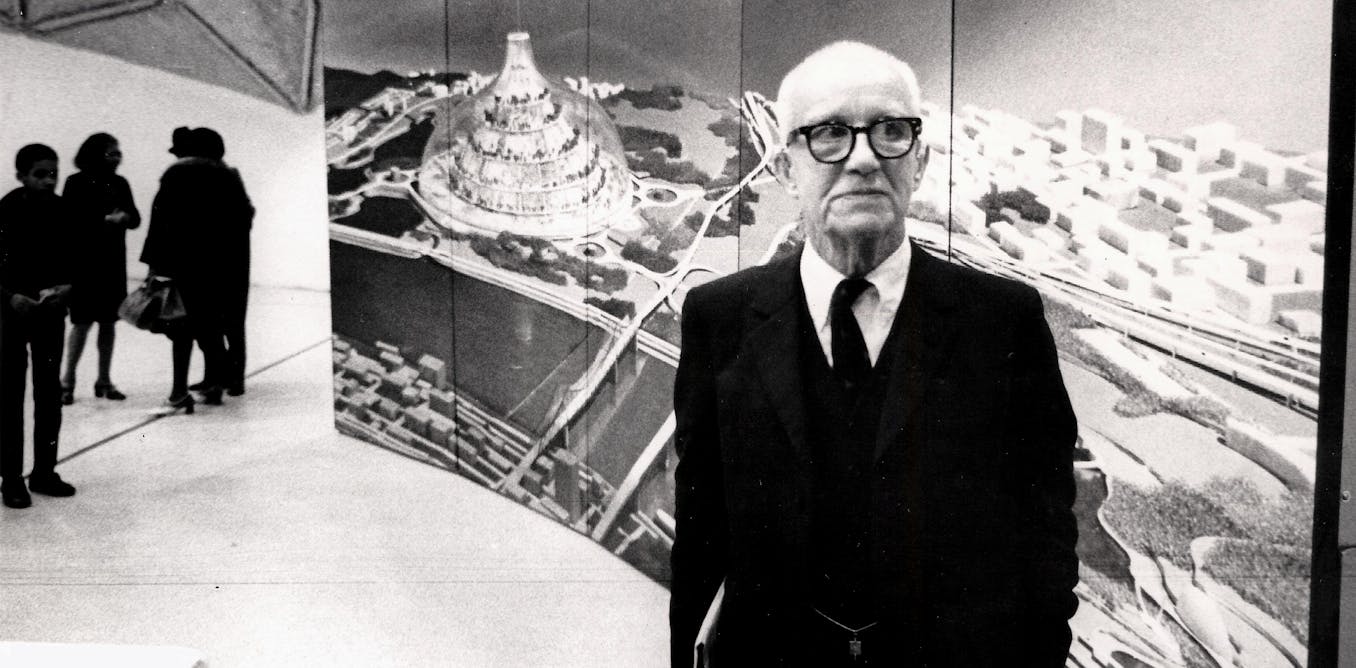
Few 20th-century figures are as hard to classify as Fuller. He was, at the least, an inventor, designer, engineer, writer, philosopher and futurist. Born in Massachusetts in 1895, his formal education was brief and rather turbulent – he was expelled twice from Harvard University. Yet this did not lessen his ambition to redesign the world.
Fuller could be eccentric and sometimes controversial. His early enterprises frequently failed, yet his charisma and boundless optimism made him a compelling public figure. The result was a remarkable portfolio of inventions and concepts, showcasing bold prototypes and radical ideas.
His earliest geodesic domes were built from lightweight materials, typically steel tubular struts connected in a triangular lattice and clad with acrylic panels. They capitalised on the structural advantage of symmetry: enclosing a vast space with relatively little material and remaining exceptionally strong.
Fuller patented the design in 1951. Despite initial scepticism from some in the architectural establishment, geodesic domes soon found practical applications. The US Marine Corps used them for rapidly deployable radar stations in Arctic conditions.
One of the most famous examples is the giant dome built for the Expo 67 international exposition in the Canadian city of Montreal. Known today as the Montreal Biosphere, the structure became one of the most recognisable symbols of futuristic architecture in the 1960s.
Alongside his designs, Fuller spent much of his life developing Synergetics, a philosophical-geometric framework exploring how structures and energies interact in nature. At the heart of this work was “ephemeralisation” — a term Fuller coined to describe the process of achieving ever greater results with fewer materials and less energy.
In later life, he became a global intellectual celebrity, delivering thousands of lectures around the world. Fuller captivated audiences with a unique vision of design, technology and planetary stewardship — once delivering a marathon series of lectures entitled “Everything I know”. It ran for 42 hours.
The power of symmetry
Symmetry is among science’s most powerful unifying codes and one of its most versatile interpretive tools. It reveals surprising equivalences between forms that differ in size but not in structure.
In the 1960s, footballs adopted a similar geometry to Fuller’s geodesic dome: a combination of 12 pentagons and 20 hexagons stitched into a resilient mesh to absorb force and rolls with minimal deformation. Indeed, a diagram of a football was used to illustrate the announcement of C₆₀: Buckminsterfullerene.

This series is dedicated to lesser-known, highly influential scientists who have had a powerful influence on the careers and research paths of many others, including the authors of these articles.
A growing family of atom-thin, superstrong materials has emerged since that 1985 Nature letter. These include the tiny-in-diameter but much longer carbon nanotubes in 1991, and the one-atom thick graphene in 2004 – both of which are now widely used in electronics, sensors, composites and energy devices.
When added to polymer composites or metal alloys, these tiny carbon cages strengthen and lighten materials, enhancing performance in everything from aircraft components and solar panels to medical tools including MRI scanners.
Doing more with less
The structure of fullerenes naturally realises Fuller’s principle of ephemeralisation – the ability to do more and more with less and less.
Fuller imagined technological progress as a path toward efficiency, elegance, sustainability and abundance. He applied ephemeralisation across his designs, harnessing science and geometry to achieve maximum performance with minimal resources.
Beyond geodesic domes, his innovations included the Dymaxion House – a prefabricated, environmentally efficient home designed for easy mass production and transport – and the Dymaxion Car. Patented in 1933, its streamlined aerodynamic bodywork was designed to carry more passengers while improving both fuel efficiency and top speed.
Fuller also imagined radical solutions for extreme environments. These included the Undersea Island – a submerged base anchored by crisscrossing cables to stay rock steady in storms – and the suspension building system, which inverted the idea of a suspension bridge into an arched dome that created vast interior space with minimal material.
Fuller died in 1983 after a lifetime spent redesigning the world – and reimagining how humanity might live. Two years later, chemistry paid him an unexpected tribute: a perfectly symmetrical carbon molecule was named after him, recognising his lifelong dedication to geometrical efficiency.
In the nanosized Buckyball, Fuller’s aspirational social ideas are encapsulated in a molecule that embodies minimalism, efficiency and intelligent design.

Antonios Kelarakis does not work for, consult, own shares in or receive funding from any company or organisation that would benefit from this article, and has disclosed no relevant affiliations beyond their academic appointment.