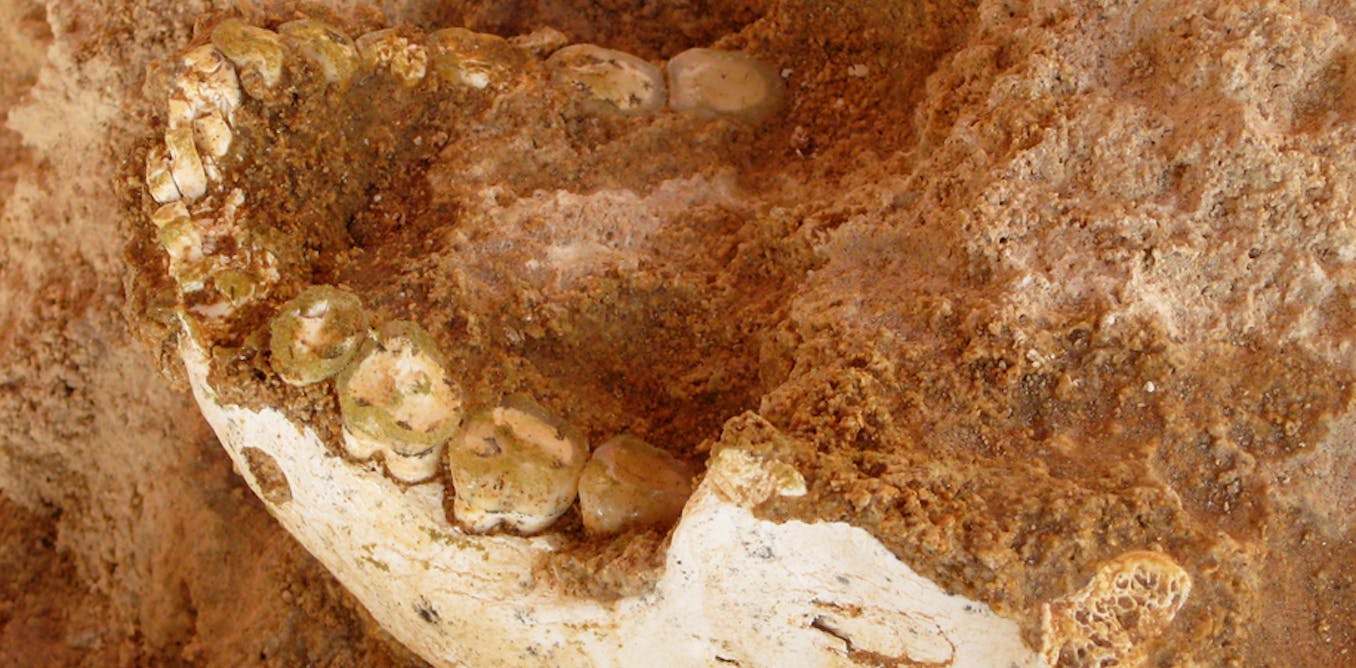
Could a Moroccan cave hold a crucial piece of the puzzle of human origins? Hominin fossils dating back 773,000 years discovered in the country are bringing new evidence to the debate about the last common ancestor of present-day humans (Homo sapiens), Neanderthals and Denisovans. The discovery points to a long evolutionary history in north Africa, much earlier than modern Homo sapiens. It also supports Africa’s central role in the major stages that shaped the human species.
Abderrahim Mohib is a prehistoric archaeologist, heritage curator, and associate professor and researcher at the National Institute of Archaeological Sciences and Heritage in Rabat. He’s one of the authors of a recent study that explains the significance of the discovery.
What did you discover and why does it matter?
Excavations have been underway since 1994 in the Hominid Cave at the Thomas Quarry I, south-west of the city of Casablanca in Morocco. A research programme called Prehistory of Casablanca working at the site is led by Morocco’s National Institute of Archaeological Sciences and Heritage and the French Ministry for Europe and Foreign Affairs.
The team has unearthed hominin fossils along with thousands of animal remains and around 300 artefacts made of quartzite and flint. The site looks like it was a den for large carnivores. This is supported by a hominin femur showing bite marks from a large carnivore, likely a hyena.
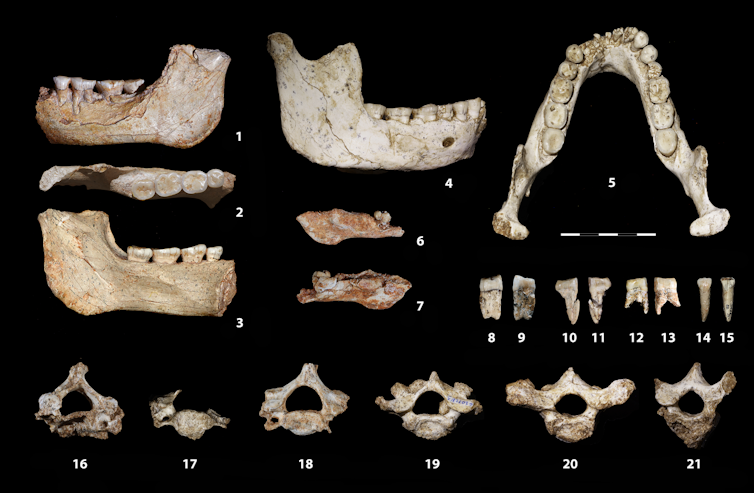
In addition to the femur, the set of hominin remains includes a nearly complete adult jaw, half of another adult jaw, a young child’s jawbone, cervical and thoracic vertebrae, and several teeth.
This discovery is significant. It sheds new light on a key period in human evolution. Fossils from this period are very scarce in Africa, Europe and Asia. These remains help document little-known populations between early Homo species and the more recent lineages. They are the oldest hominin fossils ever found in Morocco with a clear and reliable date.
Fourni par l’auteur
In addition, the site is adjacent to another, older, site named Unit L in the same quarry. This site covers more than 1,000 square metres and dates back to 1.3 million years ago. It documents the oldest human occupation in Morocco. It is linked to the Acheulean material culture in north-west Africa.
How old are these early humans and how did you date them so accurately?
These fossils found in Casablanca were dated to around 773,000 years, using palaeomagnetism, the study of the Earth’s ancient magnetic field.
The sediments in Grottes à Hominidés have recorded changes in the Earth’s magnetic field. With very high-resolution sampling (every 2cm) we were able to identify the last geomagnetic reversal from a reverse polarity (Matuyama) to a normal polarity (Brunhes). This means that we have identified a period when the Earth’s magnetic field flipped. And that is a natural event that serves as a marker for dating geological and archaeological layers.
Read more:
The whole story of human evolution – from ancient apes via Lucy to us
This reversal is a very solid and widely accepted chronological marker. What is extraordinary is that our fossil remains date precisely to the time of the reversal. This offers one of the most reliable datings of hominin fossils from the Pleistocene era (starting about 2.58 million years ago and often called the “Ice Age”). These data are consistent with the geological setting and palaeontological remains.
How does this change our understanding of modern human evolution?
The Casablanca fossils come from a time when Homo erectus spread out of Africa. It was also a time when older groups of hominins like the Australopithecus and Paranthropus died out.
In terms of shapes and features, the fossils show a mix of archaic traits typical of Homo erectus and more advanced traits closely related to Homo sapiens. They also fill an important gap in the African fossil record. Palaeogenetic data suggest a split between the African lineage to Homo sapiens and the Eurasian lineages that later produced the Neanderthals and the Denisovans.
The unique combination of primitive and more evolved features suggests that these individuals were in a population that lived close in time to this split.
Read more:
Morocco dinosaur discovery gives clues on why they went extinct
This Moroccan population can be described as having advanced traits of Homo erectus. It has more evolved traits than older Homo erectus fossils found in Africa and Asia. But it lacks the full modern features seen in Neanderthals or anatomically modern Homo sapiens.
Until now, the fossils of Homo antecessor unearthed at the Gran Dolina site in Atapuerca, Spain were the only ones to show Homo sapiens-like traits. The fossils from the Grotte à Hominidés offer a new perspective.
They open up the possibility of an evolutionary link with the oldest known Homo sapiens fossils – those from Jebel Irhoud in Morocco, dated to around 315,000 years ago. These discoveries help clarify the emergence of the Homo sapiens lineage while reinforcing the idea that its deep roots are African.
So, based on their mix of archaic and derived traits, these finds support the deep African roots of Homo sapiens but also point to an African population close to the split between Eurasian and African lineages in the Middle Pleistocene.
Why is north Africa, and Morocco in particular, so important?
North-west Africa, along with east and southern Africa, represents one of the key regions where we currently have a new window into the evolution of Pleistocene hominins. The Mediterranean Sea likely acted as a major biogeographical barrier. It contributed to the divergence between African and Eurasian populations.
The Sahara desert’s size changed over time. It probably shaped how African populations were structured. The Moroccan fossils confirm how ancient and deep our species’ roots are in Africa. They highlight the key role of north-west Africa in the major stages of human evolution.

Mohib Abderrahim is Researcher in Prehistory and Chief Curator of Monuments and Sites, National Institute of Archaeological Sciences and Heritage in Rabat.