Blood tests are useful tools for doctors and scientific researchers: they can reveal a lot about a body’s health. Usually, a blood sample is taken to get a picture of the large molecules that are present, such as cholesterols, lipids and proteins. This is called a metabolic profile.
For more specific information, another kind of blood test looks at the tiny traces of chemical processes taking place at tissue, organ, and even cellular levels. This fine-scale kind of test, metabolomics, studies metabolites – the by-products of metabolism (the body’s way of producing energy and recycling chemicals).
You’d never think this kind of test could be done for animals that lived millions of years ago. But what was very recently science fiction is now reality: it’s called “palaeometabolomics”.
Why would anyone want to know about the metabolites of long-dead creatures?
Metabolites are a way for scientists like me (a biological anthropologist) to learn more about the health, diet, environment and evolution of those creatures – including early humans.
What makes this possible is the way bones are formed: by special cells secreting a soft matrix – mainly collagen – that later crystallises and hardens into a porous material.
Metabolites in the blood that leak from blood vessels during bone formation are so tiny that they become trapped inside the bone matrix (the material that makes up bone) as it hardens. The spaces where they are trapped are so small (nanometre in scale) that bacteria and fungi, which are much bigger, can’t always get in there. Not even in a million years. And because bone mineral structures at these fine scales contain minute traces of water, metabolites are preserved there in fossils.
Studying the metabolites in animal fossils has given us a new way to discover more about the environment at sites where early humans evolved.
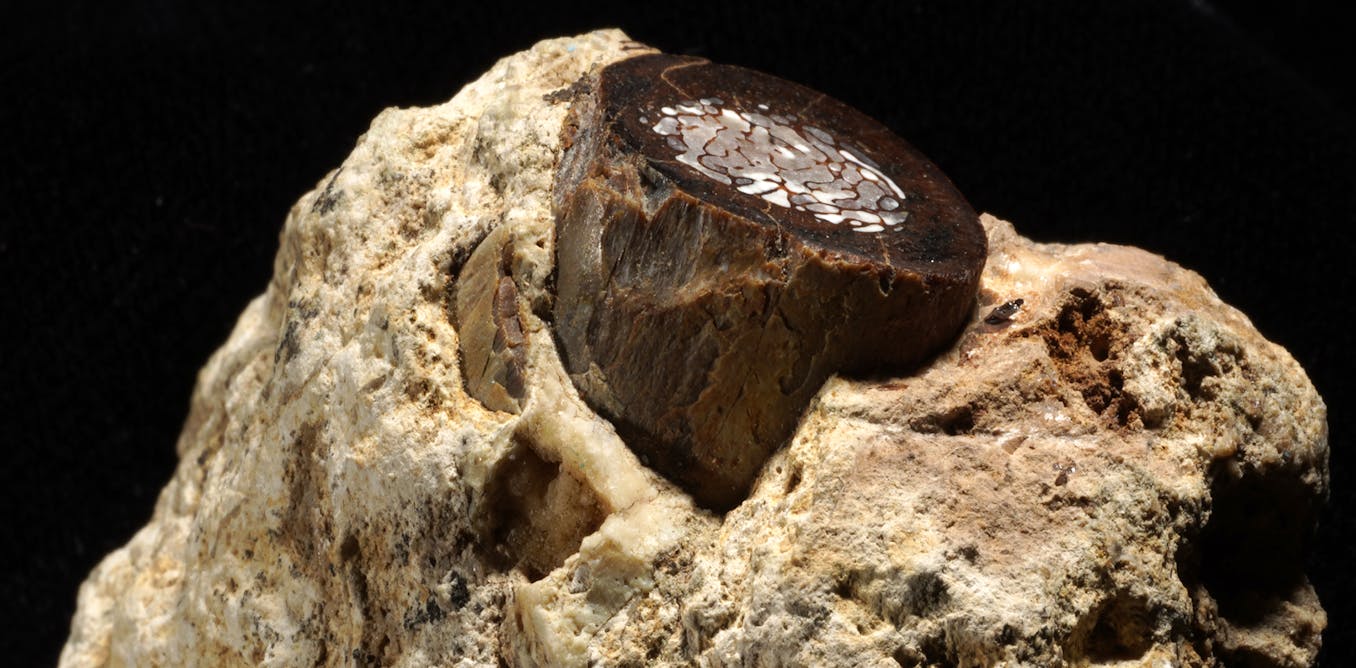
My colleagues and I looked at rodent fossils from Olduvai Gorge in Tanzania (about 1.8 million to 1.7 million years old); elephant tooth fossil material from the Chiwondo Beds in Malawi (2.4 million years old); and an antelope bone fossil from Makapansgat in South Africa (about 3 million years old). Fossils of ancient relatives of humans (species of Australopithecus, Paranthropus, and early Homo) have also been found at these sites.
For 100 years, scientists have devised methods for reconstructing the environment that early humans lived in and adapted to. Until now, these methods depended mainly upon geological clues and the kinds of animal and plant fossils found at a site. Now, by performing palaeometabolomics – especially by analysing the chemical traces left in animal bones by the plants that the animals ate – we have established a “molecular ecological” approach for describing ancient habitats.
This new method can add very specific information to other kinds of reconstructions. The metabolites allow us to describe soil pH, minimum and maximum rainfall and temperature, the type of tree cover, and elevations above sea level of plants.
We also made a surprising finding about the relationship between soil and living things.
How to give a fossil a blood test
To perform palaeometabolomics, we established a method to dissolve bits of bone no larger than a pea in a tube containing weak acid. The acid is strong enough to slowly pass the mineral into a solution, but weak enough not to degrade the metabolites. This take several days. We then let the large proteins sink to the bottom of the tube and spin it at high speed in a centrifuge, which leaves the smallest and lightest molecules at the top. We inject the metabolite “soup” into a mass spectrometer, a piece of equipment designed to measure the weights of all small molecule compounds, and refer these to a library of known masses. That’s how we identify the metabolites.
The ones generated within the body – “endogenous” metabolites – offer clues about the health and well-being of an animal. That’s interesting enough, but it’s not the full picture.
All living organisms produce metabolites, including plants. Plants also have metabolisms reflecting their physiological adaptations to the environment. If an animal eats a plant, metabolites of that plant circulate through the animal’s bloodstream and are also trapped at developing bone surfaces. These are called “exogenous” metabolites, and they tell us about the diet of the animal.
What was just interesting now becomes remarkable, because if we can identify the plant that a metabolite came from, we should also be able to reconstruct the environment the plant was adapted to.
What the body says about the bigger picture
The endogenous metabolites we identified from our fossils depict a variety of normal mammalian biological functions and disease states. The exogenous metabolites provide evidence of the environment in the distant past.
For instance, some of our fossil samples had a metabolite derived from the parasite that causes sleeping sickness in humans after a bite from an infected tsetse fly. Wild animals are tsetse fly reservoirs for the parasite. Tsetse flies have very specific environmental conditions, so that helped our reconstructions.
Read more:
Tooth enamel provides clues on tsetse flies and the spread of herding in ancient Africa
We also identified plant metabolites which implied that the Tanzanian and South African sites were wetter than they are now. Minimum temperatures were warmer, and the landscape contained more forest shade. It seems to have been a mixed, seasonally dry and wet tropical habitat. The reconstructed conditions of the Malawi site indicate a wetter environment, also with wet and dry seasons.
Reading the soil
There was one particularly interesting surprise.
Going into this study, we assumed that metabolites from ancient soils surrounding the fossils – known as palaeosols – should be considered contaminants and be disregarded from our analyses. But when we analysed metabolites of modern animals of the same fossil species living near the sites, whose bones never touched the soil, we found that both the modern and fossil animals shared large percentages of the palaeosol metabolites.
This means that the palaeosol reflects the lives of all the organisms living there. Once plants and animals live on that soil, their metabolites become a part of the soil matrix. The animals and the soil are completely connected by shared metabolites, which represent the flow of materials that sustain the habitat. They are not contaminants to be disregarded.
Our biomolecular approach – using metabolites from fossil bones and teeth as a way to reconstruct ancient environments – is a new one. It might one day make it possible to describe past habitats as precisely as we can describe modern ones.

Timothy G. Bromage receives funding from The Leakey Foundation.