Lukas Meysick, Carl von Ossietzky Universität Oldenburg, discusses his article: Facilitation and constraint: Wave exposure and intraspecific interactions influence mangrove seedling morphology and resistance to dislodgement
When mangrove forests come to mind, many people picture tropical coasts lined with diverse tree communities, sometimes consisting of more than 20 species in a single region. With this high species richness, different species have adapted both morphologically and physiologically to different parts of the tidal gradient, from saltwater-loving pioneers at the seaward edge to almost terrestrial species higher up. Yet even within these tidal zonation patterns, competition for space, light, and nutrients remains fierce, both between and within species.

Mangroves in Aotearoa New Zealand tell a different story. At the southern edge of the mangrove’s global range, only one species exists: Avicennia marina. Here, all variation in form that spans multiple species in tropical communities is expressed largely within a single species. A. marina can grow as anything from low shrubs to tall trees. And unlike in most tropical regions, many New Zealand mangrove forests have been slowly expanding seaward in recent decades, sparking discussion and at times conflict among local residents, researchers, and decision makers. While some view mangroves as critical ecosystems that provide coastal protection and habitat for many species, others perceive them as nuisance vegetation that obstructs coastal views and restricts access to the sea.
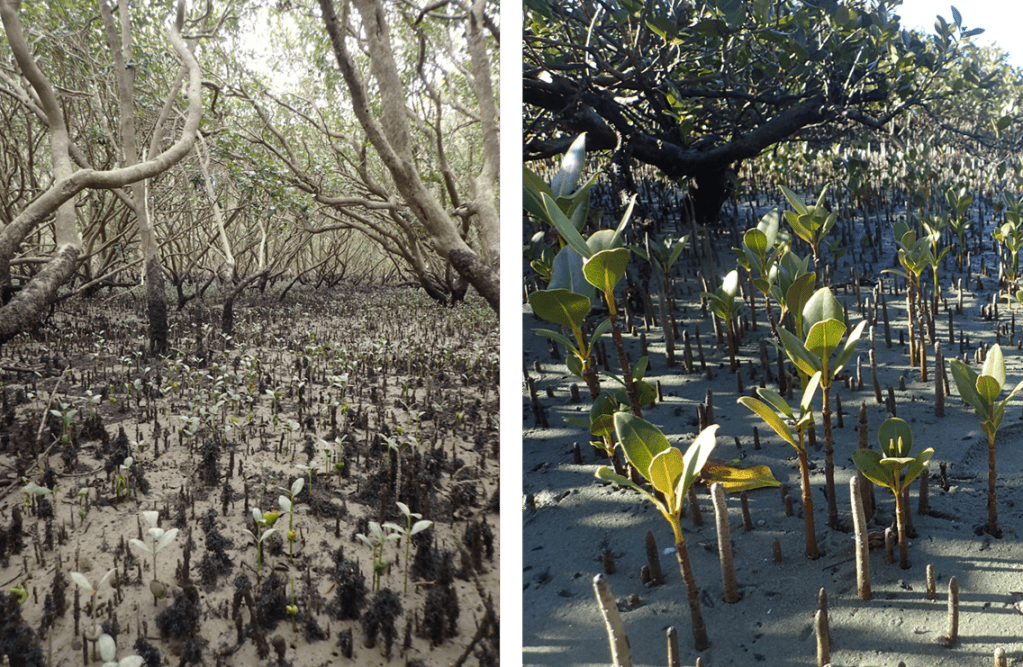
These monospecific forests with broad morphological variation and active seaward expansion make New Zealand’s mangroves a compelling system for examining how within-species interactions drive patterns of abundance and plant form along environmental stress gradients, processes especially important during early seedling development.
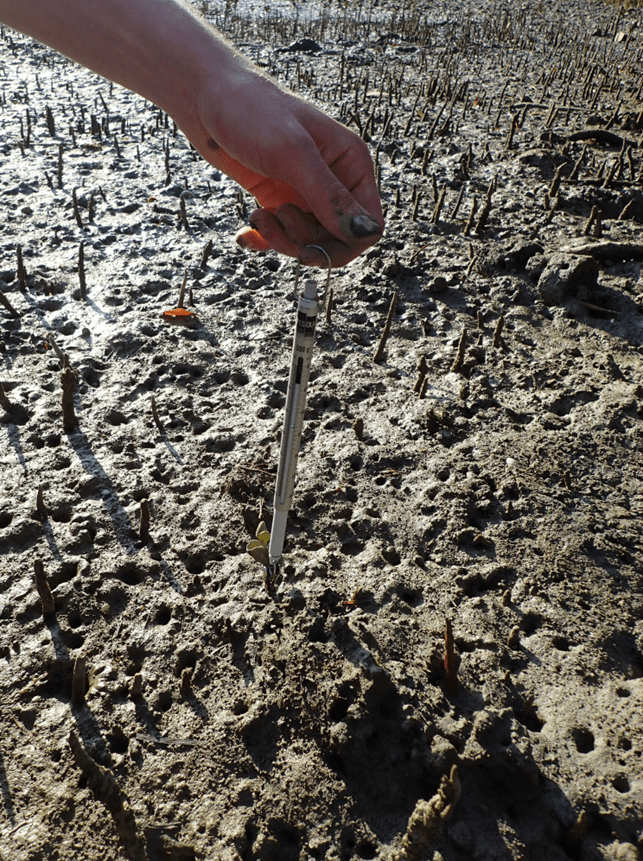
To explore this, we measured seedling removal force, morphological traits, and abundance across 12 sites of different wave energy. At each site, we sampled seedlings from three habitats: the mangrove forest, the pneumatophore zone (dense air roots but no trees), and the unvegetated tidal flat. We used spring scales to quantify the force needed to dislodge individual seedlings. After gently pulling each seedling upward until it came free, we took it to the lab for quantifying biomass and morphological traits. Our measurements revealed that for young recruits with limited root biomass, removal forces were consistently higher in the presence of neighbouring tree roots, indicating that the complex belowground structure of trees provides a mechanical benefit and protection against waves and tides.
Yet this protection came at a cost, indicated by strong shifts in seedling form. On open tidal flats, seedlings invested in short but thick stems and large lateral root systems, which are traits suited to resisting wave impact and enhancing anchorage. In contrast, seedlings near the forest edge developed long, slender stems and far less lateral root biomass. Here, risk of dislodgement is lower due to wave attenuation by adult trees and better anchorage, but competition for light and space is large, both with adult trees and other seedlings. These conditions appear to favour rapid vertical growth, a classic etiolation response, where individuals try to reach the canopy for light quickly.
Surprisingly, at sites exposed to stronger wave energy, these habitat-specific differences diminished. Seedlings converged on a common set of viable traits – they had shorter, thicker stems and greater root investment. This convergence highlights how physical forces can tightly constrain early mangrove establishment, ultimately shaping the structure and resilience of developing forests. While community-level trait convergence has been documented in various systems, evidence for intraspecific trait convergence in response to environmental stress remains scarce.
Our findings therefore help fill this gap and shed light on how trait plasticity, environmental filtering, and feedbacks interact during the earliest stages of plant establishment. That is, mangrove seedlings literally “go with the flow,” adjusting their shape in response to neighbors and waves. Understanding these strategies can help us restore and manage mangrove forests more effectively in a changing world.