(Beirut) – More than 100 Israeli strikes across Lebanon on April 8, 2026, including in densely populated neighborhoods in Beirut, killed over 300 people and damaged the last main bridge linking southern Lebanon with the rest of the country, Human Rights Watch said today. Israeli strikes making bridge crossings over the Litani River unusable threaten to sever tens of thousands of people in southern Lebanon from access to humanitarian aid, food, and health care.
“For the last two years, the Israeli military’s deplorable violations and war crimes in Lebanon and Gaza have wreaked havoc on civilians, as the continued flow of arms to Israel and the silence of other countries has only emboldened the Israeli military’s atrocities,” said Ramzi Kaiss, Lebanon researcher at Human Rights Watch. “Cutting off southern Lebanon from the rest of the country would lead to a humanitarian catastrophe and cause grave harm for the tens of thousands of people who remain there.”
On March 31, Human Rights Watch researchers visited the southern Lebanese city of Tyre and interviewed eight people, including four municipality officials; members of the Lebanese Civil Defense and the Islamic Health Committee, a civil defense and ambulance organization affiliated with Hezbollah; and an official at Jabal Amel Hospital, one of the main hospitals in Tyre.
“If they strike the bridge, where will we go? There is nowhere to go,” said Hassan Hamieh, a displaced resident who had fled to Tyre from the southern town of Beit Leif.
The Israeli military said on April 8 that it had launched over 100 strikes “within ten minutes and across multiple areas [in Lebanon] simultaneously,” including in densely populated areas in Beirut, killing at least 303 people and injuring over 1150 according to Lebanon’s Health Ministry. It was the deadliest day in Lebanon since the escalation of hostilities between Israel and Hezbollah on March 2.
Later that day, the Lebanese Armed Forces reported that they evacuated the Qasmieh bridge near Tyre, the last main crossing point into the area south of the Litani River.
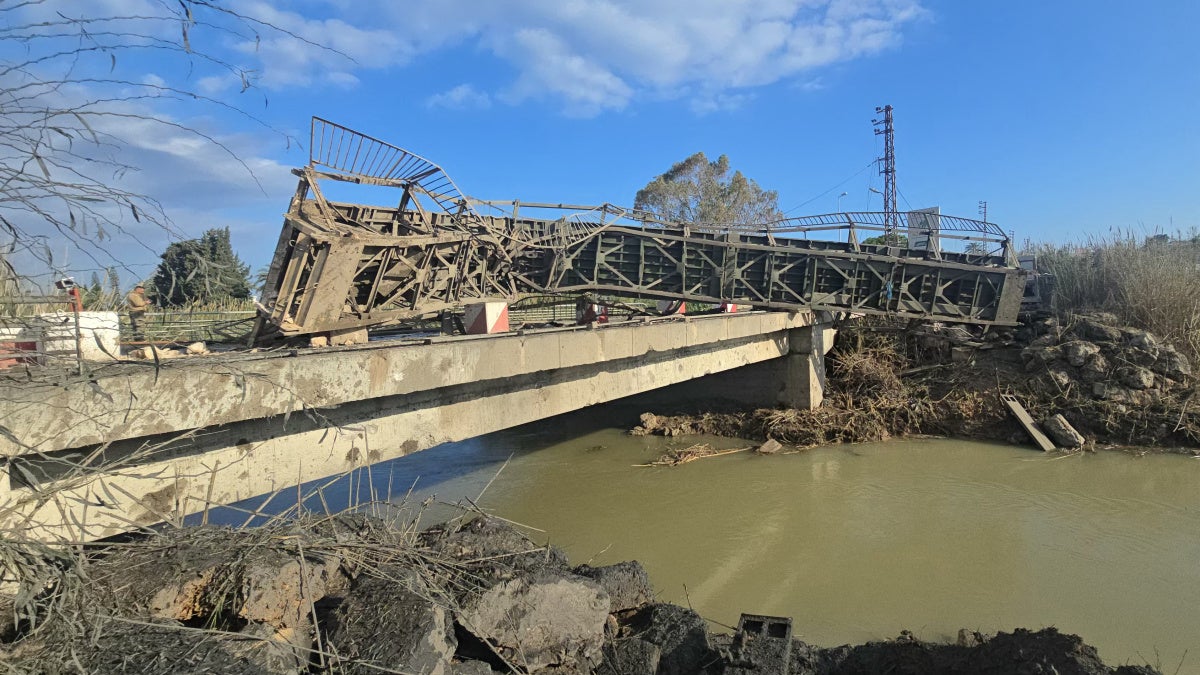
Photographs and videos taken by journalists at the scene and verified by Human Rights Watch show that Israeli strikes destroyed a footbridge near the bridge, with a large, mangled section of the footbridge landing on the main bridge, temporarily cutting off access on one side of the road. On April 9, the Israeli military said that they had “struck two key crossings” over the Litani River, accusing Hezbollah of using the crossings to transfer combatants and weapons.
Israeli attacks have killed more than 1,888 people in Lebanon since March 2, according to Lebanon’s Health Ministry. This includes more than 130 children, 102 women, and 57 medical workers, as of April 7. Hezbollah attacks have killed at least two people in Israel, Reuters reported.
Between March 12 and April 8, Israeli forces systematically destroyed or severely damaged all main bridges connecting areas south of the Litani River to the rest of the country, making the Qasmieh bridge the sole main remaining operational crossing. These attacks include strikes on nine bridges over the Litani River and its tributary, some of which were struck repeatedly, in addition to the main road leading to Al-Khardali bridge.
Human Rights Watch analyzed videos posted online showing the moment three of the bridges were struck, as well as photographs and videos of the aftermath from the strikes on the nine bridges and the road leading to Al-Khardali bridge. Many videos were geolocated by Sky News journalist Ben van der Merwe and corroborated by Human Rights Watch researchers.
These strikes had significantly limited the ability of civilians to move safely and of state institutions, humanitarian organizations, hospitals, and healthcare facilities to deliver aid and provide medical care. Despite some damage to the Qasmieh bridge and the destruction of the footbridge that runs parallel to it, the bridge remains operable and serves as the only lifeline for the tens of thousands of residents who remain south of the Litani River.
Other countries should press Israel not to cut off residents in southern Lebanon from the rest of the country and ensure they have sustainable and predictable access to humanitarian aid and are not being denied access to items essential for their survival, such as water, food, and medicine. They should further ensure safe passage for those who choose to leave.
Israel’s allies, including the United States, the United Kingdom, Germany, and other European Union states should suspend all arms sales, arms transit, and military assistance to Israel and impose targeted sanctions on officials credibly implicated in ongoing grave crimes. The EU should immediately suspend the trade pillar of its Association Agreement with Israel as long as Israel’s atrocity crimes persist, Human Rights Watch said.
The Israeli military stated that the strikes on the bridges were “to prevent the movement of reinforcements and means of combat” into southern Lebanon, accusing Hezbollah of using the bridges for military purposes.
Even if bridge crossings become military objectives—that is, if they are making an effective contribution to military action—attacks on them are still subject to the rules of proportionality. Disproportionate attacks include those that may be expected to cause excessive damage to civilians and civilian objects in relation to the concrete and direct military advantage anticipated from the attack. These attacks are prohibited under the laws of war.
The United Nations Office for the Coordination of Humanitarian Affairs (OCHA) stated on March 23 that the destruction of key bridges has “significantly [disrupted] movement and humanitarian access,” with strikes “severing connectivity” between Tyre and Nabatieh, and “[restricting] movement between south Lebanon and West Bekaa, including Marjayoun and Hasbaya.”
“The destruction of key bridges has cut off districts, isolating over 150,000 people and severely limiting humanitarian access,” OCHA said, adding that the damage to key transport routes is also “impeding the delivery of essential supplies, and limiting the ability of civilians to move safely”
Mortada Mohanna, director of the Disaster Risk Reduction and Unit Management at the Union of Tyre Municipalities, which consists of at least 55 municipalities, said that about 71,000 people remained in Tyre and surrounding towns and villages, as of April 8.
“Those who have stayed in southern Lebanon now face heightened isolation and growing obstacles to access humanitarian aid as Israeli airstrikes have destroyed bridges linking the south to the rest of the country,” said Thameen al-Kheetan, spokesperson for the UN High Commissioner for Human Rights, on March 17.
Local authorities in Tyre told Human Rights Watch that food supplies would last a week if the last remaining bridge was attacked and rendered inoperable. “By sea, by air, nothing can come in,” said Alwan Charafeddine, Tyre’s vice mayor. “That bridge is a lifeline. Our food stock is almost empty because everything we get, we are giving out.”
Charafeddine said that “the five major supermarkets in the city and the areas around it all closed,” with only five bakeries still operating in the city, and that pharmacies in the city have also shut down, with medicine now being provided by local authorities and nongovernmental organizations.
OCHA said that “markets south of the Litani River appear to have largely ceased operations, with many monitored shops closed or evacuated and supply deliveries significantly reduced.”
Access to medical treatment, medicine, and medical supplies has also been severely hampered due to the bombing of bridges, said a medical worker and a hospital official in Tyre.
An official at the Jabal Amel Hospital in Tyre said that all doctors and staff still working at the hospital are living there because travel to and from the hospital has become risky. Médecins Sans Frontières (Doctors Without Borders or MSF) and the International Committee of the Red Cross (ICRC) reported that hospital staff in the southern cities of Nabatieh and Marjayoun are doing the same.
Dialysis patients have also had to move into Jabal Amel Hospital, the official said, because they cannot travel easily or risk being cut off from the hospital all together. He also said that some doctors have even had to conduct surgeries that typically require medical tools, such as orthopedic drills used in brain surgeries, with hand-operated drills because staff are unable to replace these tools or send them for repair easily.
“To get medical supplies we have to take a hospital car, go to Sidon [more than 30 kilometers north], get the medical supplies and come back,” the official at Jabal Amel Hospital said. “But this is risky because sometimes we have to go late at night […] if the [last] bridge is struck, we’d be completely isolated.” At least six hospitals in Lebanon have had to shut down since March 2, the World Health Organization said, including three south of the Litani river.
Since March 4, the Israeli military has repeatedly issued displacement orders for the entire population of Lebanon south of the Litani River, which includes the district of Tyre. Since March 12, it has expanded the areas subject to displacement orders, ordering residents to move north of the Zahrani River, 15 kilometers north of the Litani River and 40 kilometers north of Lebanon’s southern border with Israel.
Under international humanitarian law, all parties to the conflict are obligated to allow and facilitate rapid and unimpeded passage of humanitarian aid to civilians in need. They must respect and protect aid workers, warehouses, and other objects used for relief operations.
Civilians who do not evacuate following warnings are still fully protected by international humanitarian law. Forced displacement is prohibited under the laws of war, except in cases in which the protection of the civilians concerned is involved or for imperative military reasons. A person who commits serious violations of the laws of war with criminal intent—that is, intentionally or recklessly—may be prosecuted for war crimes. Individuals may also be held criminally liable for assisting in, facilitating, aiding, or abetting a war crime.
Israeli forces have committed numerous violations of the laws of war in Lebanon with total impunity since October 2023, including apparently deliberate or indiscriminate attacks on journalists, civilians, medics, financial institutions, reconstruction-related facilities, and peacekeepers.
Human Rights Watch has also found that Israel has flouted orders from the International Court of Justice requiring Israel to enable the provision of basic services and humanitarian assistance to Palestinians in Gaza. The International Criminal Court (ICC) has issued an arrest warrant for Israeli Prime Minister Netanyahu and his former defense minister, Yoav Gallant, on charges including starvation of civilians as a method of warfare in relation to Israel’s intentional and systematic deprivation of “the civilian population in all parts of Gaza of objects indispensable to human survival,” including by obstruction of aid and attacks on and killing of aid workers.
Lebanon’s judicial authorities should initiate domestic investigations of serious international crimes, and the government should accede to the ICC’s Rome Statute and submit a declaration accepting the court’s jurisdiction prior to the date of accession, including since at least October 7, 2023.
“To prevent a humanitarian catastrophe, the international community should act immediately to demand that civilians across Lebanon are protected and that the last working bridge connecting the area south of the Litani River to the rest of Lebanon remains functional,” Kaiss said. “Civilians are paying the price of the international community’s silence and unwillingness to hold Israeli officials to account.”