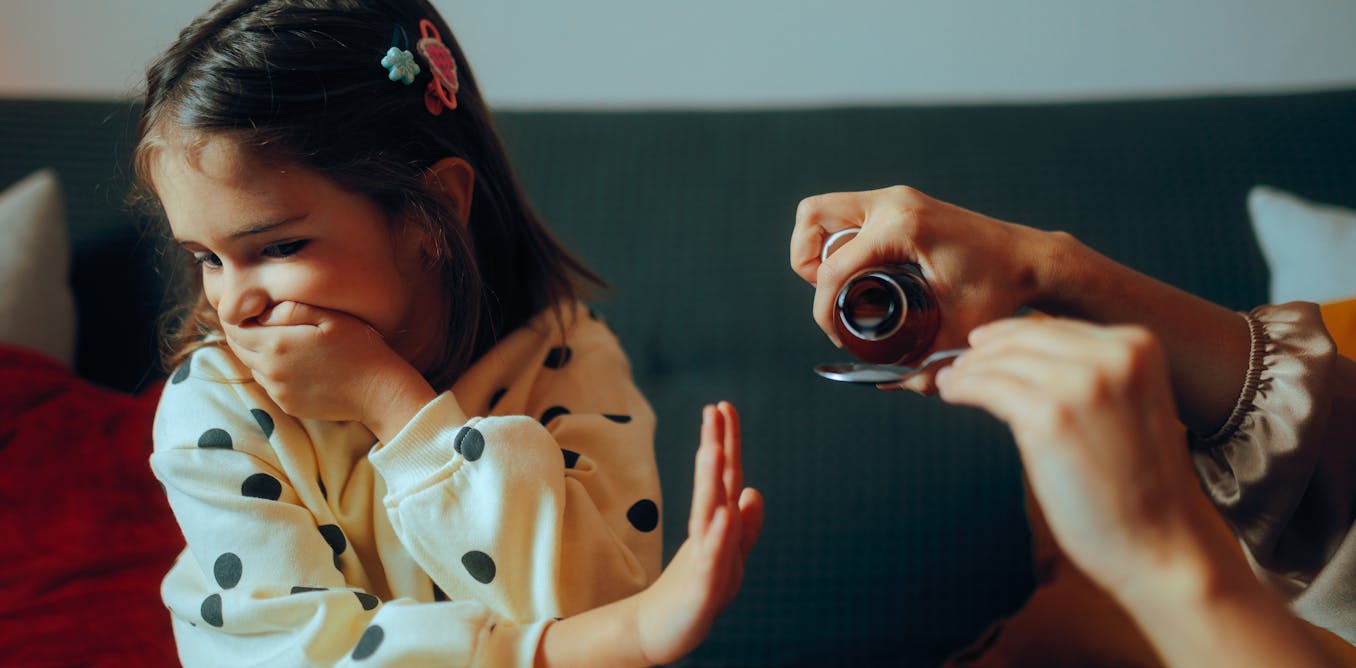
When six-year-old Seren was prescribed antibiotics, taking them four times a day quickly became a battle. The orange liquid tasted revolting, and much of it ended up on kitchen surfaces rather than in her mouth. Her mother was never sure how much she had actually swallowed, but was afraid to give her more in case the dosage was exceeded.
The final straw came on day five, when the bottle was knocked over and the remaining dose spilled across the floor. The family gave up. Seren never finished the course.
This is a situation I come across as a GP, which happens all too often in my clinical practice. But a new paper from my colleagues and I suggests that a solution may be to encourage more children to take tablets.
Liquid medicines are commonly prescribed for children. They are widely assumed to be the safest and most practical option. In reality, they can be difficult to give and easy to get wrong.
Children may spit liquid medicine out, swallow only part of it, or refuse it altogether. Measuring doses accurately can be difficult with a distressed or wriggling child, and many formulations are unpalatable. Liquids spoil quickly, with refrigeration often required. Together, these factors increase the likelihood that courses are not completed as prescribed.
The consequences are significant. Incomplete or inconsistent dosing can make treatment less effective and can contribute to the development of antibiotic resistance. Children may remain unwell for longer or return to the GP for further consultations or alternative antibiotics, adding pressure on families and the health system.
Oral liquid medicines that are prescribed, or purchased from pharmacies, can be very expensive. Research shows more than two thirds of prescriptions for liquid medicines could be safely changed to tablets or capsules, saving three quarters of treatment costs.
Costs don’t just affect parents and health care systems, but the environment too. Liquid medicines typically have a much larger carbon footprint than tablets. They require more packaging, are heavier to transport and, in some cases, need refrigeration.
Despite all this, the assumption that children cannot swallow tablets persists. This belief is widespread among parents and healthcare professionals and strongly influences prescribing habits. Yet a growing body of research challenges this long-held view.
Evidence from the UK and other countries shows that most children can learn to swallow tablets. Research has shown that with brief, structured coaching, most children from around the age of four can learn to swallow tablets safely and confidently.
International experience supports these findings, with European guidance making similar recommendations.
So, if tablets are often cheaper, easier to store and more reliable, why do liquid medicines remain the default?
Longstanding practice plays a major role. Outside specialist paediatric settings, prescribers, pharmacists and parents often assume young children can only manage liquids. Tablets can look intimidating, and both parents and professionals can worry about the risk of choking. Parents may struggle to introduce a new skill when a child is unwell and upset.
How do we teach children to swallow tablets?
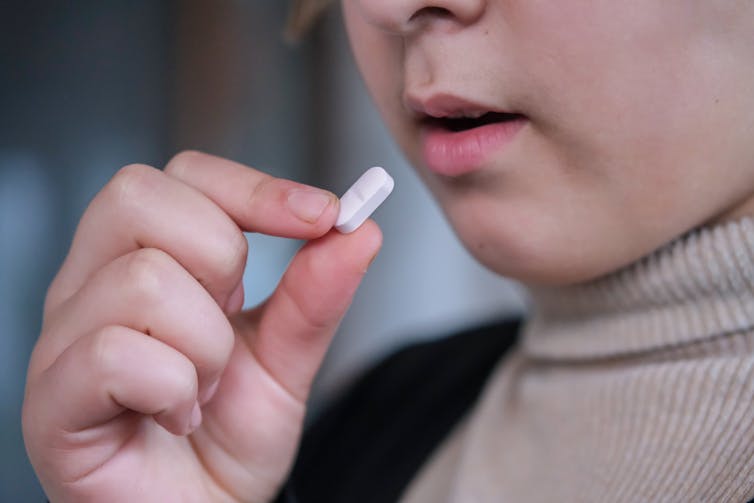
Tablet swallowing is best introduced when a child is well. Teaching can be done by parents, with online resources available to help. Training programmes such as KidzMed recommend starting with very small sweets and gradually increasing the size as confidence grows. The child chooses a favourite drink, places the sweet on their tongue, takes a few gulps and swallows. For most children, progress is rapid.
Liquids will always be necessary for babies, infants and children with complex needs or swallowing difficulties. But they do not need to be the default for every child.
GPs and other prescribers could routinely ask whether a child can swallow tablets and record this information in medical notes, making it easily available for future consultations. Prescribing systems could be adjusted so liquids aren’t the default option presented for children.
Mahsun YILDIZ/Shutterstock
Education and culture change will be needed. Training on tablet swallowing could be included in GP, pharmacist and prescriber curricula, supported by updates for current practitioners. Community pharmacists are well placed to coach families and advise on suitable formulations. Schools and children’s television shows can support culture change by normalising tablet taking.
Liquid medicines are often messy, expensive and difficult to give. Their widespread use contributes to incomplete treatment, avoidable healthcare use and unnecessary environmental costs.
With simple coaching and system change, many children can take tablets from an early age. Doing so could reduce stress for families, improve treatment effectiveness, cut costs and reduce the environmental footprint of medicines.

Rebecca Payne is partially funded by a University of Oxford Clarendon-Reuben Scholarship. She works on the REMEDY project funded by Health and Care Research Wales.