
Darvill et al. share their experience investigating soil organic carbon stocks in a new native woodland in the Yorkshire Dales, UK, highlighting the importance of careful woodland design.
Targeting the Right Soils: How Woodland Design Shapes Soil Carbon Outcomes
Tree planting is widely promoted as a nature-based response to climate change. New woodlands can reduce flood risk, improve air quality, support biodiversity, and capture carbon from the atmosphere. However, these benefits depend heavily on where trees are planted.
In upland areas, soils often contain large stores of organic carbon, particularly in peat and other highly organic soils. Disturbing these soils during planting or through changes in hydrology can release carbon that has been stored for centuries. In some cases, these losses may exceed the carbon taken up by young trees within the timeframes relevant to net-zero targets. Less is known about the effects of planting on organo‑mineral soils, but the same principle applies: planting in unsuitable locations can reduce or even reverse the intended climate benefits by releasing carbon dioxide to the atmosphere.
As woodland creation accelerates across the UK, a central challenge remains: how do we expand tree cover without inadvertently disturbing high-carbon soils and releasing carbon dioxide into the atmosphere? Our recent study set out to test whether current woodland design principles are avoiding the highest carbon soils in heterogenous upland landscapes. Our recent study set out to test whether current woodland design principles
Background
Woodland cover in the Yorkshire Dales is low, with only 4% of the National Park classified as woodland. As part of its net-zero strategy, the Yorkshire Dales National Park Authority aims to create 6,000 ha of new woodland by 2030. Achieving meaningful carbon sequestration will depend on ensuring that new planting avoids unsuitable soils.
What We Studied
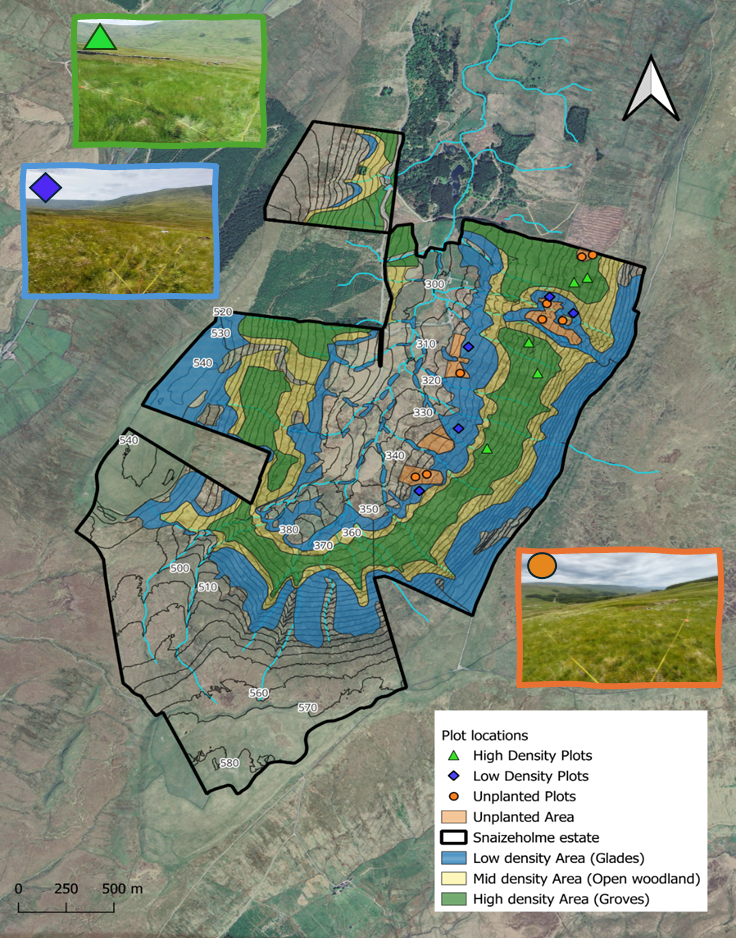
Our research focussed on Snaizeholme Valley, where a large native broadleaf woodland has been planted between 2021/22 and 2024/25. The Woodland Trust designed the scheme using updated UK Forestry Standard guidance, which prohibits planting on organic soil horizons deeper than 30 cm. The design also incorporated wider ecological and cultural considerations, including vegetation surveys, peat depth mapping, archaeological features, and breeding bird habitat.
Snaizeholme is one of the largest upland woodland creation projects of its kind in England, at over 529 hectares in size. Our study assessed how effectively the design targeted planting to appropriate locations within this complex landscape. Click here to read our recent research, Darvill et al., 2026.
What We Wanted to Understand
We focused on two practical questions that matter for woodland creation:
- Are woodland designs successfully directing tree planting toward areas with lower soil organic carbon (SOC) stocks at the site scale?
- Do low disturbance, handplanting techniques help avoid high carbon patches at the finer, plot scale?
To explore this, we established replicated 10 × 10 m plots representing three treatments: unplanted, low-density planting, and high-density planting. Each planted plot was paired with a nearby unplanted control with similar topography.
What We Found
SOC stocks were on average over 20 t C/ha lower in the high-density planting areas, and 10 t C/ha lower in low-density planting areas, than in the unplanted areas. This pattern suggests that the woodland design successfully targeted lower carbon soils for planting, exactly the intention behind current forestry guidance, and additional principles followed by the Woodland Trust for the Snaizeholme design.
At the 10 m plot scale, however, we found no significant evidence that handplanting avoided higher carbon at plot-scale. While the broader design worked, the planting technique itself didn’t appear to discriminate between higher and lower carbon patches within plots.
Why This Matters for Woodland Creation
Our findings highlight a key takeaway for practitioners: Thoughtful woodland design can effectively steer planting away from high-carbon organo-mineral soils, reducing the risk of unintended carbon release to the atmosphere.
This is encouraging news for England’s new woodland creation guidelines, which emphasise targeting higher-density planting toward soils with lower SOC stocks. Our results suggest that these design principles are likely to deliver the intended benefits.
As woodland expansion continues, ensuring that planting happens in the right places, not just the available places, will be essential for balancing carbon goals with biodiversity and land-use priorities. Furthermore, future research and assessments of tree planting impacts on soil carbon must consider the revised policy and planting principles to accurately project carbon trajectories.
Read the full article ‘Woodland creation scheme in the Yorkshire Dales successfully focuses tree planting on soils with lower soil organic carbon stocks‘ in Ecological Solutions and Evidence.








