In a move to arrest a critical decline in its aerial combat readiness, India has accelerated negotiations with France for a massive government-to-government (G2G) acquisition of 114 Rafale fighter jets.1 The talks, described as being in an “advanced stage,” are gaining significant momentum ahead of French President Emmanuel Macron’s scheduled visit to New Delhi in February 2026.2+1
The proposal, estimated to be worth over ₹1.2 lakh crore (approximately $15 billion), marks a strategic shift from a protracted global tender process to a direct diplomatic agreement. For the Indian Air Force (IAF), the deal is a demographic and tactical necessity; its fighter squadron strength has dwindled to 29 squadrons, far below the authorized level of 42.5 required to manage a potential two-front challenge.3
The “G2G” Fast-Track: Bypassing Trials
By opting for a government-to-government route—similar to the 2016 purchase of 36 Rafales—India aims to bypass the years of technical evaluations typical of the Multi-Role Fighter Aircraft (MRFA) program.
- Operational Continuity: The IAF already operates two Rafale squadrons. Expanding this fleet ensures immediate logistical and training synergies, avoiding the “complexity tax” of introducing an entirely new aircraft type.
- Pricing Benchmark: A significant hurdle was cleared in April 2025, when India signed a $7.4 billion deal for 26 Rafale-M naval variants.4 This agreement provided the pricing and contractual benchmarks necessary for the larger Air Force order.5+1
- Advanced Capability: The new tranche is expected to include the latest F4 standard and potentially the future-ready F5 variant, which incorporates AI-driven avionics and enhanced stealth features.6
A “Make in India” Industrial Revolution
Unlike previous off-the-shelf purchases, the 114-jet deal is centered on a massive indigenization effort. The goal is to localize nearly 60% of the Rafale’s manufacturing value within India.
| Key Infrastructure Project | Location | Role in the Ecosystem |
| Fuselage Manufacturing | Hyderabad | Tata-Dassault facility capable of 24 units annually |
| Engine Plant | Hyderabad | Production of Safran M88 engines for Indian jets |
| MRO Hub | Jewar, UP | Regional maintenance and repair for the Rafale fleet |
| Production Line | Nagpur | Planned site for full-scale aircraft assembly |
Strategic Context: The February 2026 Summit
President Macron’s upcoming visit, ostensibly centered on the Global AI Impact Summit, is being widely interpreted as the final political push for the Rafale deal.7 For France, India represents its most comprehensive defense partner outside of NATO; for India, France offers “no-strings-attached” technology transfer that rivals like the U.S. or Russia have historically hesitated to provide.
The deal also addresses the “Tejas Gap.” Delays in the induction of the indigenous LCA Tejas Mk-1A, caused by global supply chain bottlenecks and engine shortages, have left the IAF with no choice but to pursue a proven, interim foreign platform to safeguard its skies.8
The Bottom Line: Precision over Procedure
If finalized, the 114-Rafale deal will represent one of the largest single defense contracts in history. By leveraging its deepening relationship with Paris, New Delhi is attempting to short-circuit a decade of bureaucratic inertia to ensure its pilots have the qualitative edge required for 21st-century warfare.
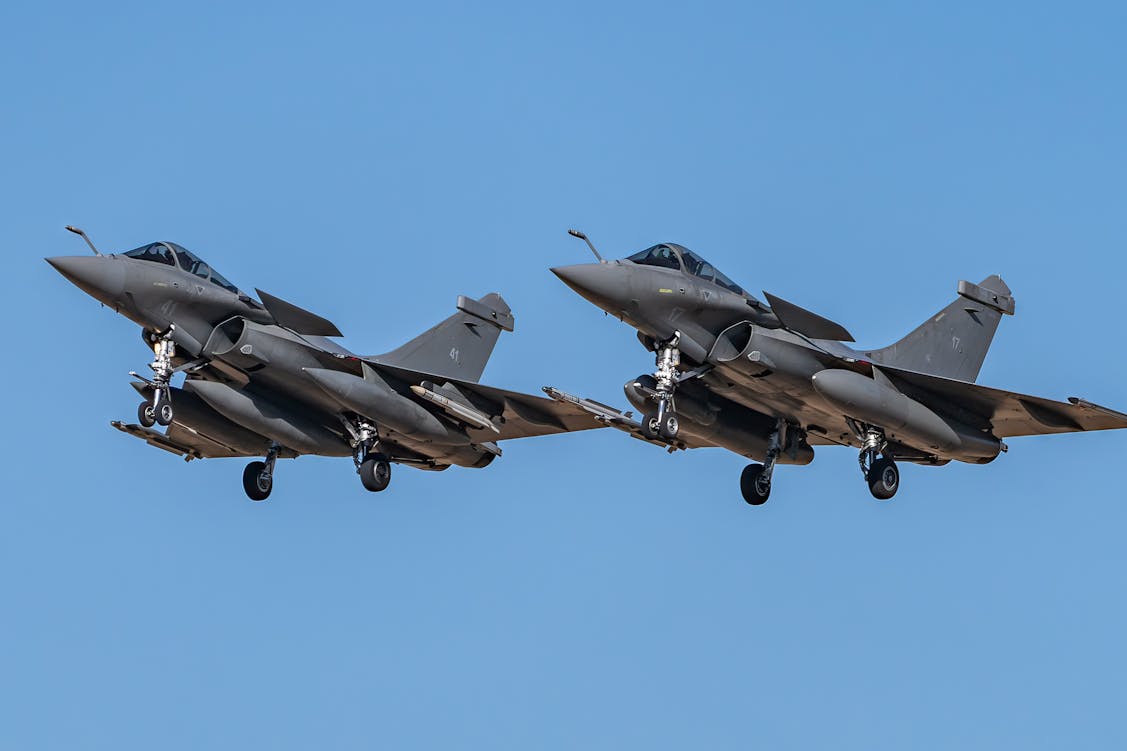
Dassault Rafale Fighter Jets Picture from Pexels by Thales