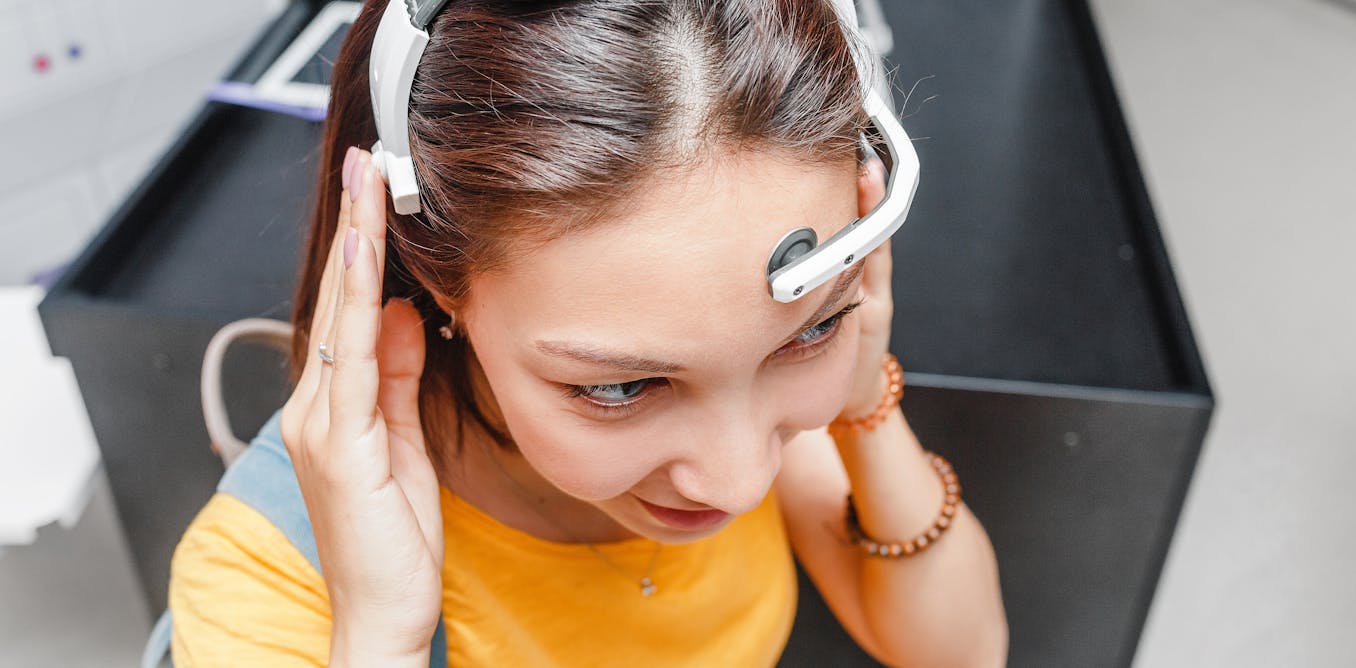
Imagine you’re shopping for a dinner party this weekend and you spot some nice, but expensive, bottles of wine. You’re not sure if you can afford them, but before you can even open your banking app to check, a lightweight head-worn wearable has already registered the neural activity involved in your mental calculation. It transmits the data to your phone, which confirms that they’re within your budget.
In this scenario, you’d be using neurotechnology.
We’re increasingly accustomed to relying on consumer wearables like smartwatches and fitness apps that measure and assess our physical parameters, but for most of us, that’s where things stop. The idea of interfacing with the brain itself is generally seen as something confined to science fiction, cutting-edge research, hospitals and medical treatments.
However, this new tech is already becoming quietly embedded into the most mundane of areas – workplaces, education, entertainment, and so on. It’s no surprise we don’t notice it, as daily life obscures any trace of novelty. But neurotechnology is fast creating a new layer of social infrastructure.
In my research, I refer to this phase of adoption as the Neurotechnology Shift. I define it as a distinct technoscientific, cognitive, and sociocultural transformation in which neurotechnology migrates from labs and hospitals into nonclinical settings, making the brain itself an everyday interface.
Beyond wearables
Technological shifts from one domain to another are not new. The internet was originally conceived as a military project, but it has since permeated almost every aspect of our daily lives. Now, much of our attention (and time) is spent interacting not only with screens, but also with virtual assistants, sensors, and smart devices. We haven’t just adapted to it; we’ve changed how we relate to each other and how we understand privacy.
Similarly, neurotechnology is drifting from another realm – medicine – into daily life, with all manner of new consumer neurotech companies emerging. This new shift doesn’t look disruptive at first, as wearing an electronic device on our wrists, ears or skin is already a very familiar sensation. However, these new devices adapt to us more than we adapt to them, and they do so because they connect with the last frontier separating the biological from the technological: the brain.
While wearables make inferences from behavioural and physical parameters, everyday neurotechnologies do much more than this. They push the boundary between intention and action backward in time. Applications like silent speech decoding – which translates neural signals into text or voice – mean that technology anticipates the execution of our decisions. The experience of being in control is deeply altered.
This isn’t necessarily a bad thing, though. Patients with ALS and other diseases that affect speech are already benefiting from communicating with medical teams and families thanks to technologies often described as “mind reading”. Now, a quiet migration is taking place from clinics to daily life. What once seemed clinically extraordinary could soon become socially commonplace. The prosthesis will become infrastructure.
Neurotech in the real world
Some companies are already beginning to explore neurotechnology to track productivity. Transportation workers, including drivers and pilots, are increasingly monitored for signs of fatigue. Research groups are developing silent-speech interfaces like MIT’s AlterEgo, which interprets subtle neuromuscular signals to control apps without spoken words.
While these developments within the Neurotechnology Shift are impressive, it is vital that we fully grasp their implications before they become invisible parts of everyday life. In the classroom, for instance, some schools are using neurotechnology for the ethically questionable purpose of tracking students’ attention, while others are exploring how it can benefit and support education.
There are still technical challenges left to overcome. Generally speaking, the more invasive and equipment-heavy medical neurotechnology is, the more accurate and reliable it tends to be. But bringing neurotechnology into everyday life requires wearable, noninvasive devices. What saves lives inside hospital walls doesn’t necessarily work outside them.
This mismatch can lead to inflated expectations and pressure to bring devices to market before they’re fully ready, as shown by the recent debut of Meta’s new wristband, which translates subtle nerve signals at the wrist into digital commands.
Protecting rights and freedoms
The ethical questions surrounding the Neurotechnology Shift are only beginning to emerge. Who is really in control – the user or the device? What are the limits between consented and unconsented uses of neural data? How should we, as a society, manage risks of inequalities in neurotechnology access and pressure toward those individuals that don’t want to use it?
We are still in the early stages of this shift, so the answers to these questions are not yet clear. Several questions about real-world performance, reliability across different users and socioeconomic consequences also remain unresolved. While some progress has been made in recent years in the form of ethical principles, much work remains to translate these principles into practical governance mechanisms for neurotechnology.
The Neurotechnology Shift entails a threefold transformation. It’s a technoscientific transition, certainly. It’s a cognitive change as well, because it will reorient how we focus, perceive, and make decisions. Finally, it also marks a sociocultural turn, one that will influence our habits and relationships, the social and legal norms that define how we live together, and even how we imagine our place alongside technology. By penetrating everyday life, neurotechnology is already blurring the boundaries between technology, mind, and society.
A famous song once warned of a society that spoke without truly connecting. The current, quiet shift may invert that idea, helping us to communicate without speaking at all. Whether that leads to deeper connection or just new forms of silence will depend on us.