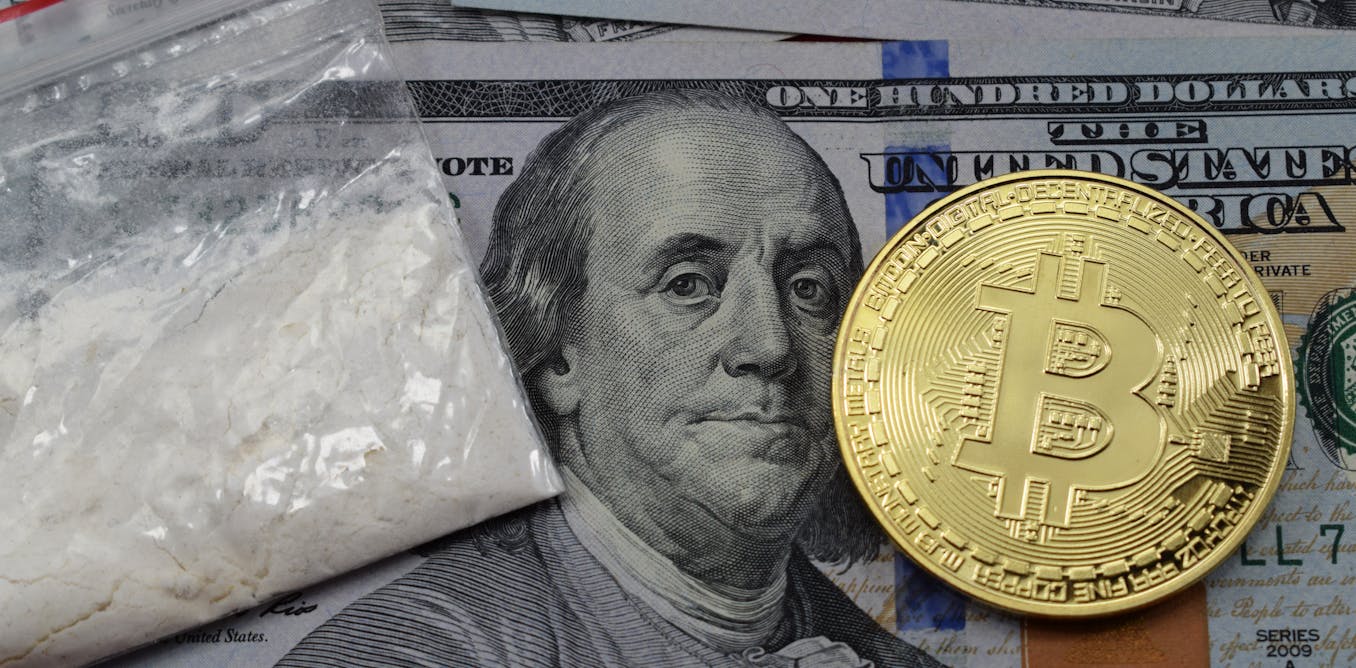
The cocaine market exploded between 2014 and 2023. Production in Colombia increased more than sevenfold to nearly 2,700 tonnes, according to the United Nations Office on Drugs and Crime (UNODC).
Behind the scenes, drug traffickers find equally illicit ways to pay their suppliers and foot soldiers, or to spend the proceeds of their criminal trade. Their solution? Money laundering. It is estimated that 25% of the funds collected is laundered.
Criminals generally launder money in three stages: firstly, they inject it into the financial system; secondly, they layer it with the aim of obscuring the origin of the funds, and finally, they integrate it into the financial system, a process aimed at legitimising the money. This typology does not take into account the fact that money laundering is sometimes partial, i.e. it stops at the first stage. Let us consider an example.
Take the money from cocaine originating from the main exporter of coca: Colombia. Some of it is laundered entirely on site, by reinjecting the cash into legitimate businesses – restaurants, hairdressers, etc. – while another part is used to pay for the goods. To do this, it has long been sufficient to provide cash – in banknotes – which is then laundered in Colombia.
Cash smuggling
In Europe, the cash is exchanged for €500 notes by accomplices working in banks and then entrusted to money mules. The latter take the plane with sums of between £200,000 and £500,000.
It is this link in the drug trafficking chain – bulk cash smuggling – that has allowed cryptocurrencies to emerge as a key cog in narco traffic.
To fully get one’s head around the use of cryptocurrencies in drug money laundering, one needs to understand how cash smuggling works. An article by Peter Reute and Melvin Soudijn (the former is a criminologist and the latter an intelligence officer with the Dutch police) has made it possible to accurately measure the costs of this operation. They accessed the accounting records of traffickers in six cases tried for offences that took place between 2003 and 2008. Between them, they accounted for €800 million transported between the Netherlands and Colombia.
The costs amounted to around 3% for changing small denominations into €500 notes, the same amount to pay the mule, and slightly less for their travel expenses. The heavy surveillance at Amsterdam-Schiphol Airport meant that they had to fly from elsewhere in Europe. Factoring in additional costs, the transport of funds to Colombia alone costs between 10% and 15%, or even up to 17% of the amounts moved.
In concrete terms:
-
The cocaine leaves Colombia.
-
It is sold by intermediaries in Europe.
-
The money collected from this sale is turned into 500 euro notes, at the cost of a 3% fee.
-
The €500 notes are entrusted to mules, at the cost of a 3% fee.
-
The mules travel to Colombia, at the cost of 3% fee.
-
The cash arrives in Colombia to pay for the drugs, then is laundered on the spot, again at a cost.
According to the authors, anti-money laundering regulations have succeeded in significantly increasing the costs of smuggling, particularly transport, but not the selling price, as we consider France’s booming cocaine market. Indeed, national consumption has increased ninefold since 2000. To circumvent these regulations, traffickers are relying on the 500-euro note.
End of the 500-euro note
In a twist on 4 May 2016, the European Central Bank (ECB) decided to stop issuing 500-euro notes. The number of these notes in circulation fell from 614 million at the end of 2015 to just under 220 million by mid-2025.
’It has been decided to permanently discontinue the production of the 500-euro note and to remove it from the “Europe” series, taking into account concerns that this denomination could facilitate illegal activities,’ the bank explained.
That same year, a new financial asset burst onto the scene: bitcoin.
Enter cryptocurrencies
As 500-euro notes grew scarcer from 2016, Bitcoin contributed to redrawing the map of cash trafficking.
Instead of an integrated chain where cash returns to the source of the drugs to pay for deliveries, we are witnessing a process of specialisation. On the one hand, drug traffickers exchange their cash for cryptocurrencies, which they use to pay for their supplies in Colombia. On the other, a money laundering network collects the banknotes and transports them along easier routes, such as those leading to Dubai (United Arab Emirates).
How do we know this? Thanks to, for example, Operation Destabilise by the UK’s National Crime Agency. The press release describes an international money laundering network controlled by Russians. They used an exchange platform that did not exercise its duty of care, Garantex, for cryptocurrency transactions, and Dubai, for cash transactions.
The money laundering network collected cash from drug traffickers and paid them in crypto tokens (particularly USDT-Tether), charging only 3% in fees. Compared to the 10% to 15% that transport cost in Colombia before the 500-euro note was phased out, this represents a saving of 70% to 80%.
Reporting
Cryptocurrencies – initially Bitcoin and now stablecoins such as USDT-Tether – have enabled drug traffickers to save on the cost of sending cash by choosing the safest routes. It is too early to know whether the significant increase in transatlantic drug trafficking, as reported in a recent investigation by the Financial Times, is linked to this technical innovation.
In concrete terms, the new method follows this new route between drug traffickers and money laundering networks:
-
The cocaine leaves Colombia.
-
It is sold by intermediaries in Europe.
-
The money collected from this sale is exchanged for USDT-Tether cryptocurrencies, with a 3% fee.
-
The USDT-Tether cryptocurrencies are sent to Colombia to pay for the drugs.
-
For the money laundering network, the cash is entrusted to mules, who travel to Dubai, for a 1% fee.
-
In Dubai, the cash is laundered for a 1% fee.
Legislation against crypto asset laundering
It’s reasonable to believe that the recent anti-money-laundering rules on crypto-asset service providers in countries that have signed the Crypto-Asset Reporting Framework will complicate matters for criminal organizations. We can also trust the latter will pinpoint the smallest loopholes and exploit them.
The invention of cryptocurrencies has set back the fight against organized crime by years, but the “coalition of the willing”, including Switzerland, the Bahamas, Malta and France, is finally getting organized.
In France, the fight against money laundering is being strengthened by a law “aimed at freeing France from the trap of drug trafficking”, passed in June 2025. A specialized national public prosecutor’s office has been created. A raft of measures is being put in place, from the administrative closure of front businesses (by prefects rather than mayors, who are too exposed) to the freezing of drug traffickers’ assets and initiatives against the mixing of crypto-assets.
But traffickers are adapting to avoid being caught, as we will see in a second article.