Shortlisted for the 2025 Southwood Prize
About the research
Overview
Our study was part of my PhD thesis. I tried to understand how increasing diversity within cropping systems changes trophic interactions and crop damage, together with my knowledgeable promotors, Erik Poelman and Dirk van Apeldoorn; an analytical behemoth, Daan Mertens; and two diligent MSc thesis students, Yufei Jia and Nelson Ríos Hernández.
Sustainable alternatives to pesticide use in agriculture are necessary to prevent damage by herbivorous insects, while reducing the impact of agriculture on the environment. Several large meta-analyses showed that pest management may be enhanced by growing multiple crops in close arrangement (intercropping), but many of the studied cropping arrangements are difficult to implement in industrial agriculture. A more workable solution in industrial agriculture may be strip cropping, where crops are grown in relatively narrow strips, wide enough for managing crops using current machinery. Yet it remained unclear whether pest management could also be enhanced by strip cropping, where crops are spatially segregated albeit in adjacent strips. Moreover, in many greenhouse studies, we see that plants that were previously infested with herbivores differed in how susceptible they were to later infestations compared to previously uninfested plants (plant-mediated interactions). We were curious if such patterns could be observed in the field and whether they influence eventual crop yield and quality.
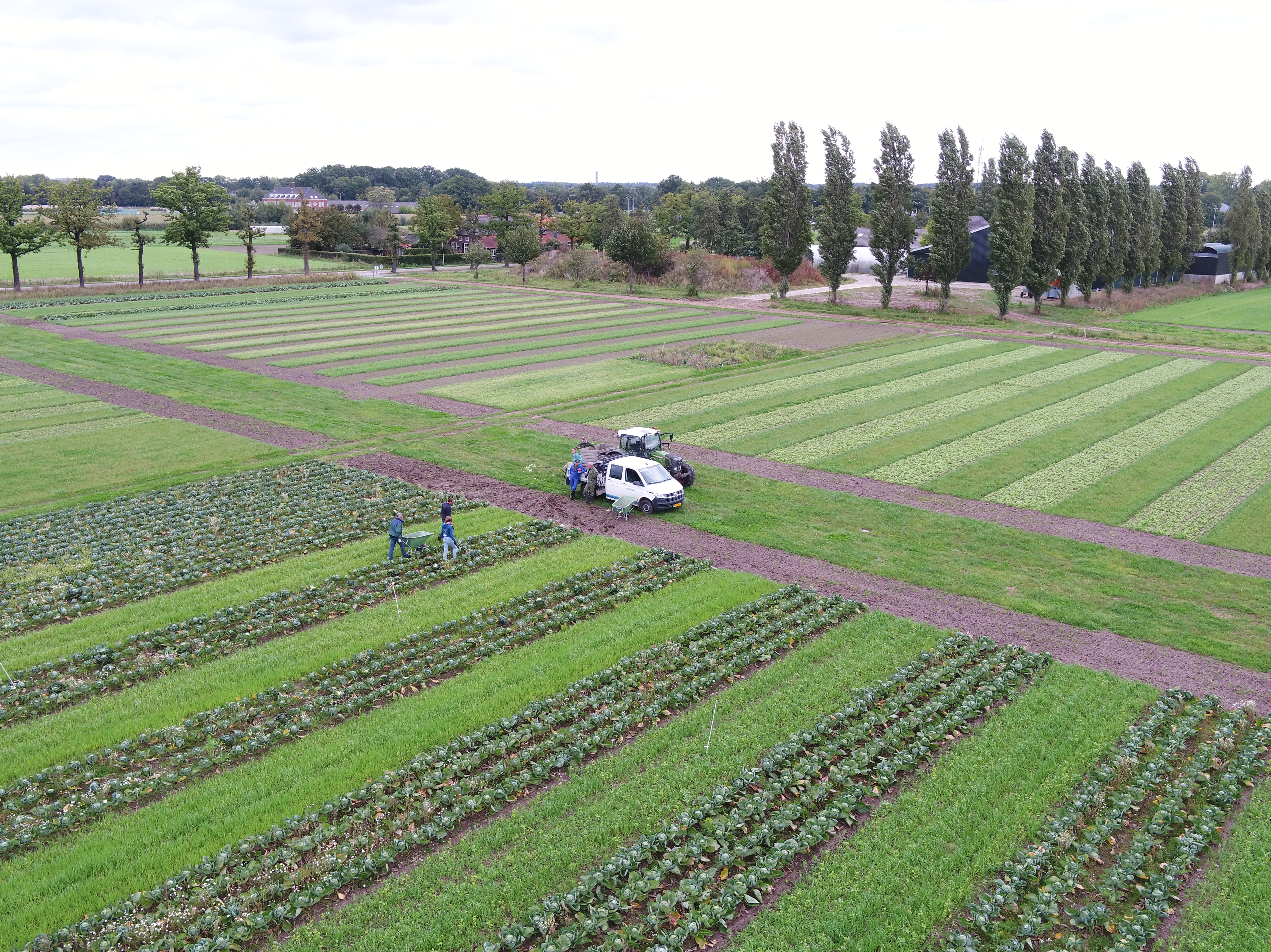
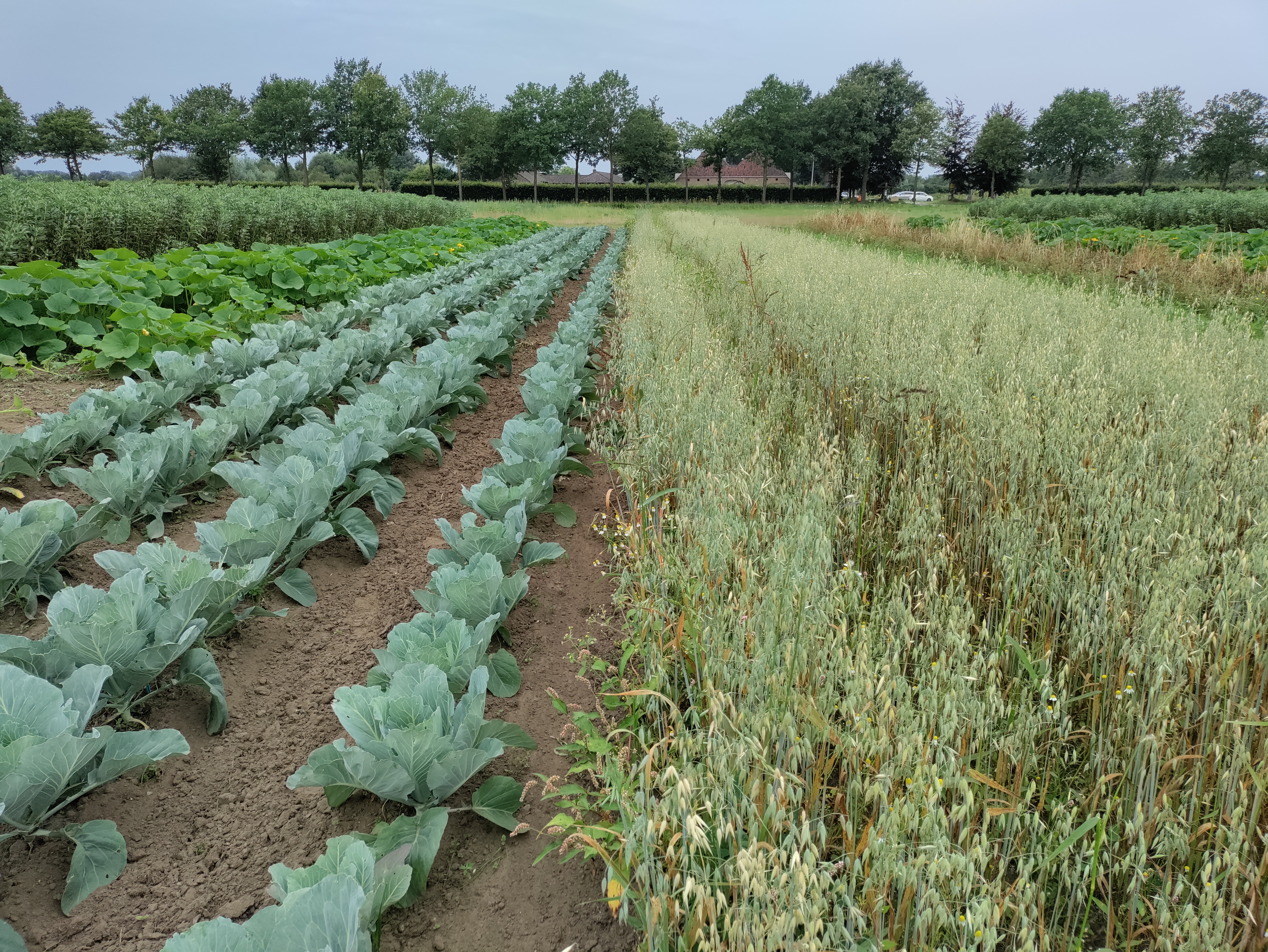
In our study we compared monocultures with four strip cropping arrangements of increasing diversity (more crops and/or crop cultivars included). We followed over 1000 individual cabbage plants, identifying and counting their associated insect communities and assessing final cabbage yield and marketable quality. Using structural equation modelling, we examined (1) whether plant-mediated interactions between early and late herbivores could be observed in the field and whether these were relevant for crop yield; and (2) whether crop diversification influences the damage per individual herbivore to cabbage yield and quality.
We could indeed observe changes in the abundance of certain late herbivores in response to the presence of early herbivores on individual cabbages, but these effects were relatively minor and inconsistent. However, interestingly the crop diversification context influenced the extent to which herbivorous insects affect crop yield. Especially the yield loss by thrips and caterpillars were alleviated in highly diverse cropping systems. As a result, we concurrently saw higher cabbage yields and abundances of herbivorous insects in the most diverse cropping system.
These results show two important things related to crop diversification. First, the intuitive assumption that more plant-eating insects will result in lower yields does not straightforwardly hold in diverse cropping systems, where top-down control may be more prevalent. Second, not all herbivorous insects are actually damaging the harvestable crop, and diverse cropping systems may be able to sustain enhanced herbivorous insect abundances, which may enhance biodiversity of organisms in higher trophic levels.
Surprises and challenges
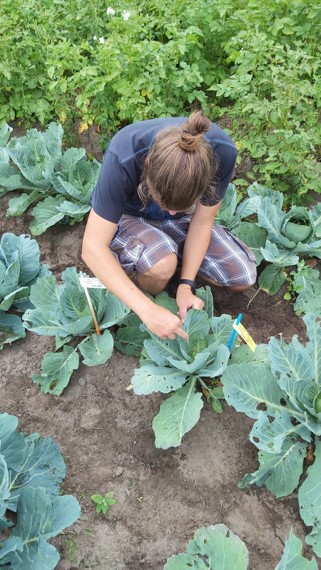
I was surprised by how the market deals with crops damaged by insect herbivores. Most insect damage doesn’t reduce edibility or size of cabbages, yet cabbages with insect damage are regularly sold to industry for processing as lower quality produce or discarded. The most striking example for me was the damage by thrips, tiny insects that feed on cell contents of plant tissue. Upon thrips damage, cabbage plants create scar tissue which results in aesthetically less-pleasing cabbages. However, thrips damage usually doesn’t result in rotting and the cabbage is still perfectly edible. Moreover, our work shows that most herbivorous insects hardly reduce cabbage size, especially in more diverse cropping systems. We still regularly approach insect pests as a problem that needs agronomical or ecological solutions, yet the example of thrips in cabbage illustrates that damage by insects may need social (consumer behavior) or market solutions.
In my opinion, ecological research aimed at enhancing biodiversity is only truly successful if it eventually reaches relevant stakeholders and changemakers. In my research, a relevant group of stakeholders are farmers, which is why I also make considerable time available to discuss my results with them, gather their inputs and co-design cropping systems. However, in the first farmer meetings that I joined, I was a bit discouraged by the skeptical mindset of many farmers but also intrigued by the vast knowledge that was already at their disposal. It was challenging for me, someone who is not very direct and generally open to new ideas, to adjust to that attitude. Now I’ve matured a bit more in this regard and I love working with those real-world farmers, and I encourage any ecologist to regularly move from their academic bubble into practice to share ideas with diverse peoples with diverse interests.
Next steps and broader implications
Currently, strip cropping is gaining traction and the number of farmers that are employing strip cropping is increasing. This created the opportunity for my subsequent post-doctoral research for a collaborative effort of on-farm research on the effect of strip cropping on insect biodiversity, pest and weed management and crop productivity. Here, we visited 26 farms across the Netherlands that all had paired monoculture and strip cropping fields.
The first preliminary results show a clear positive impact of strip cropping on insect biodiversity, but we also have indications that strip cropping may enhance populations of potential pest, such as slugs and herbivorous insects. However, as natural enemy abundances and diversity are also enhanced, we believe that, like the findings in our study, increases in herbivorous invertebrates do not necessarily translate in more crop damage. The effect of strip cropping on yields of cereals and potatoes seems to be roughly neutral, showing that strip cropping may promote biodiversity without trading-off with yield.
About the author
Current position and research focus
I recently started as an assistant professor at the Centre for Crop Systems Analysis at Wageningen University & Research. Here, I will focus mostly on (insect) pest and crop disease management, preferably by enhancing ecosystem services via habitat management. A major project that I’ll be involved in in the coming years is Robotic Intercropping, where we will develop complex intercropping systems aimed at conserving industrial crop yields, while reducing agricultural inputs and enhancing biodiversity. Partners in Denmark will simultaneously co-develop robots that can manage these complex intercropping systems.
Getting involved in ecology
A fondness for nature and ecology runs through my veins, as I’ve been fascinated by all critters with six or more legs since childhood. I would turn over rocks to see what treasures lay beneath, and my parents had to read me dry nature books for bedtime. As a young ranger for the World Wide Fund I became fascinated by the endless forms that our beautiful planet holds and the conservation of this diversity for future generations. Throughout my work, I hold the intrinsic value of biodiversity in high regard and use the privilege and autonomy I find in my job to research topics that will directly or indirectly benefit biodiversity.
Advice for fellow ecologists
Choose collaboration over competition whenever possible. The projects that I liked working on most were those that allowed me to work with some very pleasant and knowledgeable colleagues. It allowed me to learn so much more, use diverse expertise and angles to interpret data, share the burden of elements of research that can be tedious and, above all, set up bigger and more impactful research. For this study, my collaborator Daan helped me to learn structural equation modelling quicker than I had imagined; and the farm network collaboration resulted in a huge dataset that I’m sure will result in some of the best papers on the effect of strip cropping on a wide diversity of elements. And all while having fun doing science with people I like.
Read the full article ‘Herbivore prevalence poorly predicts yield in diverse cropping systems’ in Journal of Applied Ecology.
Find the other early career researchers and their articles that have been shortlisted for the 2025 Southwood Prize here!