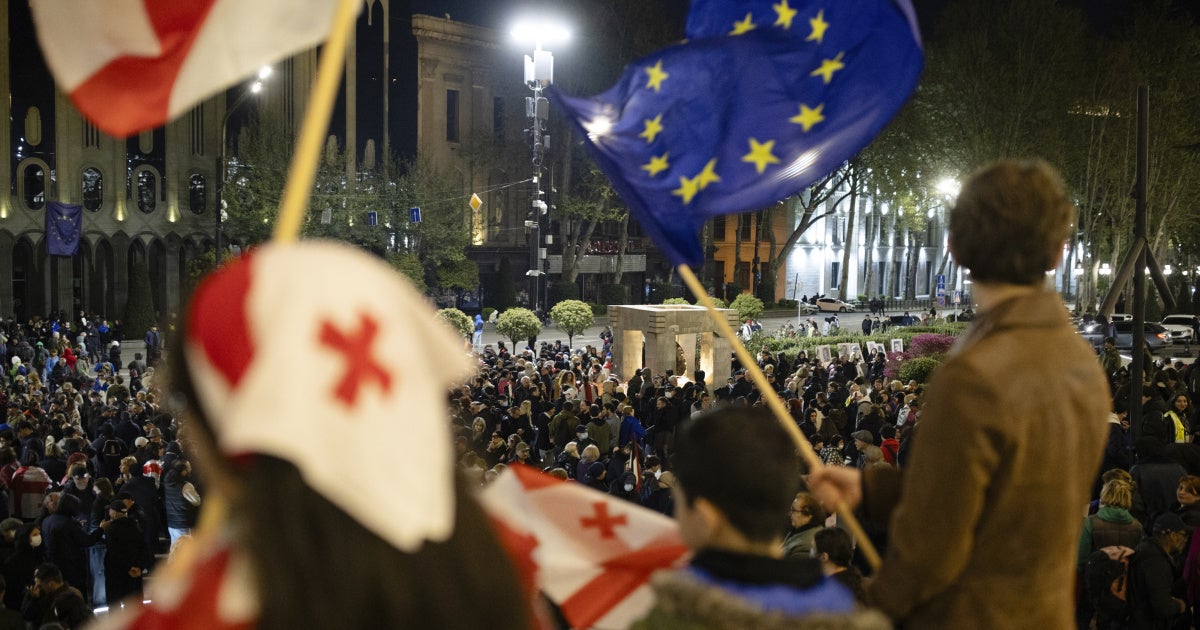
(Berlin, December 4, 2025) – Georgian authorities have adopted a series of laws that unjustifiably interfere with the right to peaceful assembly and are being used to suppress dissent, Human Rights Watch said today. Combined with abusive policing and steep fines, these measures violate Georgians’ right to peaceful protest, making dissent increasingly risky and leaving critics vulnerable to punitive measures.
“The Georgian government is systematically dismantling protections for peaceful assembly and free expression,” said Giorgi Gogia, deputy Europe and Central Asia director at Human Rights Watch. “People are being detained or slapped with ruinous fines for exercising their fundamental rights.”
Massive nationwide protests have swept Georgia following the ruling party’s November 2024 decision to abandon Georgia’s EU accession process. Authorities have responded to the protests with police violence, and local rights groups have documented hundreds of detentions on alleged administrative grounds and thousands of fines for alleged violations of protest-related rules. Together, this has created a hostile and punitive environment for peaceful protest.
Since November 2024, the ruling party has rushed multiple legislative amendments through the parliament, essentially criminalizing a wide range of protest-related actions integral to the peaceful exercise of the right to assembly.
December 2024 amendments impose tenfold increases in fines—from 500 to 5,000 Georgian lari (about US$185 to 1,850)—for ordinary protest conduct, including blocking building entrances, painting political graffiti, wearing masks, or possessing laser pointers. The new fine is about twice Georgia’s average monthly income, which stands at 2,212 lari (about $820). These fines reach levels typical of criminal liability, but since they are labeled as administrative offenses, the accused do not benefit from the safeguards of criminal procedure.
The December 2024 amendments also grant police vague preventive arrest and frisking powers, allowing them to “preventively” detain individuals for up to 48 hours if they had previously been implicated in an administrative offense and deemed likely to reoffend. Such broad grounds for detention are not permitted under human rights law and violate the prohibition on arbitrary arrest.
Amendments adopted in February 2025 extend detention for administrative offenses from 15 to 60 days, a change applied almost exclusively to protest-related offenses, such as petty hooliganism, disobeying police orders, or violating assembly rules. They also introduced new offenses, including “verbal insult” of officials, punishable by up to 45 days’ detention, and imposed new restrictions by subjecting spontaneous assemblies to notification requirements and requiring prior written consent for indoor gatherings.
In July, the parliament adopted further coercive measures, introducing automatic 30-60-day detention for anyone with unpaid prior fines who committed even a minor assembly-related offense.
October legislative amendments elevated repeated minor conduct—such as wearing a mask, blocking a roadway, installing temporary structures, or participating in a police-terminated protest—to felonies, punishable by up to two years in prison, and up to four years for those deemed organizers.
Together, these laws transform routine protest activity into conduct punishable by criminal-level sanctions, reduce clarity about what conduct is legal and therefore the ability of people to regulate their behavior accordingly, and vastly expand police discretion to interfere with public gatherings, Human Rights Watch said, violating Georgia’s obligations under international human rights law.
Georgian authorities have enforced the new restrictions through arbitrary detentions and abusive administrative proceedings, often imposing sanctions equivalent to criminal penalties. Police have detained protesters for wearing masks, briefly stepping onto the road, or allegedly blocking traffic.
Interviews with defense lawyers indicate that convictions that often lack sufficient evidence to establish criminal wrongdoing frequently rely on video surveillance footage, including through the reported use of facial recognition technology, to identify protesters.
Lawyers handling dozens of such cases told Human Rights Watch that officers who claim to identify protesters from surveillance footage are never questioned in court, and judges routinely ignore the heightened procedural safeguards required when detention is at stake.
The financial penalties imposed under the new laws have been punitive and disproportionate. In one such case, courts fined Gota Chanturia, 36, a teacher and education researcher, a total of 365,000 lari (about $135,200) for 73 alleged instances of “road-blocking.” According to Chanturia’s lawyer, police presented short surveillance footage showing Chanturia peacefully standing on the roadway near the parliament. Chanturia’s 60-year-old father has accumulated around 70 similar fines, including in situations where the roadway had already been closed by police. The lawyer said that the courts in both cases offered no justification for upholding such extreme penalties and instead simply confirmed fines issued by the Interior Ministry without assessing their proportionality.
Lawyers representing dozens of protest-related cases described the same pattern: sanctions imposed without meaningful evidence review and without assessing whether fines—often equivalent to years of income—are proportionate.
Human Rights Watch also spoke with other protesters who have faced repeated detentions and large fines. For instance, philologist Rusudan Kobakhidze, 61, who was already serving time in detention for alleged administrative offenses, also had three other 5,000-lari (about $1,185) fines imposed, despite a monthly income far below the cost of a single penalty.
The combination of open intimidation along with arbitrary arrests and overwhelming fines has created a pervasive climate of fear around participation in peaceful assemblies, Human Rights Watch said.
The Ministry of Internal Affairs publishes only limited statistical data, making it impossible to determine the full scope of protest-related penalties. Even so, available figures are alarming. In 2024 and the first nine months of 2025, authorities sanctioned 4,444 people for petty hooliganism and 6,725 for disobeying police orders—charges often used against protesters—and imposed detention in 6,504 cases.
As a party to the European Convention on Human Rights, Georgia is obligated to protect the rights to freedom of expression and to peaceful assembly, and any restrictions must not only be for a lawful purpose and have a proper legal basis, but must also comply with the requirements of necessity and proportionality. These safeguards are intended to ensure, amongst other things, that people can participate in public life without fear of abusive policing, arbitrary arrest, or disproportionate sanctions.
The convention also requires Georgia to apply criminal due process safeguards to any offense that in substance attracts criminal liability, even if authorities label it as administrative under domestic law. This means examining the nature of the offense, including if it is directed at the public in general, and the severity of the potential penalty. This standard ensures that authorities cannot evade their obligations to uphold due process by mischaracterizing offenses, and helps identify when governments are effectively criminalizing behavior that does not substantially rise to that level and may instead be seeking to suppress legitimate activity.
Prominent international bodies have warned that Georgia’s recent legislative changes fall far short of these standards. The Council of Europe’s Venice Commission found that the December 2024 amendments significantly undermine freedom of assembly, noting that vague provisions and harsh penalties risk creating a “chilling effect” on participation. The Organization for Security and Co-operation in Europe’s Office for Democratic Institutions and Human Rights, in urgent opinions issued in March and November 2025, criticized the expanded detention powers and disproportionate sanctions, cautioning that the new measures could be used to silence or punish peaceful protesters and civil society activists for legitimate public engagement.
“Over the past year, the Georgian government’s response to mass public protests has been a coordinated drive to suppress criticism and keep people off the streets,” Gogia said. “Georgia’s international partners should press the authorities to urgently reverse this repressive course and restore space for peaceful assembly.”