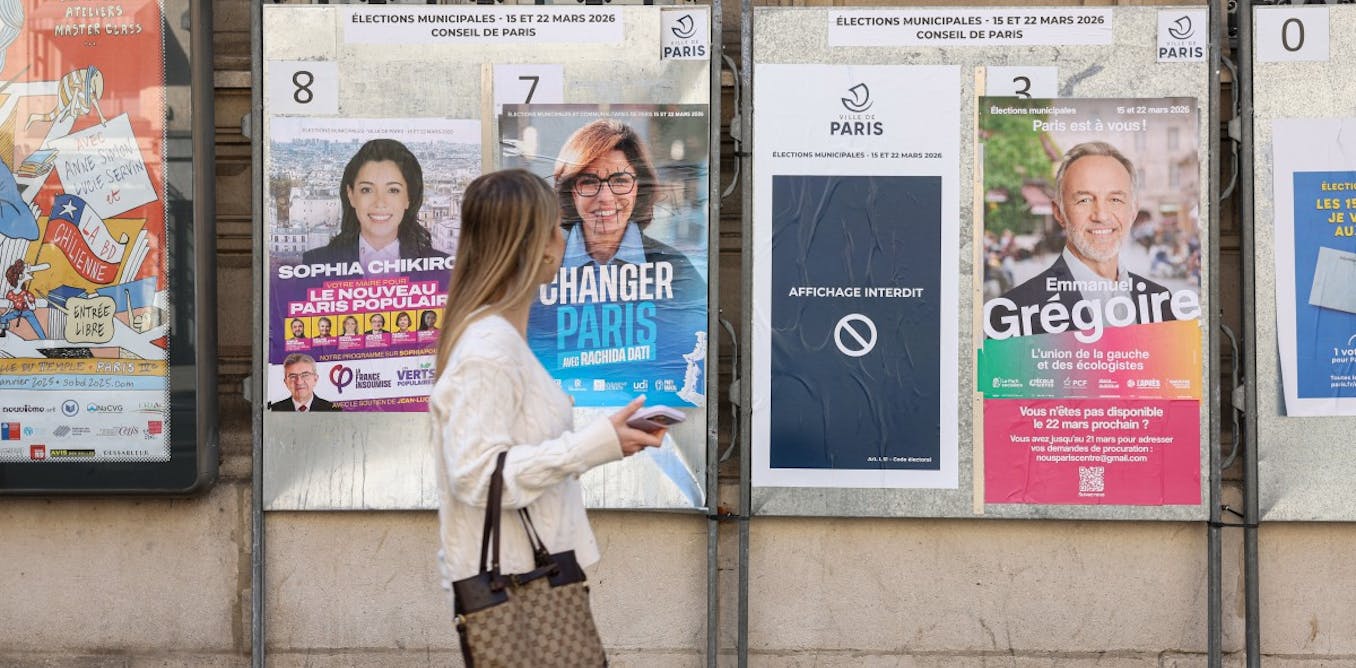
When election time comes around, campaign posters feature candidates with a determined look in their eye, their local promises, well thought-out slogans in full view, and a smile – which particularly among women politicians has become something of a quiet, political prerequisite.
In 2016, during the Democrat National convention Hillary Clinton was commented more on supposedly not smiling or lacking warmth than on her electoral manifesto. Some years later Élisabeth Borne, who was then Prime Minister of France, was described several times as being “cold” and “stiff.” Recounting her twenty months spent at Matignon in a book (2024), she explains how her attitude was more harshly judged than if she had been a man. She appears on the cover of her book with a frank smile. In both cases, it was her appearance and allure that was being held against her rather than her ideas.
Women often get criticised for not smiling. But does this expectation have an impact electorally speaking? In other words, does choosing not to smile cost women more votes than it does men?
A ‘smile monitor’ for candidates
A recent study carried out on 9,000 electoral manifestos from local elections in France in 2022 and 2024 subjected the phenomenon to a statistical reality test Lippmann, 2026. The promises that were examined are a precious source of analysis. In France, each elector whether male or female receives a copy before the ballot, presenting their manifesto pledges with a photo of the candidate alongside prominent politicians from the political parties they are affiliated with.
The emotions and smiles that could be detected or that were missing from the photos were measured with the help of artificial intelligence. Almost 80% of women were perceived to be “smiling” in the photo compared with 60% of men, representing a difference of 19% percentage points. Women appeared to be smiling far less than their male counterparts.
The statistical analysis also shows that this difference is not electorally neutral. Using the same data from the 2022 and 2024 legislative elections, we measured the impact of smiling on the election results by taking into account the candidate’s age, political party, profession, department, and the type of constituency, as well as the content of their manifestos.
Does a smile go a long way in terms of votes?
At comparable characteristics, smiling men and smiling women score about two points more in the polls compared to non-smiling men. But the asymetry lies with the candidates who don’t smile; a female candidate that doesn’t smile scores about two points less than a non-smiling male politician. For men, smiling adds value. For women, it’s more of a condition to avoid being penalised.
To confirm these results, we set up an online experiment with 1000 people – a representative sample of the French population. We provided participants with a pair of photos of “mock,” AI generated female and male candidates. For each imaginary candidate, two versions of the same photo were created, one smiling and the other with a neutral expression, then they were presented to the participants in order to measure whether a smile can affect voting intentions.
We asked each participant the following question: “If you had to choose between two candidates what is the probability that you would vote for candidate A rather than candidate B.”
The preliminary results indicated that a neutral expression reduces voting intentions for all candidates, but that was more pronounced for the female candidates. Not smiling reduces their chances of being selected by approximately three percentage points more than men. These results that tally with the analysis based on the electoral programmes, are the subject of a scientific paper that is currently in the process of being edited.
Fourni par l’auteur
A ‘double-edged sword’ for women in politics
Why is the stigma attached to smiling so strongly directed at women? Psychology establishes that gender stereotypes make women into people who are naturally warm, attentive and less likely to be aggressive whereas men are associated with competitiveness, self-assuredness and emotional control. But when women obtain positions of power these expectations meet are met with tension.
Female candidates face “double trouble:” as women, they are situated on the register of warmth and empathy while as politicians, they must incarnate authority, firmness, which are qualities considered to be masculine. If they display too much heat, they risk being deemed insufficiently credible or less competent.
Conversely, if they adopt the codes of seriousness and distance, which are valued in politics, they expose themselves to criticism of coldness, of “stiffness” or of a lack of empathy, as experienced by Hillary Clinton or Élisabeth Borne. This double-edged sword raises a strategic question: should you smile to get elected, even if it means having to recompose your image once in office? While our data does not allow us to answer this question, it does point towards a paradox: the cogs behind electoral victory are not necessarily the same cogs that are in motion during the exercise of power.
For men, this conflict is much less marked. The stereotypes associated with them immediately correspond to those related to the exercise of power. This concordance offers them greater emotional freedom. Showing warmth is not considered a transgression, it is simply a mark of accessibility, which does not take anything away from their credibility.
Conversely, if a woman meets the expectations of warmth and empathy traditionally associated with femininity, she risks being perceived as less competent. Smiling then becomes a tool for adjustment that reduces the tension between these contradictory requirements, a way of “countering” access to a power function still perceived as a transgression of the female role. This constraint forces women to invest more in controlling their image.
An emotional load is thus added to the political burden, a form of “invisible tax” that would represent an expenditure of energy and resources that their male counterparts do not have to bear. Although this emotional cost is theoretically well documented, investigations conducted directly with women politicians on this experience are still rare.
Dealing with gender-related stigma
Faced with these constraints, women politicians can adopt different strategies. The first is conformity: displaying warmth and a smile to meet gendered expectations, at the cost of an additional effort. The second is the challenge by refusing these standards and assuming neutrality or distance. But this path is electorally risky. As our data shows, unlike her male counterparts, a candidate who does not smile exposes herself to a penalty at the ballot box.
A third strategy consists in instrumentalising these constraints. In his study, French political scientist Frédérique Matonti demonstrated that stereotypical media coverage of female politicians can, in some contexts, be turned to their advantage. In Marine Le Pen’s case, this treatment actually gave her a more human touch in contrast to her politically notorious father, and served her strategy of de-demonising France’s far right party.
A smile may seem trivial. But when we observe who is asking for it, and at what moment it is valued, then it reveals the norms that are still framing women’s access to positions of power. Understanding these mechanisms invites us to reflect and ask ourselves questions about what we expect, often unconsciously, from those who govern us.

A weekly e-mail in English featuring expertise from scholars and researchers. It provides an introduction to the diversity of research coming out of the continent and considers some of the key issues facing European countries. Get the newsletter!