Jenna Braun, York University, Toronto, discusses her article: Experimental resource supplementation shifts ant-mediated defense on silver cholla
Extra-floral nectaries (EFN) play an important role within mutualisms between plants and ants. In this relationship, ants receive a nutrient-rich food source from plants in exchange for defending the plant from herbivores. Ant species are not equally effective as plant defenders and plants have no physical way to limit EFN visitation to only the best mutualists.
Producing EFN nectar can be costly for plants, particularly in water-limited environments like deserts. Understanding how a plant’s investment into producing EFN nectar affects the identity of its partners, and therefore the quality of defense, is fundamental to understanding mutualisms.
Ant species compete for resources, and higher quality resources are expected to attract ants that are better defenders. This is because the same traits that make an ant species a good competitor, like aggressiveness or numerical dominance, should also make that species a good defender. We hypothesized that EFN resource availability influences the quality of ant defense through resource partitioning within the ant guild.

We studied a population of silver cholla, Cylindropuntia echinocarpa, an EFN-bearing shrub in the Cactaceae. Cholla are infamous for their incredibly sharp and abundant spines; however, Cactaceae, and the opuntiads in particular, are emerging as model systems for studying the function of EFN in deserts, even though only a very small proportion of species have been studied. This study was conducted at the University of California’s Sweeney Granite Mountains Desert Research Center (GMDRC) within the Mojave National Preserve in California (https://granite.ucnrs.org/).
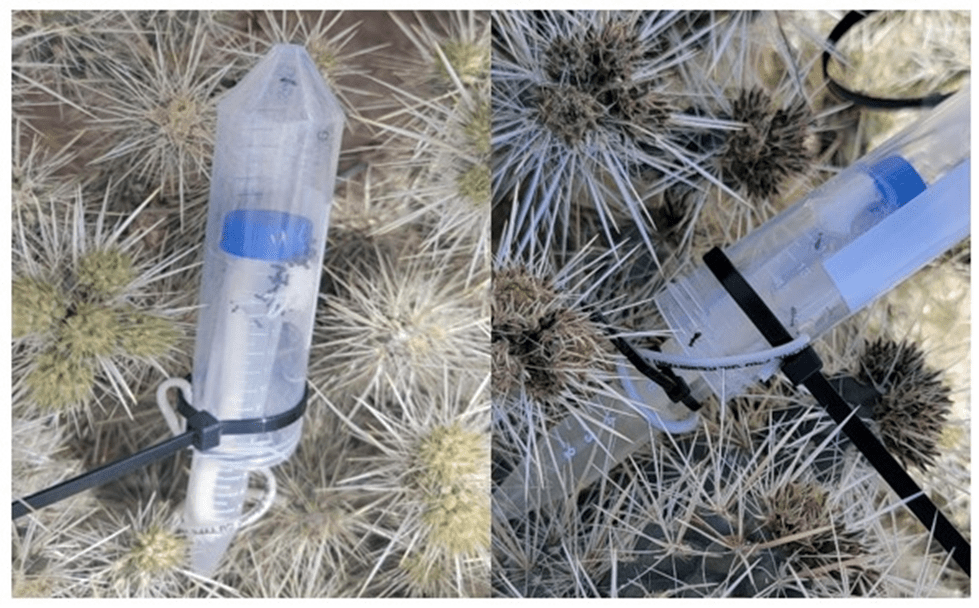
We offered high-value resources by creating artificial nectaries (tubes filled with 20% sugar by mass honey-water solution) on silver cholla. We maintained the artificial nectaries for 4 weeks in spring, replicated over 2 years.
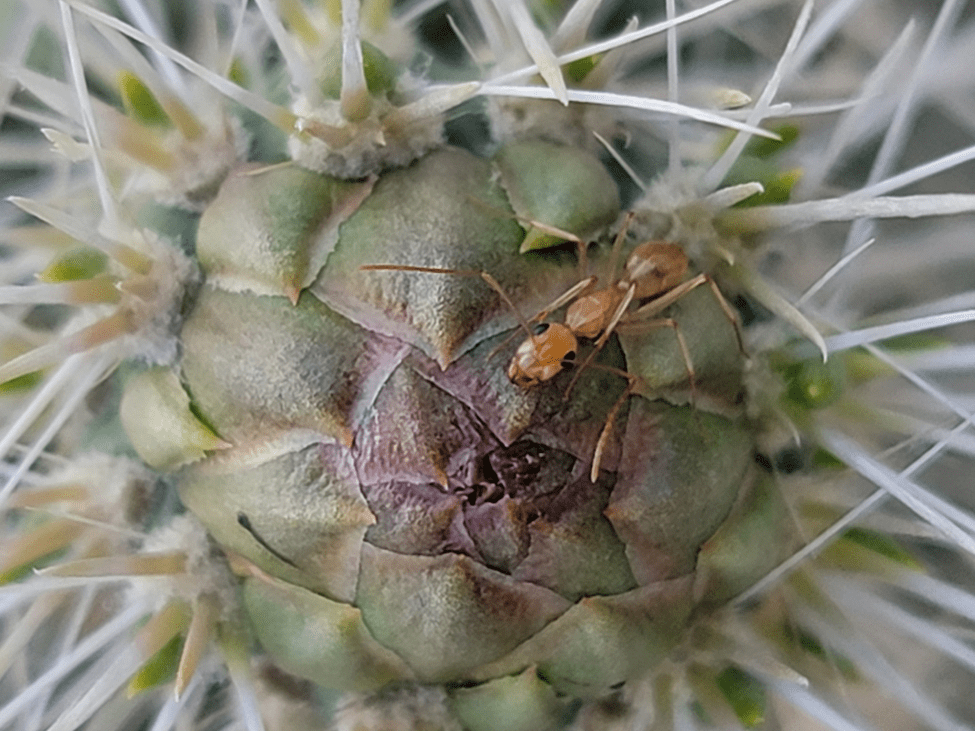
Both naturally occurring EFN and the supplemental resources increased the abundance and influenced the identity of ants associated with silver cholla. The three most abundant ant species (Solenopsis xyloni, Crematogaster depilis, and Myrmecocystus flaviceps) used control silver cholla with significantly different quantities of natural EFN resources. Of the three species, Solenopsis xyloni used cholla with the largest quantities of EFN resources, M. flaviceps used the least, and C. depilis was intermediate.
Supplementation changed the composition of the ant communities associated with silver cholla, primarily attracting the native fire ant Solenopsis xyloni, and altering the partitions.
Ants reduced the abundance of herbivores on silver cholla, including an economically important pest, the cactus coreid, Chelinidea vittiger. Over the study period, the abundance of C. vittiger was also reduced on plants with the artificial nectaries.

Collectively, these results suggest that the energetic investment into EFN is worthwhile for silver cholla because ant-mediated defense benefits this species. The most important ant mutualist, at least during the early spring, was Crematogaster depilis, because this species was associated with lower herbivore abundance and increased seed set. In contrast, the most competitive ant species, Solenopsis xyloni, was a less effective mutualist in terms of improving seed set.
Therefore, the return on investment for silver cholla is mediated by competition hierarchies between mutualists. These results suggest that when the best ant defender isn’t the best competitor, there could be a ‘sweet spot’ when providing sugar rewards.