DOHA / DUBAI — A sweeping digital crackdown has resulted in the arrests of hundreds of individuals across the Persian Gulf as authorities move to strictly control the flow of information during the ongoing conflict with Iran. On Monday, March 9, 2026, the Qatari Ministry of Interior confirmed the detention of 313 people of various nationalities, while the United Arab Emirates and Kuwait have initiated similar legal actions against those who filmed or circulated unauthorized footage of missile strikes and military movements.
The arrests highlight a regional “zero-tolerance” policy toward social media activity that authorities claim “stirs public opinion” or compromises national security.
The Qatari Crackdown: 313 Detained
In the single largest reported enforcement action since hostilities began, Qatar’s Department for Combating Economic and Cyber Crimes carried out a series of raids targeting individuals who shared videos of recent Iranian strikes.
- The Charges: Those detained are accused of circulating “misleading information and rumors” and filming military-related scenes.
- The Rationale: Officials argue that amateur footage—often tagged with precise locations—can reveal the effectiveness of air defenses or provide “battle damage assessment” to Iranian intelligence.
- The Penalty: Under Qatari law, spreading rumors that undermine national security can carry a sentence of up to five years in prison, with harsher penalties applicable during wartime.
Dubai: The Tourist and the “Wiper” Video
The UAE has intensified its monitoring of digital platforms, emphasizing that simply “reposting” a video is a criminal offense under Federal Decree-Law No. 34/2021.
- A High-Profile Case: A 60-year-old British tourist is among 21 individuals recently charged in Dubai for filming Iranian missiles hitting the city. Despite reportedly deleting the footage immediately when challenged, he faces up to two years in prison and a fine of up to 200,000 dirhams (£40,000).
- The “Incitement of Panic” Clause: UAE Attorney General Hamid Saif Al Shamsi warned that publishing images of incident sites “distorts the perception of safety” and can lead to immediate deportation for foreign nationals.
- Text Alert System: Residents across the Emirates have received emergency SMS warnings stating that documenting “falling projectiles or shrapnel” is strictly prohibited.
Regional Contagion of Enforcement
The legal push extends beyond Doha and Dubai, as other Gulf monarchies align their cybercrime frameworks with a “wartime footing.”
- Kuwait: On Saturday, authorities arrested three individuals for a video that reportedly “mocked” the national security situation. Kuwaiti State Security Law mandates a minimum of three years in prison for those spreading news deemed to undermine the state.
- Bahrain: Four people were taken into custody for “broadcasting clips” that showed the physical effects of Iranian strikes on civilian infrastructure.
- Saudi Arabia: Riyadh has issued a directive to all residents to “verify before you publish,” clarifying that the only authorized source for war-related news is the official state media.
A “Parallel Front” in Cyber Warfare
For the Gulf states, the restriction of information is framed as a matter of survival. As Iranian President Masoud Pezeshkian and Supreme Leader Mojtaba Khamenei utilize social media for “psychological operations,” regional governments are treating the digital sphere as a parallel arena of confrontation.
By centralizing all information through official channels, authorities aim to prevent the spread of “manipulated or out-of-context” digital content that could trigger bank runs or mass evacuations. However, for the millions of expatriates living in the region, the new rules have turned a “natural reflex” to record one’s surroundings into a potential ticket to a prison cell.
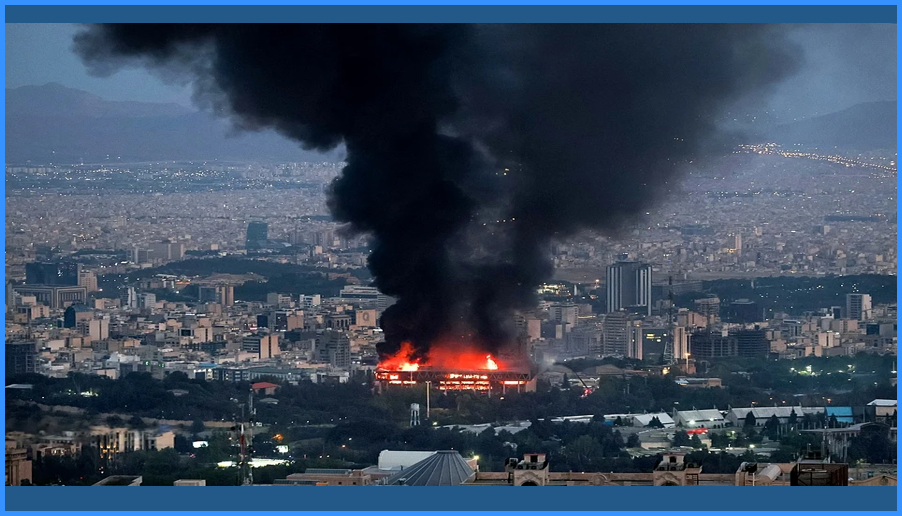
IRIB’s Broadcasting Studio Attack Picture by محمد برنو