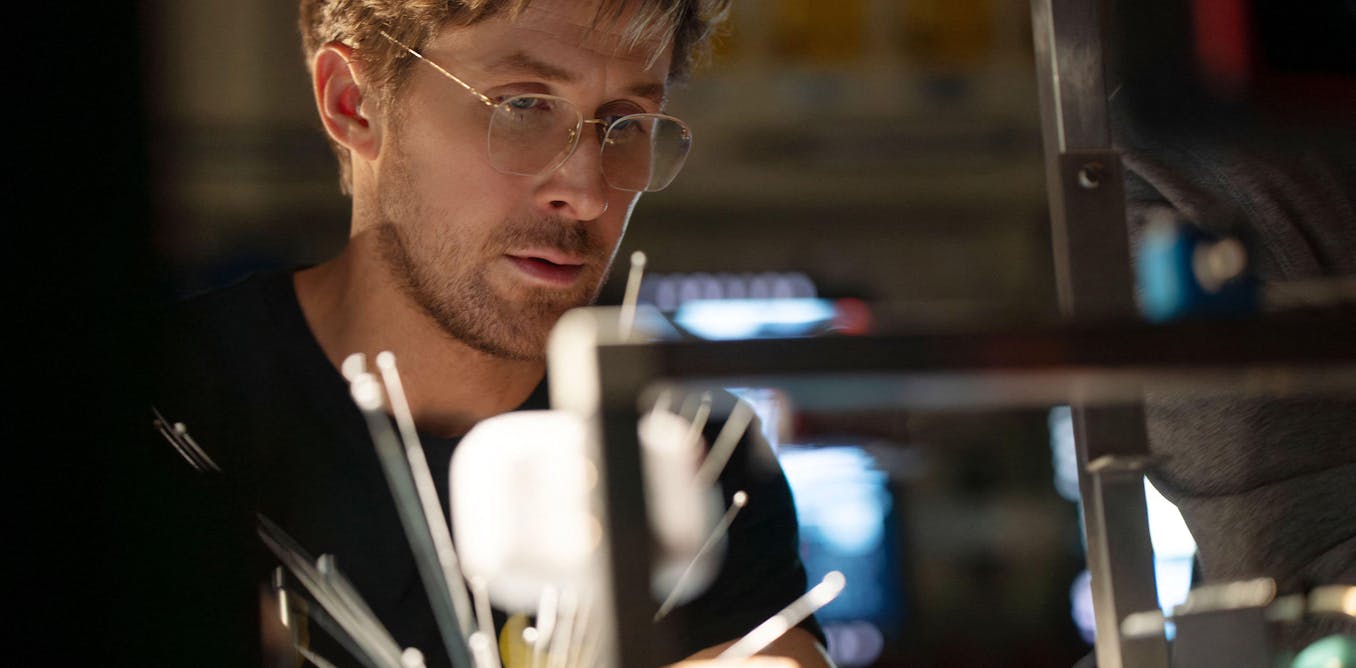
The science fiction film Project Hail Mary brilliantly uses authentic science to underscore the human drama and narrative tension of the story.
Based on the novel by Andy Weir, the story revolves around an effort to save the Earth – threatened by an alien organism that is consuming the Sun. By combining real science, compelling characters and a gripping narrative, the filmmakers have crafted a science fiction odyssey that might just inspire a whole new generation of scientists.
The story begins with the main protagonist, Ryland Grace (Ryan Gosling), waking from a coma in a sealed lab with no windows. Affected by amnesia, the novel describes how he nevertheless applies his knowledge of high-school physics to deduce that gravity in the lab is 50% greater than on the surface of the Earth. He concludes that he must either be in a constantly accelerating spaceship, or on the surface of another planet.
This opening scene perfectly illustrates a concept that Einstein described in 1907 as his “happiest thought”. Einstein realised that while a person is in perfect free-fall, they don’t directly experience the effects of gravity themselves. This is the state of weightlessness experienced by astronauts in orbit – in a perpetual state of free-fall about the Earth.
By the same token, Einstein realised that this inertial experience of acceleration is also perfectly equivalent to the force of gravity. As Grace discovers, there’s no way to distinguish the two. This principle of equivalence was the essential insight that Einstein needed to describe gravity as the effects of warped space-time in his general theory of relativity.
Grace soon discovers that, not only is his increased sensation of gravity due to the constant acceleration of the spacecraft Hail Mary, he’s rapidly approaching the vicinity of the star Tau Ceti, some 11.9 light-years from Earth. To date, the fastest that humans have ever travelled was on the Apollo 10 mission, which reached nearly 25,000 miles per hour – or about seven miles per second.
That may sound fast, but at that speed, it would take about 320,000 years to reach Tau Ceti. But Grace nevertheless finds himself there well within the course of a human lifetime. To understand how, we have to turn to some of the most fascinating results from Einstein’s theory of relativity.
A famous equation
A capable sports car might accelerate from 0 to 60mph in a time of 2.7 seconds. This is the same rate at which an object falls to the ground due to the effects of Earth’s gravity: 1g of acceleration. The 1.5g of the Hail Mary spacecraft corresponds to a 0-60mph time of 1.8 seconds; clearly rapid, but a comparable rate to a modern hypercar.
The difference is that even the highest performance cars can maintain that acceleration for only a few seconds. The Hail Mary accelerates at that rate for eight and a half months, reaching a maximum speed of 92% of the speed of light, or about 165,000 miles per second; about 25,000 times faster than Apollo 10. So how could the Hail Mary sustain this acceleration for so long?
The answer lies in Einstein’s most famous equation: E=mc². The Hail Mary is fuelled with huge tanks of astrophage – the fictional microorganisms in the story that feed off the Sun and can convert matter to pure energy. The astrophage provides the continuous thrust required to reach almost the speed of light. But it takes light itself 11.9 years to reach Tau Ceti, so even at 92% of the speed of light, how could Grace experience the journey in less than half that time?
The ultimate speed limit
Relativity is clear that nothing can travel faster than the speed of light. At a constant speed of 92% of the speed of light, it would take the Hail Mary 12.9 years to reach Tau Ceti. However, one of the essential principles of relativity is that the speed of light is an absolute constant for all observers.
To keep the speed of light constant for all observers, Einstein realised that our intuitive expectations about time and space would have to be modified at relativistic speeds. To put it another way, some very weird stuff happens when travelling close to the speed of light.
If we assume that the Hail Mary is 40 metres long, an observer watching the ship fly by at 92% of the speed of light would observe the ship to be less than 16 metres in length. If we assume that Ryland Grace is the same height as his onscreen counterpart Ryan Gosling, he would appear to an external observer to be only 72 cm tall.
However, one of Einstein’s key insights from relativity is that anyone moving at a perfectly constant speed can consider themselves at rest, and everything else in the universe as moving towards them. If Grace is flying towards the distant star with a constant speed of 92% the speed of light, we can equally say that the Hail Mary is at rest, and that Tau Ceti is approaching the ship at close to light speed.
This can play with our perceptions. From the perspective of an external observer, at 92% the speed of light, the Hail Mary would appear to be length contracted by a factor of 2.55, but from the perspective of the Hail Mary, the ship is still its original length, and all other distances in the same direction appear to be contracted by this same amount.
Whereas the “rest-frame” distance to Tau Ceti remains 11.9 light-years, from the perspective of the Hail Mary, the distance is less than 4.7 light-years. At a constant speed of 92% the speed of light, the Hail Mary would arrive in about five years. This doesn’t mean that Tau Ceti is physically closer – only that from Grace’s point of view the distance is contracted. An observer tracking the mission back on Earth would still find that the journey took 12.9 years. While everyone would agree on the speed of the Hail Mary, the time and distance involved depend on the point of view of the observer.
By embracing the genuine principles of relativity, the filmmakers have crafted a science fiction masterpiece with a foundation in authentic physics. Far from detracting from the story, Weir’s masterful skill of weaving real science together with a riveting plot helps to underscore the emotional stakes of the narrative.
Science fiction is one of the few avenues through which concepts from relativity and astrophysics enter the mainstream public discourse. By brilliantly engaging with these concepts as part of such a compelling story, Project Hail Mary may just inspire a whole new generation to study these subjects, and perhaps even make new discoveries of their own.

Ed Macaulay does not work for, consult, own shares in or receive funding from any company or organisation that would benefit from this article, and has disclosed no relevant affiliations beyond their academic appointment.