
Shortlisted for the 2025 Southwood Prize
About the research
Overview
Our paper explores the community, population, and functional aspects of tropical savanna grasses in response to an extreme, prolonged fire regime of seven consecutive annual dry season fires. We were interested in understanding how the repeated fires would affect community composition, species persistence, population turnover, functional composition and structure, and ecosystem functioning. So, we used permanent plot data from before and after the seven prescribed fires to compare changes in all these aspects, bringing light to the extreme resilience of the grass layer. In summary, the grass community benefited from the extremely frequent fires, became more resilient to disturbance the more it burned, and doubled its size due to the multiplication of clonal grasses.
Surprises and challenges
While we expected fires not to be negative to the grass layer, we were very surprised (and excited!) by their beneficial effects. It was a surprise to see that, even considering an extreme fire regime of consecutive repeated annual fires, the grass layer can persist, thrive, and multiply. This finding really emphasizes how tropical grassy biomes have a persistent connection with fire, since the dominant ground layer component is very well linked to fire occurrence and benefits from it.
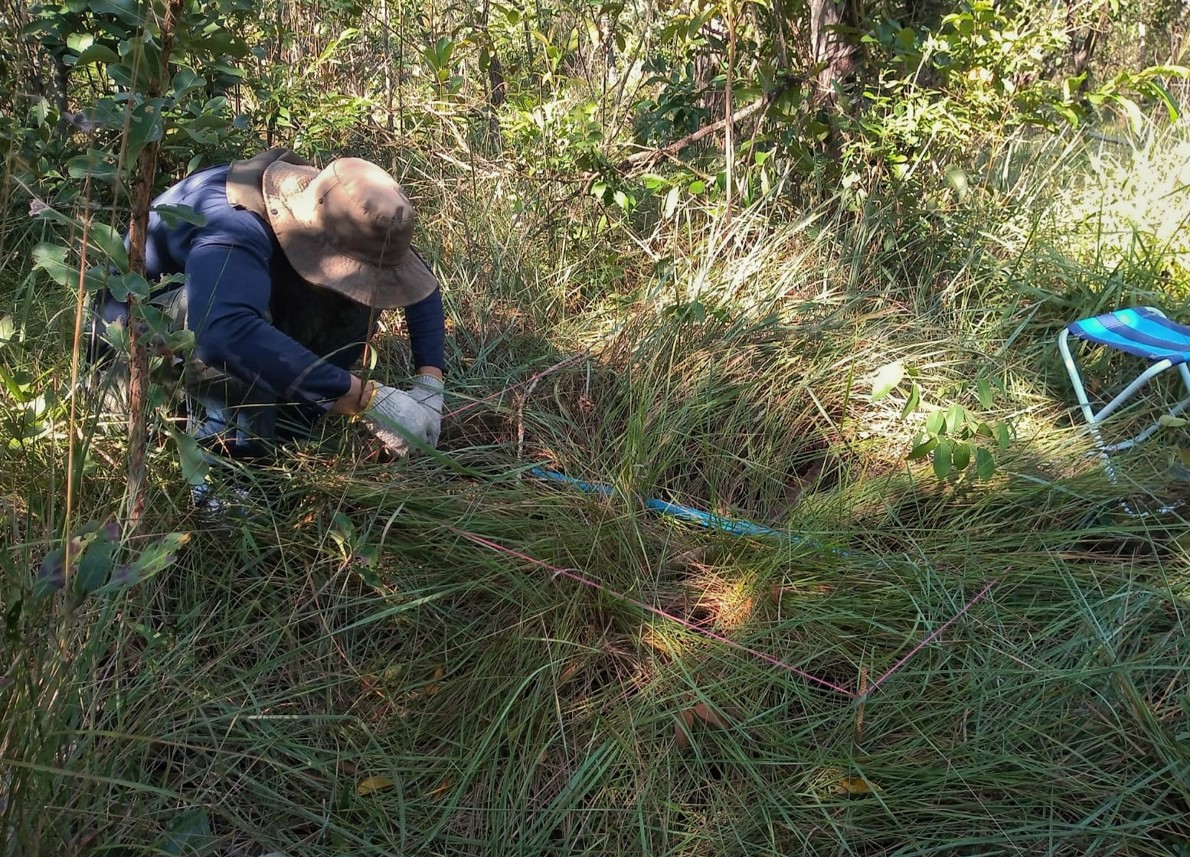
I believe my main challenge was to build a story out of so much data. The paper was very long, and we had so many variables, perspectives, and information to integrate into a single framework, so a lot of work had to be done to make a compelling paper with sufficiently detailed information.
Next steps and broader implications
The next step is to repeat the same analysis and investigation for other fire seasons. We now know that dry season fires are safe and beneficial for these tropical grasses. But fire may also occur during the wet season, especially considering management activities. I believe that is an essential step to fully understand the effects of fire on the community. Is fire in the wet season also beneficial? Can the same frequency also be sustained? We still don’t know. It will also be very interesting to know (and we are already analysing that) how other components of the ground layer, like forbs and subshrubs, respond to these repeated fires.
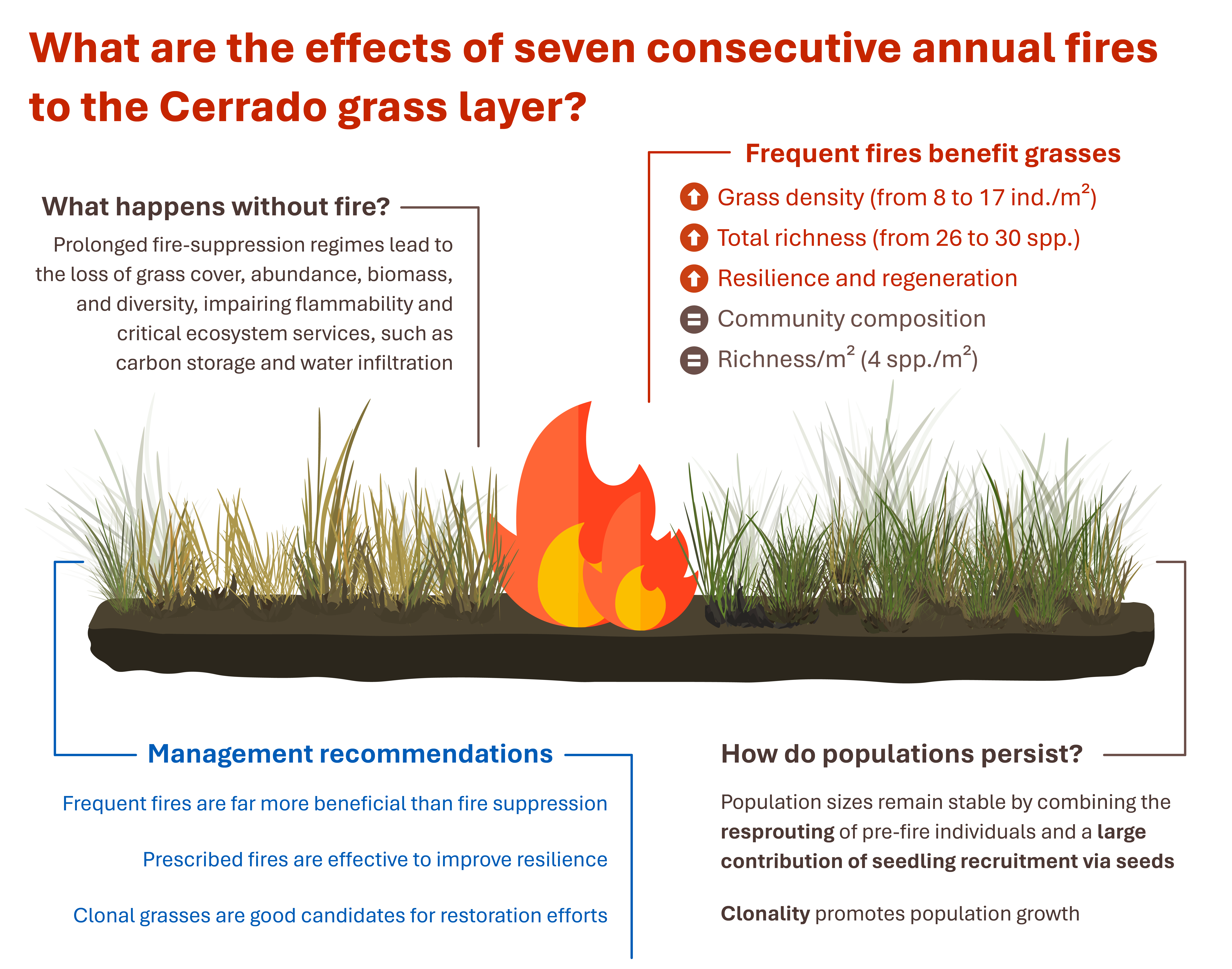
The main contribution of our research is showing that fire is not a bad guy in tropical grasslands and savannas, with its dominant vegetation component, the grass layer, being adapted to, benefited by, and resilient to it. Our paper brings strong evidence that using fire as a management tool is possible without detrimental effects on the vegetation. In fact, fire could be used to improve grassland and savanna resilience and health, as well as increase diversity, maintain functioning, and improve productivity and overall health. For policy, we show that fire-suppression laws and policies are actually more dangerous to these ecosystems than frequent fires, reducing diversity, density, cover, and functioning.
About the author
Current position
I am a Ph.D. candidate at the University of Brasília, Brazil, continuing my work on grass-fire relations.
Getting involved in ecology
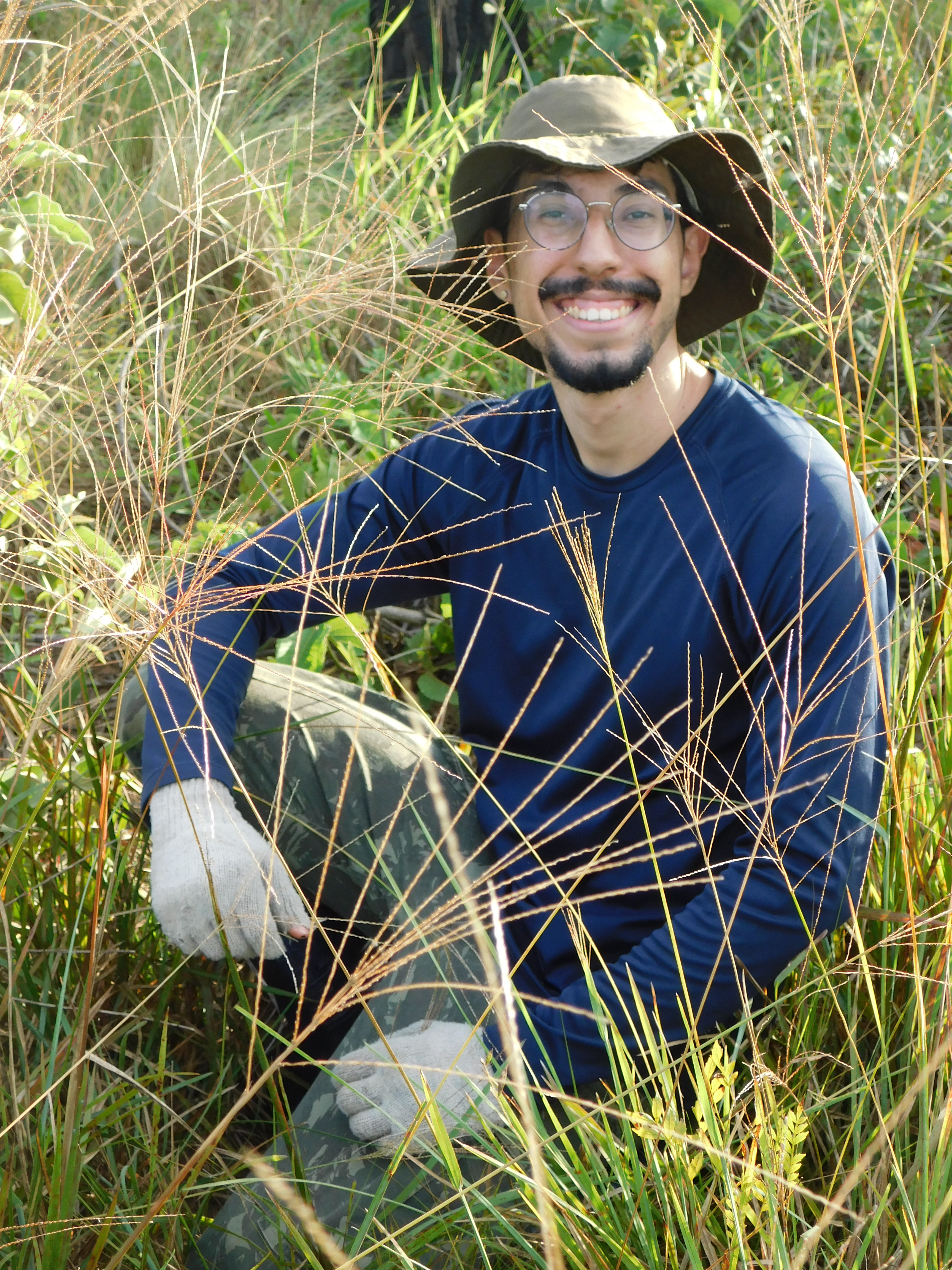
I actually started very early, when I was just 17 years old, during my first undergrad year. I had just started my bachelor’s degree, and I joined the Laboratory of Fire Ecology at the University of Brasília. It was my first internship, and I have since been a member of the laboratory, studying, researching, and networking, all in connection with where it first started. Growing up, I have always loved nature, and I was actually passionate about large mammals and birds, which were my go-to research subject. But since I first learned about fire ecology, I have never been more interested in another subject, and I love to study it.
Current research focus
The permanent plots we used for data collection are still being monitored and will continue to be for the next few years, which will allow us to investigate fire effects in other regimes and for longer durations. We are also looking more deeply into the clonal grasses, since they were very important contributors to fire responses. Now, I am investigating what environmental changes created by fire promote clonal growth and how they can increase their abundances more easily than strictly non-clonal species.
Advice for fellow ecologists
I would say that every plant ecologist must be a bit of a naturalist and go to the field, get down on the ground, and look very closely at every plant. I believe that is such a big and essential part of ecological research, ecological thinking, and, particularly, vegetation science. To feel the plants in our hands, to observe the vegetation patterns from up close, to walk around the grasslands, and to see plants in their habitats are all very important to formulate questions and interpret the results. So get in the field and live the vegetation.
Read the full article ‘Doubled density and increased resilience: Consequences of seven consecutive annual dry-season fires to the unburned Cerrado grass layer’ in Journal of Applied Ecology.
Find the other early career researchers and their articles that have been shortlisted for the 2025 Southwood Prize here!








