Category: Finance

  • $35K a Year Is How Much an Hour?

    $35K a Year Is How Much an Hour?

    [ad_1]

    As the cost of living continues to rise, many people find it difficult to make ends meet. A full-time job may not be enough to cover all one’s expenses, but it is still better than being unemployed.

    If you’re being offered a job with an annual salary, you may be interested to know how your new income translates to an hourly wage.

    By doing a simple calculation, it is possible to determine how much someone earns per hour. To illustrate, this blog post will explain the calculation using a $35,000 income, including how much you would make per hour, a sample budget, and more.

    $35K a Year Is How Much an Hour?

    If you make $35,000 a year, you earn approximately $16.80 an hour. Here’s how the calculation works, based on a 40-hour work week.

    1. Calculate the number of hours you work in a year: 

    40 Hours per week X 52 weeks = 2080 Hours per year 

    2. Divide $35,000 by 2080 hours = $16.82 per hour.

    Remember, this is just an estimate. Your exact hourly wage may vary depending on your job and other factors, such as the number of days off, vacation time, etc.

    An hourly rate of $16.82 is above the federal minimum wage of $7.25, although most state minimum wages are higher than that. Nevertheless, keep in mind that your hourly pay will be lower if you work more than 40 hours per week and higher if you work less.

    For example, earning $35,000 a year but working 50 hours a week only translates to $13.46 per hour. On the flip side, if you earn 35k per year but only work 20 hours a week, your effective hourly rate climbs to $33.65.

    You’ll still make the same amount of money, but the number of hours you work will differ.

    How Does 35K a Year Compare?

    Now that you know how much you would make an hour, it’s time to compare your salary to national and median household income statistics in the United States.

    In 2022, the national median household income was $78,075, a 1.1% increase from 2021. So, $35,000 is 45% less than the median.

    However, the median income measures households, not individual earners. So if your family has more than one person working and earns a total of $70,000 a year, your family is making close to the median income in the United States.

    Is $16.82 a Good Hourly Rate?

    The 2022 federal poverty level for a single individual without dependents is $13,590, while it’s $27,750 for a family of 4. In other words, according to federal poverty guidelines, a living wage that can support yourself and a small family is $13.34/hour (based on $27,750 yearly.)

    But how realistic is that number? Depending on the cost of living where you live, a living wage is much, much higher. Take New York City, for example.

    New York City’s cost of living is much higher than the national average. No family of four can afford a decent quality of life in NYC on a yearly income of $27,750, let alone $35,000. Therefore, it’s best to check where you live and research the area’s cost to determine if $35,000 is a livable salary.

    Is $35K a Year Worth Your Time? 

    Single people living alone may find that $35,000 per year is more than enough to support themselves. However, they’ll need to be mindful of spending to save money or build up their retirement fund.

    What is the opportunity cost of working a job that pays $35,000 a year? The opportunity cost is what you give up to do something. In this case, the opportunity cost is your time.

    For every hour you work, you give up an hour of your life that you will never get back. Therefore, you should ensure that your job is enjoyable and worth your time.

    Some people may value their time more than others. For example, if you are a student, you may be willing to work a job that pays less because you gain valuable experience that will help you in your future career.

    On the other hand, if you have a family to support, you may value your time because you must ensure that your family is taken care of.

    Ultimately, it is up to you to decide if $35,000 a year is worth your time.

    How to Make More While Working Less?

    This is the dream for many people, but making more money while working less is possible. The key is to be productive with your time and use your skills to their fullest potential.

    There are a few things you can try:

    Invest in Passive Income Opportunities

    One way to make more money is to reinvest part of your salary into a business or investment that will generate passive income. It will take time, but if you can do it effectively, it will be worth it in the long run.

    Some examples of investments that generate passive income are: 

    Sell Your Services as a Freelancer

    If you have certain skills, consider freelancing to increase your income. This is a great way to use your skills and talents to make extra cash. Another benefit of freelancing is that you can set your own hours and work as much or as little as you want.

    Some examples of freelance work include:

    Almost anything you are doing in your full-time job can be done freelance on the side.

    Look for a Higher-Paying Job

    If you are unhappy with your current salary, you can always look for a higher-paying job within the same company or elsewhere. Who knows, you may be able to make more money while working less.

    The best way to find a higher-paying job is to network with people in your industry and to look for job postings online.

    You could also consult a career coach to help you find a better-paying job.

    Ask for a Raise

    It would cost more money for your employer to replace you than to pay you a higher wage. Work hard and smart, and don’t be afraid to ask for a raise at your current job. The worst thing they can say is, “No.”

    Be sure to consult with your boss to see if there are any opportunities for advancement at your company.

    What Is Your Paycheck if You Make $35,000 a Year?

    Let’s look at how a $35,000 annual salary looks on a paycheck by breaking it down biweekly and monthly.

    Biweekly Pay

    f you work 40 hours per week with no overtime in a full-time job, then $35,000 / 26 bi-weekly pay periods = $1,346.15 per paycheck. But that’s not what will appear in your bank account.

    Take-Home Pay

    Your take-home pay will be lower than your biweekly paycheck because of taxes and other deductions such as:

    • Income taxes
    • Pre-tax deductions, including retirement accounts, health savings bank accounts, etc.
    • FICA (Social Security and Medicare) taxes
    • State and local taxes, if any
    • Miscellaneous employer deductions
    • Health insurance premiums

    Monthly Pay 

    If your salary is $35,000 annually, each paycheck would equal $2,916.67 before taxes and deductions. You may receive paid time off and federal holidays depending on your company. If this is the case, you’re effectively making more money per hour than your hourly rate suggests.

    How Much is $17 an Hour Annually?

    If you make $17 an hour, you make about $35,360 annually. But the above-mentioned figures are based on 40 hours weekly. If you work more than that, then you can make more money.

    For example, if you work 50 hours a week, you will make $44,200 annually. If you work 60 hours a week, you will make $53,040 annually.

    The salary will decrease if your working hours are less than 40 weekly.

    For example, if you work 30 hours a week, you will make $26,520 annually. If you work 20 hours a week, you will make $17,680 annually.

    This is why knowing how many hours you are expected to work is important if offered a job that pays $17 an hour.

    How Does Vacation Impact My Annual Salary? 

    Everyone needs a break from work to recharge. What most people don’t realize is that vacation can have a direct impact on your salary.

    When you take a vacation, you essentially take time off from work. This means that you are not working and not earning an income.

    Your salary will not be reduced if you take paid vacation days as part of your employment contract. However, your salary may go down if you receive unpaid vacation days. Every company does things differently.

    For example, bi-weekly pay cycles amount to $1346.15 annually for those earning $35,000. If someone in this income bracket took two weeks of unpaid vacation, their annual earnings would be lower by that same amount.

    Remember that these examples only give you an idea of your salary, which will depend on other skills, experience, qualifications, and how many hours you plan to work.

    How Much Is $35000 a Year After Taxes?

    Whatever your tax bracket is, you can expect to lose a chunk of your $35,000 salary to taxes. The amount you’ll pay in taxes depends on your filing status and how much money you make.

    There are many moving parts regarding taxes, making it hard to advise without knowing complete details about your finances. However, here are some general things to keep in mind.

    For example, say you live in Florida and make $35,000 a year.

    Here’s a quick breakdown of what you can expect to pay in taxes:

    • +$35,000 annual pre-tax income
    • -$2,515 federal income tax
    • -$2,678 FICA taxes
    • $29,808 after-tax take-home income

    State By State $35,000 a Year Salary After Taxes in 2022

    Like their federal counterparts, each state and territory has tax brackets that are calculated similarly.

    However, because each state or territory can set its own marginal tax rates and has different laws about what is and isn’t taxed, the amount of taxes you pay on $35,000 a year can vary based on your state or territory of residence.

    The following table displays what your after-tax salary will be on a $35,000 salary for the 2022 tax year:

    State After-Tax Net Salary
    Alabama $28,297
    Alaska $29,882
    Arizona $29,300
    Arkansas $28,178
    California $29,371
    Colorado $28,878
    Connecticut $28,332
    Delaware $28,506
    District of Columbia $28,759
    Florida $29,882
    Georgia $28,306
    Hawaii $27,859
    Idaho $28,781
    Illinois $28,149
    Indiana $28,751
    Iowa $28,440
    Kansas $28,544
    Kentucky $28,270
    Louisiana $28,863
    Maine $28,603
    Maryland $28,383
    Massachusetts $28,132
    Michigan $28,394
    Minnesota $28,699
    Mississippi $28,547
    Missouri $28,880
    Montana $28,416
    Nebraska $28,841
    Nevada $29,882
    New Hampshire $29,882
    New Jersey $29,339
    New Mexico $29,081
    New York $28,516
    North Carolina $28,771
    North Dakota $29,639
    Ohio $29,605
    Oklahoma $28,709
    Oregon $27,288
    Pennsylvania $28,807
    Rhode Island $28,918
    South Carolina $28,883
    South Dakota $29,882
    Tennessee $29,882
    Texas $29,882
    Utah $28,187
    Vermont $28,992
    Virginia $28,385
    Washington $29,882
    West Virginia $28,532
    Wisconsin $28,944
    Wyoming $29,882

    Note: The figures above account for the federal and state taxes you’ll need to pay on an annual salary of $35,000 for the 2022 tax year in each of the 50 states and the FICA and Medicare contributions you’ll need to pay.

    Source: World Salaries

    What Types of Jobs Pay $35,000 Per Year?

    Many jobs pay at least $35,000 per year and higher. Here are some examples:

    1. Survey researchers.
    2. Electro-mechanical and mechatronics technologists and technicians.
    3. Physical therapist assistants.
    4. Crane and tower operators.
    5. Property, real estate, and community association managers.
    6. Fundraisers.
    7. Legal support workers, all others.
    8. Tapers.
    9. junior bank account cashier.
    10. Cardiovascular technologists and technicians.
    11. Flight attendants.
    12. Plant and system operators, all other.
    13. Telecommunications line installers and repairers.
    14. Sales representatives of services, except advertising, insurance, financial services, and travel.
    15. Property appraisers and assessors

    The job list above is not all-inclusive, but it gives you a good idea of the positions offering an annual salary of $35,000+.

    How To Budget $35,000 a Year?

    The following budgeting tips can be helpful for any income. But for the purpose of this article, if you earn in the neighborhood of $35,000 a year, here are some ways to stretch your money further.

    Cut Unnecessary Monthly Expenses

    Whether you make $35,000 a year or $350,000 a year, it is important to live within your means. One of the best ways to do this is to cut unnecessary monthly expenses.

    If you are unsure where to start, your budget is a good place to look. Are there any expenses that you can live without? If so, cut them from your budget and use them to pay down debt or build up your savings.

    Here are some examples of expenses that you may be able to reduce or cut from your budget altogether:

    • Cable TV
    • Gym membership
    • Eating out
    • Clothes shopping
    • Entertainment expenses
    • Subscriptions (e.g., magazines, music, etc.)
    • Travel expenses

    Avoid High Car Payments

    Unless you’ve saved a lot of cash, owning a new vehicle usually results in having a high car payment. According to Experian, the average monthly loan payment for a new car in the U.S. nearing $600 – which, for someone making $35,000 annually – is more than 20% of their monthly income.

    This doesn’t even account for insurance, gas, and maintenance costs.

    If you want to save money, one of the best things you can do is avoid having a big car payment. There are a few ways to do this, such as:

    • Buy a used car: You can save a significant amount of money by buying a used car instead of a new car.
    • Get a smaller car: The operating costs of a small, fuel-efficient sedan are far lower than a gas-guzzling SUV or pickup truck.
    • Pay cash: If you have the cash, you can avoid having a car payment altogether.

    Avoid Credit Card Debt

    One trap that many people fall into is using credit cards to finance their lifestyle. Financially, it’s a dangerous proposition that can quickly lead to debt.

    If you want to stay out of credit card debt, only use your credit cards for things you can afford to pay off in full each month. You need to re-evaluate your spending if you can’t afford to pay your credit card bill in full each month.

    Sample Budget For Those Earning $35,000 a Year

    By breaking down your monthly costs, it can be simpler to conceptualize living on a $35,000 salary. To help, here is a sample budget for an individual or family earning $35k annually.

    Category Budget Amount Percentages
    Giving $160 10%
    Savings $438 15-25%
    Housing $817 20-30%
    Utilities $117 4-7%
    Groceries $244 5-12%
    Clothing $29 1-4%
    Transportation $117 4-10%
    Medical $175 5-12%
    Life Insurance $15 1%
    Education $29 1-4%
    Personal $29 2-7%
    Recreation / Entertainment $58 3-8%
    Debts $0 0% – Goal
    Government Tax (including Income Tax, Social Security & Medicare) $690 15-25%
    Total $2,918

    Note: This budget covers fixed expenses and assumes no debt.

    Final Thoughts on a 35K a Year Salary

    Salaries are highly relative because buying power varies greatly depending on where a person lives, as do lifestyle expectations.

    In some parts of the world, a 35K yearly salary would be relatively low. In others, it would be considered an excellent salary. The same is true in the US.

    For example, if you live in New York City, you must make nearly double that amount just to get by. In rural Mississippi, on the other hand, you could get by on $35,000 a year.

    The key to surviving and thriving on a $35,000 salary is to live below your means, be mindful of your spending, and invest in yourself and your future.

    Do you think you could live on a $ 35,000-a-year salary? Why or why not? Let us know in the comments below.

    [ad_2]

    Source link

  • How to Invest in The S&P 500 Index (Guide for New Investors)

    How to Invest in The S&P 500 Index (Guide for New Investors)

    [ad_1]

    Whether you’re a newbie or a seasoned investor, you’ve probably heard these words from a friend or family member who invests in the S&P 500:

    “Just buy an index fund.”

    Consider the words of the billionaire investor Warren Buffet:

    “In my view, for most people, the best thing to do is own the S&P 500 index fund”.

    Warren took it one step further, once betting hedge fund manager Ted Seides $1 million that an index fund would outperform a portfolio of hedge funds over the next ten years.

    And he won.

    But does it make sense for ALL investors to invest in the S&P 500? What if you like to pick stocks? What if you’re not 100% comfortable investing all your money in the stock market?

    Let’s look at how the S&P 500 works, along with some pros and cons of investing in the S&P 500, so you can make a more informed decision for YOUR portfolio.

    What Is the S&P 500?

    S&P stands for Standard & Poors, one of the most well-known financial companies in the world over the past 150 years.

    The S&P 500 is an index of roughly 500 large-cap US stocks. It’s a widely used benchmark for US stock market performance. It differs from the Dow Jones index because it includes a wider range of tech and growth stocks. The Dow Jones only consists of 30 stocks vs. 500 in the S&P.

    Interestingly, even though the S&P 500 gives a better representation of the “stock market” performance, my financial planning clients always used the Dow Jones as their reference.

    I was often asked, “How’s the Dow doing today?”

    Yet, when you read anything about how the market is performing or hear an expert share on CNBC what the market is doing, they usually refer to the S&P.

    The S&P 500 also serves as a lead benchmark for US equity performance. When the S&P 500 is up, other US stocks tend to follow suit.

    It also gives investors a good gauge to compare how their portfolio or certain investment are performing. For example, if you own Tesla and the S&P is down, but your stock is up, you know your investment is doing well. Thank you, Elon!

    S&P 500 Industry Sectors

    There are 11 sectors in the S&P 500, ranked below by the percentage of the index represented by each:

    • Information Technology (26.4%)
    • Health Care (15.1%)
    • Consumer Discretionary (11.7%)
    • Financials (11.0%)
    • Communication Services (8.1%)
    • Industrials (7.9%)
    • Consumer Staples (6.9%)
    • Energy (4.5%)
    • Utilities (3.1%)
    • Real Estate (2.8%)
    • Materials (2.5%)

    What Is Required to Be Listed in S&P 500?

    According to SPC Global, to be included in the S&P 500, a company must meet the following criteria:

    • It must be headquartered in the United States.
    • File financial statements with the SEC (10-K reports)
    • Have a market cap above $8.2 billion.
    • Have at least 50% of its float-adjusted shares outstanding listed on a US stock exchange.
    • Be considered a “blue chip” company, meaning it must have stability and continuity of earnings and dividend payments.
    • Not be in bankruptcy proceedings.
    • It must have a market capitalization of at least $8.2 billion.
    • It must be listed on the NYSE, Nasdaq, or Cboe BZX Exchange.
    • It must have posted positive earnings in the most recent four quarters.

    The most recent additions include: Crocs, ServiceNow, and Zoom Video Communications.

    Top 10 Companies in the S&P 500

    1. Apple Inc. (AAPL)

    2. Microsoft Corporation (MSFT)

    3. Amazon.com, Inc. (AMZN)

    4. Alphabet Inc. A (GOOGL)

    5. Tesla, Inc. (TSLA)

    6. Berkshire Hathaway Inc. (BRK.B)

    7. Unitedhealth Group Inc (UNH)

    8. Alphabet Inc. C (GOOG)

    9. Exxon Mobil Corporation (XOM)

    10. Johnson & Johnson (JNJ)

    The companies change often, but these ten have been pretty consistent over the last five years. Apple, Amazon, and Google (Alphabet) are all tech companies. These three companies make up a large portion of the S&P 500 index. In fact, as of October 2019, they make up about 22% of the entire index!

    How to Invest in the S&P 500

    There are many ways to invest in the S&P 500. You can buy individual stocks, purchase an index fund or exchange-traded fund (ETF), or create your own M1 Finance index fund (I’ll cover that later.)

    Buy individual stocks: This is probably the most challenging way to invest in the S&P 500. Not only do you need to have a large sum of money to invest, but you also need to know what stocks to buy. And even if you buy the right stocks, there’s no guarantee they will perform well.

    Purchase an index fund: An index fund is a type of mutual fund that aims to track the performance of a specific market index, such as the S&P 500. Index funds are a great way to invest in the stock market because they offer diversification and professional management.

    The largest 3 mutual funds on the S&P 500 are :

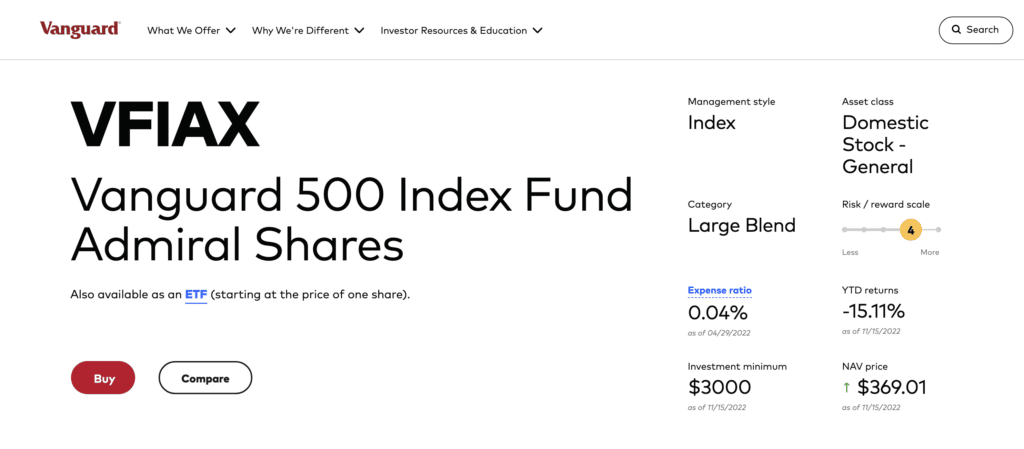
    • Vanguard 500 Index Fund Admiral Shares (VFIAX)
    • Vanguard Institutional Index Fund Institutional Plus Shares (VINIX)
    • Schwab S&P 500 Index Fund (SWPPX)

    Buy an ETF: An exchange-traded fund (ETF) is a type of investment fund that tracks the performance of a particular asset or group of assets. Like index funds, ETFs offer diversification and professional management.

    The top 3 S&P 500 ETFs are:

    • SPDR S&P 500 ETF (SPY)
    • iShares Core S&P 500 ETF (IVV)
    • Vanguard S&P 500 ETF (VOO)

    Should You Invest in the S&P 500?

    There’s no easy answer to this question. It depends on your goals, risk tolerance, and time horizon. If you’re investing long-term and can stomach a little volatility, then investing in the S&P 500 may be a good choice. However, if you’re looking for immediate returns or can’t handle the ups and downs of the stock market, don’t buy the S&P 500.

    Pros of Investing in the S&P 500:

    Diversification: When you invest in the S&P 500, you’re buying a piece of 500 different companies. This diversification can help protect you from losses if any one company underperforms. And since the index represents 11 different industry sectors and approximately 80% of the total capitalization of all US stock markets, you can enjoy overall diversification in the US economy.

    Professional management: Index funds and ETFs are managed by professionals who know how to pick stocks and allocate assets, taking the guesswork out of investing for many people.

    Low cost: Because S&P funds are tracking the index, there is little to no active management required. Therefore, fund managers can keep costs to a minimum. This is unlike actively managed mutual funds, whose managers are trying to beat the benchmark.

    An ETFs annual expense ratio, often less than 0.10%, will have a minimal impact on your overall returns. This compares well to the 1% – 2% MERs charged annually by active mutual funds.

    The S&P 500 outperforms actively managed funds: The Index beats nearly 80% of actively managed funds.

    S&P 500 index funds pay dividends: Since the index represents the largest corporations in America, many are well-established companies that pay dividends regularly. Those dividends are paid to investors through the fund. For example, the Schwab S&P 500 Index Fund has a dividend yield of 1.54%.

    Performance: The S&P 500 has an average annual return of 9.4% between 1972 and 2021. And, as it turns out, it turns positive returns in the vast majority of years!

    Cons of Investing in the S&P 500:

    Volatility: The stock market can be volatile, which means that the value of your investment can go up and down. If you’re investing for the short term, this volatility can be a big risk.

    No guaranteed returns: There’s no guarantee that you will make money by investing in the S&P 500, and you could lose money.

    No international diversification: The S&P 500 is invested entirely in companies that trade on US stock exchanges, and there is no foreign exposure to established or emerging markets.

    Large-cap stocks only: The index comprises the US’s 500 largest publicly traded companies. It provides no diversification into mid-and small-cap stocks.

    The S&P 500 doesn’t always lead the market: Though it has outperformed other indices in recent years, that isn’t always the case. Other investment strategies, like value investing and small-cap stocks, have performed better in different market environments.

    Market capitalization weighting: Though the S&P 500 represents the 500 largest publicly traded corporations in America, the index itself is calculated by the market weight of each component company. The companies with the largest market capitalization make up a disproportionate percentage of the index value.

    For example, as of April 2022, the ten largest holdings in the index represented nearly 30% of its total value. A severe decline in the stock price of any of just three or four of those top holdings could have an outsized negative effect on the index’s overall performance.

    Create Your Index Fund in M1 Finance

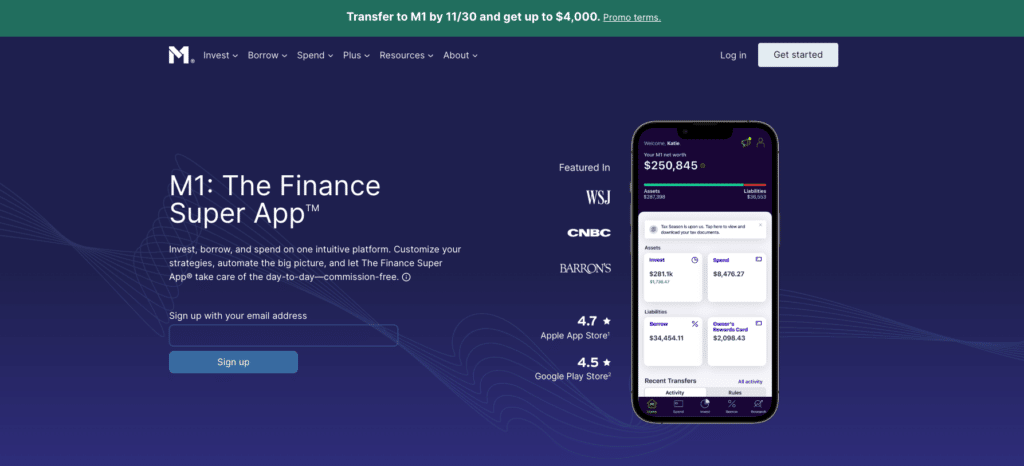
    M1 Finance Homepage Screenshot

    With M1 Finance, you can easily create your own index fund and invest in the S&P 500 with no management fees or commissions. Plus, you can reinvest your dividends and grow your investment over time.

    To get started, sign up for a free account and then follow these steps:

    1. Choose the S&P 500 from the list of indexes.

    2. Select the stocks that you want to include in your fund. You can choose the stocks manually or have M1 Finance select them based on your goals and risk tolerance.

    3. Set up a recurring investment plan to regularly invest in your fund.

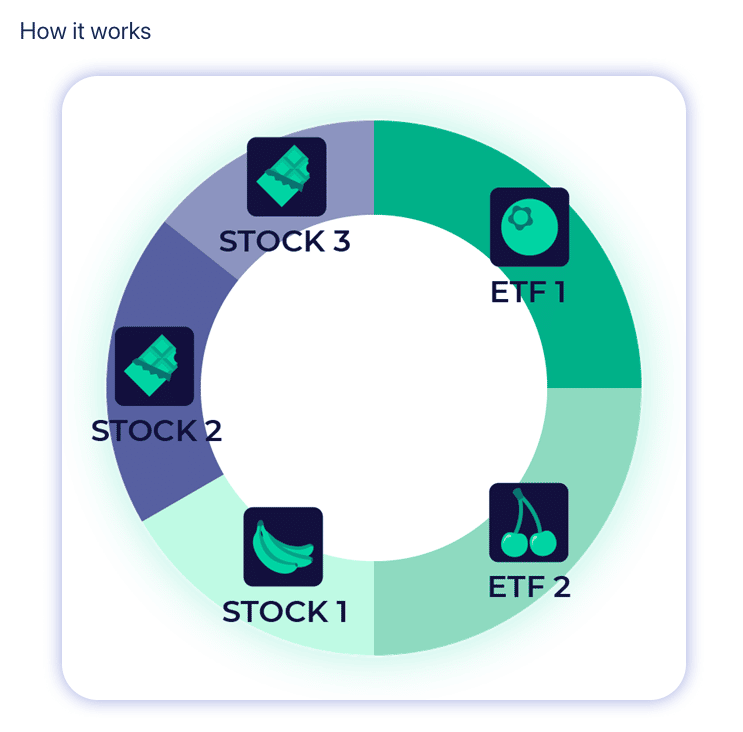
    M1 Finance uses a unique investment vehicle referred to as “Pies.” These are custom-designed portfolios that you can fill with up to 100 individual stocks and exchange-traded funds.

    M1 Finance Investment Pies
    M1 Investment Pie

    You can hold most of your money in a pie with three or four different S&P 500 index funds. But if you want to diversify beyond the S&P 500, you can also set up additional pies, focus on different indexes, or choose your own individual stock holdings.

    Once you create your pies, M1 Finance will manage them for you. That includes periodic rebalancing to maintain target allocations. And there is no fee charged for this service.

    You can open an account with M1 Finance with no money at all, though you will need at least $100 to begin investing (or $500 for retirement accounts). Available accounts include individual and joint taxable brokerage accounts; traditional, Roth, rollover, and SEP IRAs; and trust and custodial accounts. Learn more in our M1 Finance review.

    Should You Buy Individual Stocks and Create Your Own S&P 500 Index?

    There’s no denying that platforms like M1 Finance, Robinhood and other alternatives give you a low cost and simpler way to create your own index fund, it doesn’t necessarily mean you should.

    Even with nifty rebalancing options, you still have to go through the process of buying ALL 500 individual stocks.

    And when a stock is removed from the index, you’ll need to replace it and the rebalance your portfolio.

    It’s a lot of work that I don’t think offers enough upside reward.

    Can You Just Invest in the S&P 500?

    Some investment advisors recommend investing all or most of your money in the S&P 500. The recommendation is especially common for younger investors.

    The theory is that you can afford to be 100% invested in stocks – or something close to it – because even if the market falls, you’ll have several decades to recover.

    While I understand the reasoning behind both recommendations, I don’t necessarily agree, at least not in all cases.

    It’s never a wise idea to hold your entire portfolio in a single asset or fund, even if it’s performing very well, as the S&P 500 has for most of the past decade.

    But there’s no guarantee that the trend will continue.

    Meanwhile, your portfolio should include positions in fixed-income investments, like government and corporate bonds, cash, and cash equivalents. These positions will not only reduce the negative impact of a decline in the stock market but will also help you to maintain liquidity, so you can increase your stock position after a big market selloff.

    The best strategy may be to hold most of your stock position in the S&P 500 and diversify into other stock sectors and international markets, along with bonds and cash.

    What Is the Best Way to Invest in the S&P 500?

    Earlier, I listed the three largest ETFs and mutual funds invested in the S&P 500 index. Given that these are the largest S&P 500 index funds and commonly held in professionally managed portfolios, each represents a popular way to invest in the index.

    The table below provides a breakdown of the most important details of each of those six funds:

    Fund / Feature Fund type Minimum investment Expense ratio 1 Year Return 5 Year Return 10 Year Return
    Vanguard 500 Index Fund Admiral Shares (VFIAX) Mutual fund $3,000 0.04% -15.51% 9.20% 11.66%
    Vanguard Institutional Index Fund Institutional Plus Shares (VINIX) Mutual fund $5 million (as the name implies, this fund is designed for institutions) 0.04% -15.50% 9.21% 11.67%
    Schwab S&P 500 Index Fund (SWPPX) Mutual fund No minimum 0.02% -15.49% 9.21% 11.64%
    SPDR S&P 500 ETF (SPY) ETF $1 for a fractional share 0.945% -15.53% 9.09% 11.56%
    iShares Core S&P 500 ETF (IVV) ETF Not indicated 0.03% -15.50% 9.20% 11.66%
    Vanguard S&P 500 ETF (VOO) ETF No minimum 0.03% -15.39% 9.23% 11.68%

    As you can see, the six funds are very similar, especially their one, five, and ten-year performance numbers. And except for the SPY, each has an expense ratio well below 0.10%. The main difference is that the VFIAX has a minimum initial investment of $3,000, while four funds have either no minimum requirement or very little.

    Any of these funds (except the VINIX with its $5 million minimum requirement) will be a suitable way to invest in the S&P 500 index.

    You can invest in any of these funds through the fund family (Vanguard, Schwab, SPDR, or iShares) or a discount broker. But be aware that while brokers typically charge no commissions on buying and selling ETFs, many still charge fees for mutual funds. Therefore, you should favor ETFs if you’re investing through a broker.

    How Much Does the S&P 500 Return Each Year?

    The average annual return on the S&P 500 was 9.4% between 1972 and 2021. During that 50-year timeframe, the index provided positive returns in 40 years, with losses in the remaining 10.

    The performance has been even more impressive for the 10-year period from 2012 through 2021. During that decade, the average annual return on the S&P 500 was nearly 14.8%.

    But it’s always important to remember that these statistics represent averages. You shouldn’t expect to earn 9.4% in any given year, though the return may average that over a decade or more. Along the way, expect years when the index will return more than 20% – or lose more than 20%.

    Therefore, investing in the S&P 500 index is best used as a long-term strategy.

    Final Thoughts on Investing in the S&P 500

    There’s little doubt the S&P 500 has become the go-to stock market investment. For that reason alone, it should represent the largest stock position in your portfolio. But diversification should never be overlooked, so be sure to hold smaller allocations in other stock sectors and cash and bonds.

    [ad_2]

    Source link
  • 5 Ways to Make it Happen

    5 Ways to Make it Happen

    [ad_1]

    Could you turn $0 to $10,000 within a year? If you’re willing to put in the work, there are ways to do it.

    With most $0 to $10,000 challenges you find online, participants usually look for “free stuff” they can sell or trade. From there, they invest time and energy into “trading up” to better stuff that can make money, or they create a business strategy that helps them grow their initial cash into something bigger.

    If I were to try to grow $0 to $10,000, I would start with proven strategies, including the easy ones everyone should be doing! Most of all, I would focus on the steps I have used to build wealth for my family.

    Here are five steps almost anyone could take to grow $0 into $500, which can turn into $5,000, $10,000, or more within a year. And yes, I include plenty of examples to help you get started.

    Step 1: Get Free Stock

    When turning $0 into $10,000, you need to start with something of value you can get for free. Free stock promotions are an excellent way to do that, and some of the best promos come from two popular investing apps – Robinhood and Webull.

    Robinhood Free Stock Promo

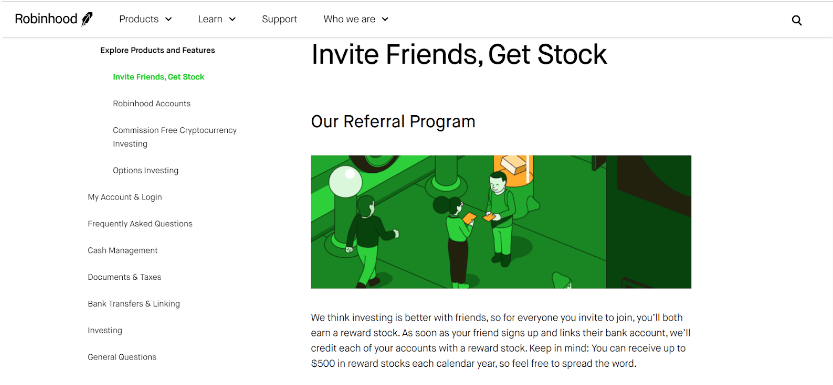
    With Robinhood, you can get a free stock worth $3 to $225 after opening an account and fulfilling its conditions. Just keep in mind this promotion is only available for new customers.

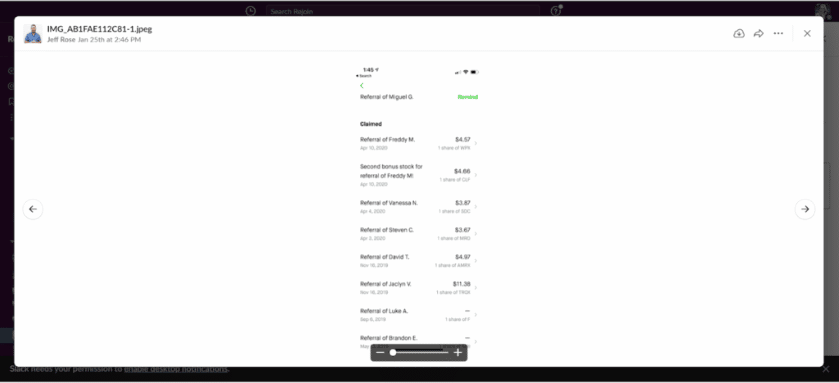
    Also, remember that your stock will likely be worth on the lower end of the promised range. Robinhood says about 98% of the free stock they give out is worth $3 to $10, which is what I have found from personal experience and in the screenshot from my Robinhood account below:

    But free is still free. You can also refer friends to get more free stock from Robinhood (see my own example in the above image). You can get up to $500 in referral stock within a year, and your free stock will fall within the same general rate of $3 to $225 per share.

    Webull Referral Program Screenshot

    By combining these promotions, you could easily get one free stock for opening an account, then refer 20 friends and get 20 more shares. Even if the average price of each stock you received were only $5, you would accumulate $105 in wealth.

    Webull Free Stock Promo

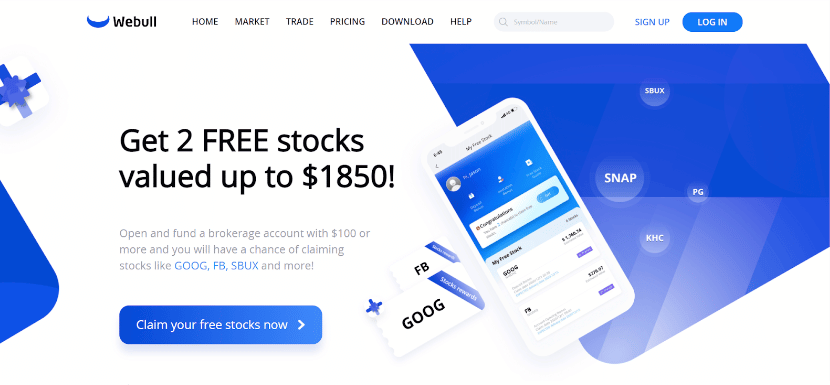
    With Webull, you can get two free stocks valued up to $1,850 when you open an account and fund it with $100. While you might not have the $100 in cash right away, you can start with Robinhood and build up your $100 in seed money.

    Webull Free Stock Promo Screenshot

    You can also get a free stock worth $2.50 to $250 just for opening an account – even if you don’t fund it.

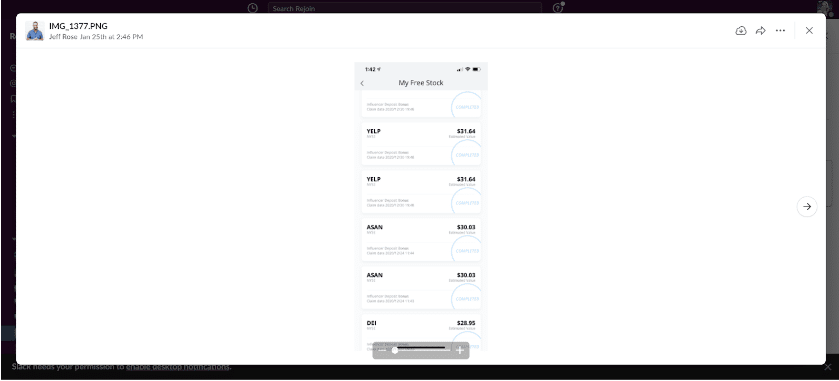
    Even better, Webull lets you refer friends and get THREE free stocks, each worth $12 to $1,400. In reality, though, many of the stocks I have received are worth around $30. Here’s an example using my personal Webull account:

    Jeff Rose Webull Account Screenshot

    The results: You can easily combine Robinhood and Webull promotions to earn hundreds of dollars in free stock, which you can use to begin your journey to $10,000. And since this stock is free, why wouldn’t you?

    Step 2: Retail Arbitrage

    Retail arbitrage is a great way to make money fast, but it can also be a key step in your journey to $10,000. Also referred to as product flipping, retail arbitrage involves buying products at a low price and then reselling them for a profit.

    There are many ways to make money with retail arbitrage, including shopping for antiques, at thrift stores, or find hidden gems at garage sales in your area.

    Jason Butler of My Money Chronicles has had success with retail arbitrage, starting most of his deals at thrift stores. He hunts for brand-name clothing at bargain prices, but he also looks for other stuff that sells well. He then resells most of the items on eBay. 

    His eBay top sellers include sports jerseys, bobbleheads, coffee mugs, board games, vintage sweaters, and blank VHS tapes. Butler says he has no idea why blank VHS tapes sell so well, but he focuses on profits and doesn’t spend too much time trying to figure it out.

    Of course, Butler goes out of his way to look for sneakers, his #1 resale item. He says he buys sneakers as cheaply as he can find them, and sometimes he’ll devote some energy to cleaning them up. His best-selling brands are Jordans, Kobe Bryant’s, and Hoka One One. As a side note, Butler has an eBay course that can help you learn how to flip items for profit: 

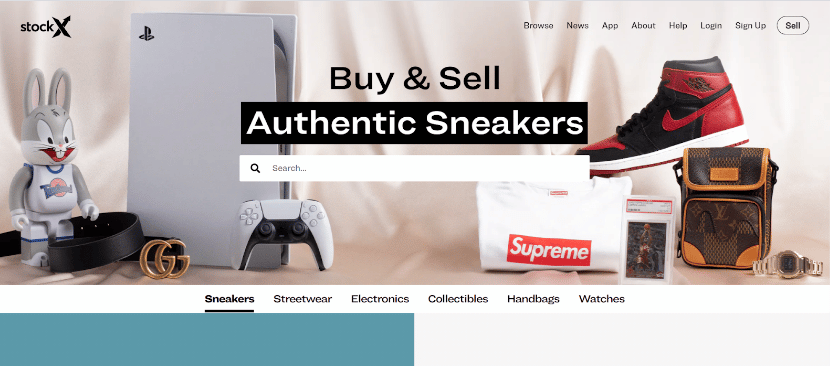
    I know for a fact that sneaker flipping works! I have bought a lot of sneakers and resold them on StockX for hundreds of dollars more than I paid. 

    Stock X Landing Page Screenshot

    The results: Retail arbitrage is something anyone can do, and you can easily turn hundreds of dollars into thousands if you find the right items. The key is knowing what sells and finding it at a rock-bottom price.

    Step 3: Start a Side Hustle

    Another way you can build up $10,000 is by starting a side hustle. I’m not talking about your ordinary, run-of-the-mill part-time job, although that works too.

    If you prefer a flexible schedule and own a reliable vehicle, consider picking up a side gig driving for Uber or Lyft or delivering food for DoorDash. You could even deliver groceries using an app like Instacart, or you could run errands and assemble furniture with an app like TaskRabbit.

    You can sell your services as a freelancer if you have a particular skill that translates to the online marketplace. Websites like Fiverr.com and Upwork let you advertise your services to potential clients worldwide. The more specialized your skill, the more money you can make.

    Fiverr Seller Screenshot

    Here are just some of the services you can promote through Fiverr or Upwork:

    • Social media management
    • Graphic design
    • Freelance writing
    • Resume writing
    • Editing
    • Video editing
    • Voiceover work
    • Logo design

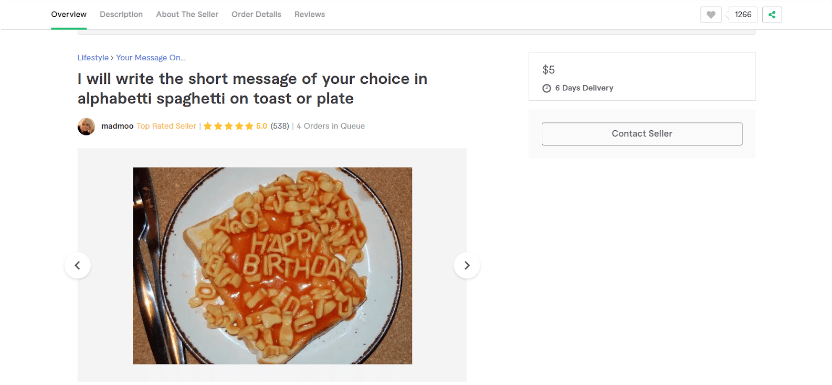
    And that’s not all! There are also plenty of “weird” skills people pay for on Fiverr. Here’s a gal who will spell out a name in spaghetti and take a picture for $5 – that’s all she does.

    Fiverr Weird Skills Screenshot

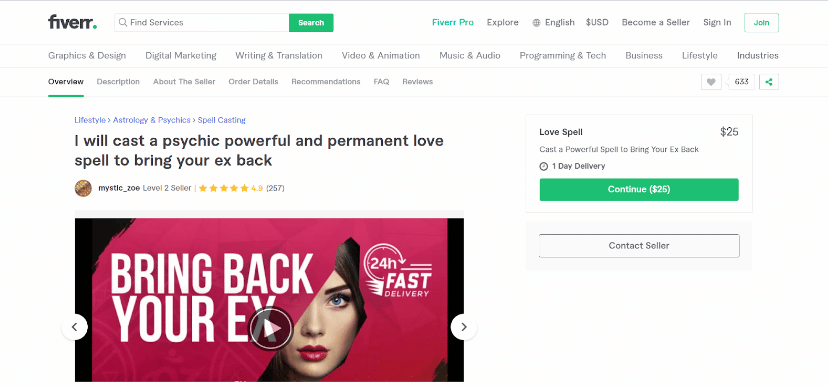
    Or how about the lady who says she will cast a spell to bring your ex back for $25? 

    Fiverr Bring Your Ex Back Screenshot

    I couldn’t make this stuff up if I tried!

    While Fiverr was designed to offer small gigs for $5 each, you can charge a lot more than that – especially if you’re experienced.

    The results: The examples above prove that just about anyone can find something to do to make extra cash. The right side hustle alone could make $10,000, or you could use it to build enough cash to invest in a larger project.

    Step 4: Build a Niche Website

    Once you have some money to get started, starting a niche website is a great way to build passive income. Most people have heard it’s possible to earn money blogging, but building a website that focuses exclusively on a single (and profitable) topic can also work.

    Take my niche website, LifeInsurancebyJeff.com, as an example. My life insurance website has made $100,000 in 9 months, sometimes more than that. 

    That said, you can build a niche website in any niche. Just try to think of a topic you’re passionate and knowledgeable about, as well as one where it’s easy to recommend products and services. Some examples of niche websites include:

    Swim University — a site that sells hot tub and pool supplies

    Avocadu — a site that sells supplements to yoga fans

    Nichehacks — a site about niche websites

    No matter which topic you decide to dive into, you can monetize your niche website using affiliate marketing, ads, sponsorships, and more. My guide on How to Make Money Blogging explains all the different ways you can make money with a niche site, including examples.

    The results: A niche website can help you make hundreds or thousands of dollars annually. The best part is that many of the various income streams you can use are passive in nature. This means you can set up the income stream once, tweak it periodically, and watch the money roll in – yes, even while you sleep.

    Step 5: Create a Course or Challenge

    As your confidence grows with earning income, consider creating a digital product or freebie that brings in money through related sales. You could create a course that helps people learn a specific skill or create a challenge that translates into income later on.

    I have used all of these strategies in the past. First, I created an online course for financial advisors, which helps new advisors learn how to build an online presence and grow their client base.

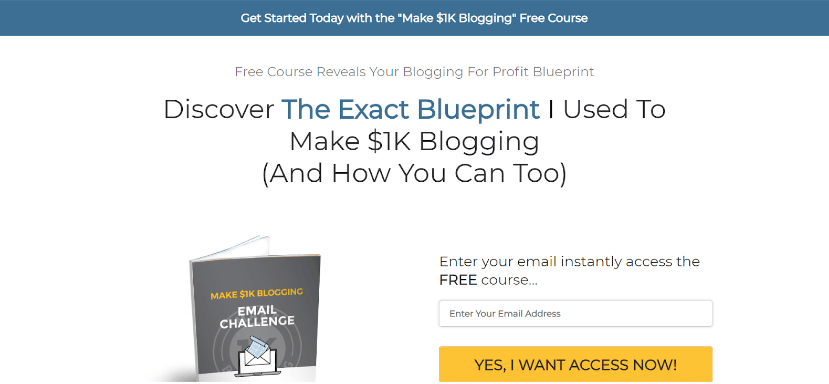
    I also have a free challenge, which is known as the Make $1K Blogging Challenge.

    Make $1K Blogging Course Screenshot

    You probably noticed that this is a free email course, but you have to dig a little deeper than that. People who sign up for the challenge give me their email addresses, which I use to move them into my email funnel and sell them other products.

    I have a $7 add-on to the free course that sells like crazy! While $7 may not sound like a lot, the key here was creating this product and selling it repeatedly. And believe me, $7 can add up fast when you sell thousands of the same thing 24 hours a day.

    Maybe you’re a subject matter expert or someone with a specific skill to teach. 

    For example, someone I know named Tela Holcomb has a ton of different online courses that teach people how to make money through investing. Her popular “Trade Your 9 to 5” course aims to help you quit your regular job and become a profitable day trader, and she sells it for $1,800! That’s pretty sweet.

    Tela Holcomb Screenshot

    Then there’s Bobby Hoyt, who has a Facebook Side Hustle Course. Bobby learned to use Facebook ads to successfully market digital products and now teaches others to profit from his techniques in his course. 

    Facebook Side Hustle Course

    Bobby teaches you not only to use Facebook ads but also shows you how to turn your Facebook ad knowledge into a profitable side business. It’s an opportunity to learn a profitable skill, then use it to earn even more money by offering your services to others. 

    The results: While creating a course or an online challenge is much more advanced; almost everyone has something they can teach or share. And with the proper online training, you can easily make thousands of dollars per month – or even thousands of dollars per day.

    Turn $0 to $10,000: The Bottom Line

    By following the five money-making strategies I’ve shared, and a few of your own, it’s possible to turn $0 to $10,000 within one year. The best part is that you don’t have to wait, you can get started today. But remember – anything worth doing will take some hard work, and you’ll likely fail a few times along the way.

    But if you keep going, you’ll eventually find a few different ways to earn money that can grow over time. You might even spark an idea that leads to a home-based business, where you can eventually hire people to do the work for you. 

    Once you have the hang of it, there’s almost no limit to how much you can earn. 

    How do I know? I’m living proof.

    [ad_2]

    Source link
  • Real Estate Investing Made Easy

    Real Estate Investing Made Easy

    [ad_1]

    Real estate investing can be intimidating to new investors – you must search for the right property, obtain financing, purchase the property, and then find tenants. A lot can go wrong, from buying a property with structural issues to challenges with finding the ideal tenants. 

    Real estate investing takes work and can be risky, and many don’t have the time or risk tolerance to commit.

    Enter Roofstock, a real estate investing platform that helps you invest in single-family homes without leaving your home. Roofstock wants to help you become a real estate investor regardless of where you live. 

    About Roofstock

    Roofstock is working on building the world’s best real estate investing marketplace. The company was founded in 2015 by Gregor Watson, Gary Beasley, and Rich Ford, all having years of real estate experience. 

    Roofstock’s primary service is a marketplace that allows you to buy and sell single-family homes. The marketplace is free, giving anyone access to explore and browse properties. 

    The Roofstock Marketplace allows real estate investors to find essential information in one place, making informed investment decisions easier. The company touts that its mission is to make investing in real estate accessible and simple. 

    Roofstock has passed over $5 billion in transactions in more than 70 real estate markets. 

    What Does Roofstock Offer? 

    Roofstock offers three main programs, each differing based on how much money you want to invest and your experience with real estate investing

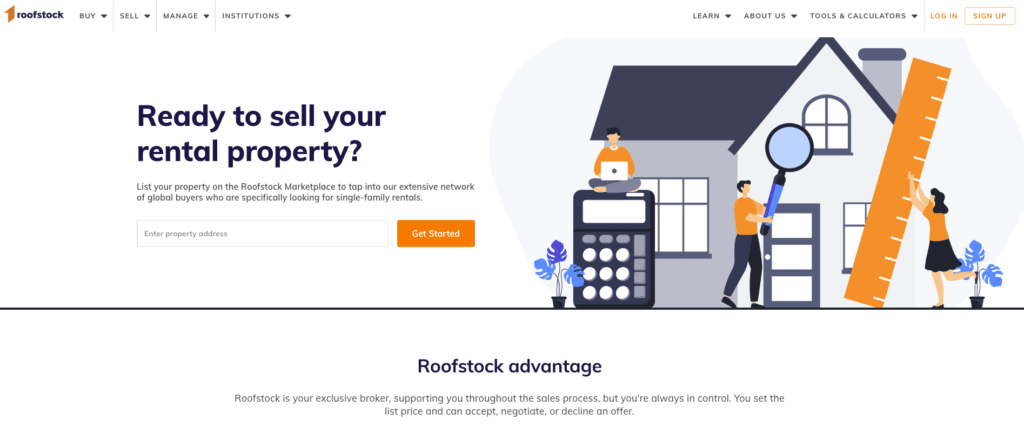
    Roofstock Marketplace

    This online marketplace is for buyers and sellers of investment properties and portfolios, and Roofstock vets its properties through a strict process. 

    This marketplace lists properties based on your preferred criteria, like location, neighborhood rating, listing price, and more. You can also find tenant-occupied investment properties here. It’s also worth noting that you can use the marketplace to sell your home and only pay a final 3% sale fee. 

    We go into detail on using the Roofstock Marketplace later in this review. 

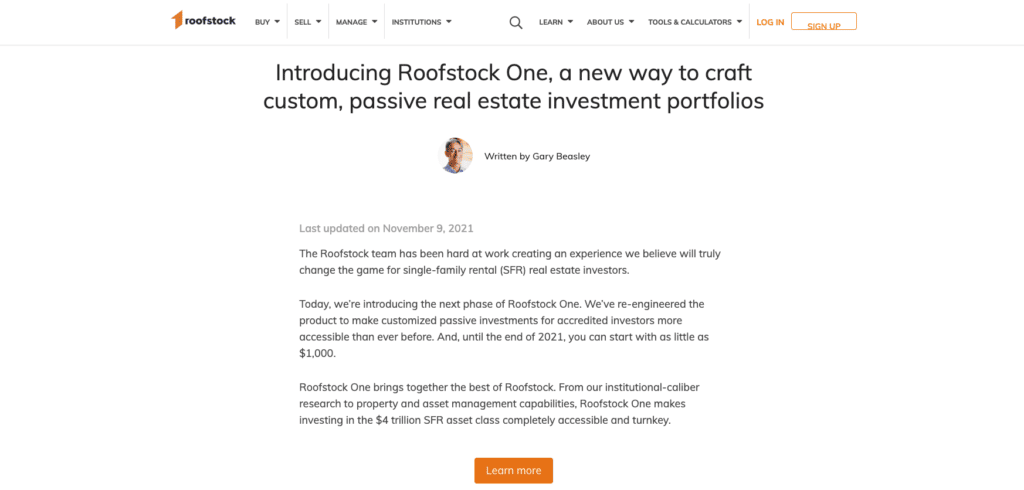
    Roofstock One

    Blogpost introducing Roofstock one

    Roofstock One is an option for accredited investors who don’t want to purchase an entire property. The minimum amount to get started is $5,000, and users can buy a 1/10th share of some of the properties on the marketplace. Roofstock One is ideal if you don’t want the burden of carrying the entire property loan alone. 

    Roofstock One provides two investment options:

    1. Tracking stock: Provides exposure to many properties and markets. 
    2. Common stock: Gives you broad exposure to all homes in the Roofstock One REIT.

    Both options will help you avoid the risks associated with home ownership, and you won’t have to worry about putting your name on a mortgage. Roofstock One allows investors to make personalized choices in their portfolio strategies, unlike traditional REIT investments

    It’s worth mentioning that these investments are highly illiquid, and there’s no secondary market for Roofstock One shares. It requires an investment horizon of at least five years, so you must be patient. 

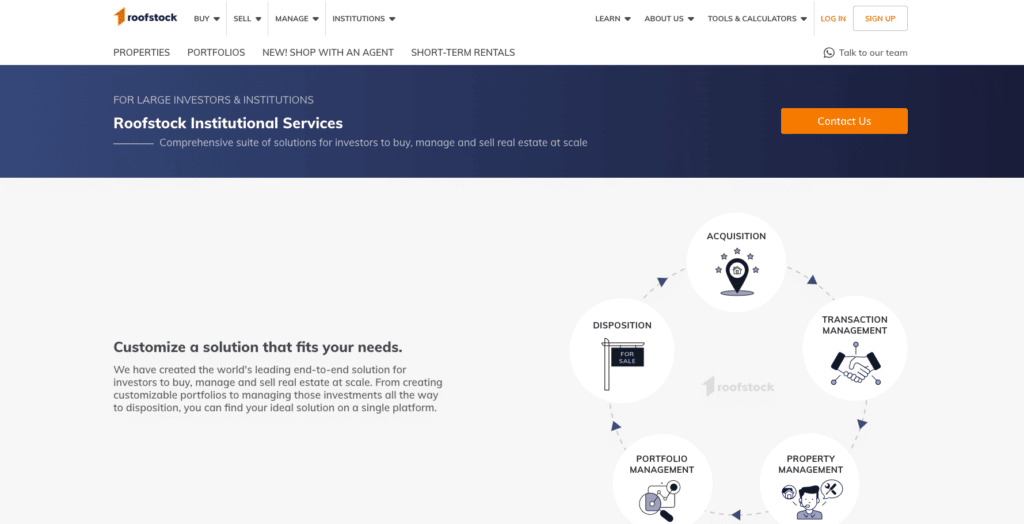
    Roofstock Institutional Services

    Screenshot of Roofstock Institutional services website landing page

    Roofstock Institutional Services is an end-to-end solution for investors with more capital who are looking to scale their portfolios. They offer these services for large investors and institutions and include the following benefits:

    1. Acquisition: This includes market analysis, underwriting, and rehab management. 
    2. Transaction management: You can receive local market information, offer management, and complete transaction services.
    3. Property management: This covers marketing, tenant relations, repairs, maintenance, and construction management.
    4. Portfolio management: You get reporting, accounting, oversight, and recommendations.
    5. Disposition: This covers strategy recommendation, a multi-channel exit strategy, and portfolio disposition. 

    Lets’ take a closer look at some other noteworthy services Roofstock offers its users:

    Retirement Accounts

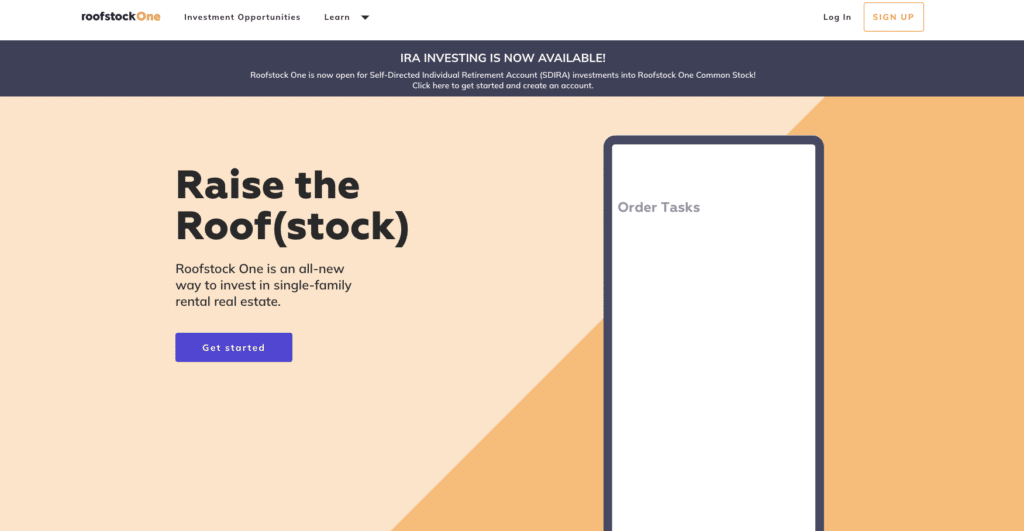
    Screenshot of RoofstockOne landing page

    You can invest in real estate through your retirement account with Roofstock’s partnership with New Direction Trust Company. Roofstock allows you to integrate your properties into a self-directed IRA. Once done, the IRA becomes the holder of your title report, meaning the income from your rental property becomes tax-deferred.

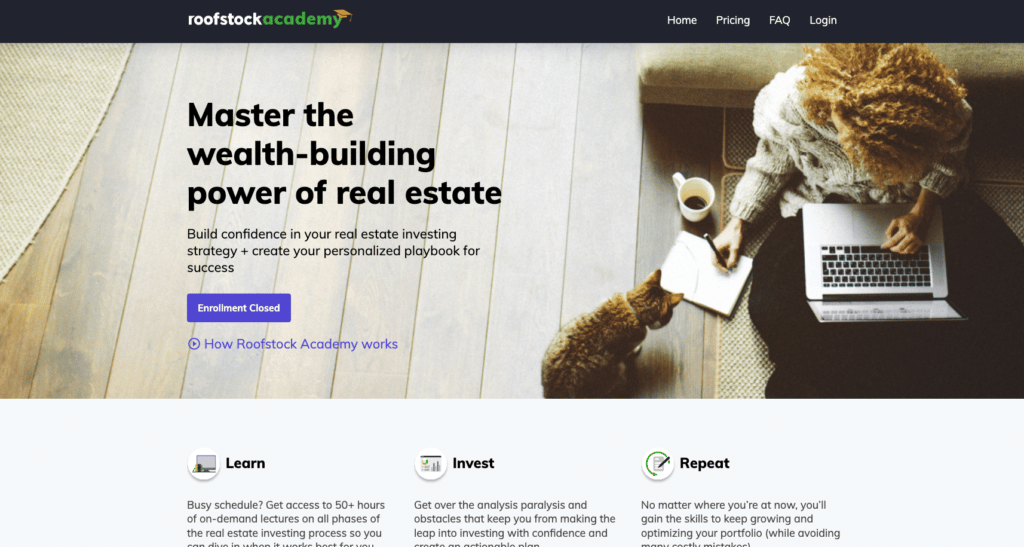
    Roofstock Academy

    Screenshot of Roofstock Academy landing page, depicting woman on a laptop

    Roofstock launched a course that teaches you everything you want to know about investing in real estate properties. The program’s goal is to have a one-stop resource for all real estate investors. There’s access to a private Slack group, coaching groups, and private coaching. 

    Roofstock claims that academy members have closed $45 million in real estate acquisitions on and off the Roofstock platform. There’s a money-back guarantee, but enrollment is presently closed. 

    While there’s no free academy tier, you can access the Roofstock blog for free. The blog covers topics ranging from inflation to REITs. 

    Shop with an Agent 

    Man watching a video on a laptop

    Roofstock has a curated network of agents who closed more than $50 million in real estate transactions in 2021. The new Shop with an Agent feature connects you with a certified agent who will help you decide on which property to invest in and how to make an informed offer. 

    This tool is worth considering if you’re new to real estate investing and want someone to guide you through the process. 

    How Does Roofstock Work? 

    If you want to get into real estate investing, Roofstock simplifies the entire process. You can browse properties on the Roofstock Marketplace without registering on the website. Simply click on the “Properties” tab to see the available homes. From there, you can filter your research by

    • Newly Listed 
    • Neighborhood rating
    • Best schools
    • Multiple units
    • Pre-inspection
    • Higher yield

    When you click on a specific property, you get detailed information about the investment to make an informed offer. 

    You can also decide how many Roofstock services you want to use. You can tap into Roofstock for financing and property management, or you can use the platform to find tenant-occupied investment properties on the other side of the country. With so many services offered, most investors can benefit from using Roofstock.

    Roofstock Pricing

    There are no fees to signup with Roofstock and browse properties on the Roofstock Marketplace. As mentioned in this article, if you close on a property, you will pay 0.50% of the contract price or $500, whichever is greater. When you sell a property through Roofstock, you pay a listing fee of 3% or $2500, whichever is greater. Remember to obtain an accurate valuation of your home before you list.

    Accredited investors will pay asset management fees of approximately 0.50% (and up) when they invest through Roofstock One.

    How to Get Started With Roofstock Marketplace

    Roofstock offers different options for property buyers and sellers. If you’re ready to invest with Roofstock, create your free account and begin your search. 

    Step 1: Search for your property.

    Custom filters allow you to find a property based on the price, expected return, location, and more. You can even sign up for alerts when a property that fits your criteria comes on the market. With thousands of properties listed on its marketplace, Roofstock will likely have something for everyone.

    Step 2: Analyze the property.

    Roofstock provides enough detailed information about the property to answer most questions you may have. The platform shares the following:

    • Floor plans and pictures: You can also get a 3D tour and curb view.
    • Property inspection and valuation: This includes the title report and an insurance quote so that you know exactly what you’re signing up for. 
    • Tools for figuring out the numbers: You can see how much of an initial investment you have to make, along with the total return. 
    • Current lease and tenant information: You know what kind of tenants you inherit. 
    • School and neighborhood ratings: You can get an accurate picture of the community you’re investing in.
    • Local options for property management services: You can use one of Roofstock’s property managers to handle everything and be a hands-off investor.

    Step 3: Make an offer. 

    You can submit an offer on Roofstock for free and not get charged any commission until your offer is accepted. The marketplace fee is either 0.5% of the contract price or $500, whichever is higher. 

    Roofstock provides an Open House feature where you get an exclusive look at properties on the platform. You’re allowed to review and submit an offer within the first 24 hours. 

    Step 4: Close the property.

    The service and transaction team from Roofstcok will work with you through escrow until the property is finally under your ownership. Once this process settles, you’re officially the rental property owner.

    Roofstock Advantages

    Over the years, many competitors have popped up in the online real estate investment space. Investors have more options than ever before, making it difficult to choose one platform over another. Here are some benefits of choosing Roofstock over competitors in the real estate space.

    Free to start

    You can browse properties for free on the Roofstock Marketplace, including the full inspection report and analysis of potential properties. Users can access all the information they want about the report, from the current lease to the detailed financials (like the down payment and the expected annual return). 

    Eliminates the stress of finding tenants

    Being a landlord can be stressful. Roofstock helps you find tenant-occupied properties, so you don’t have to worry about finding tenants. With tenant-occupied properties, you assume the lease agreement from the previous landlord, meaning you don’t have to worry about screening tenants or performing background checks. 

    The company also offers Vacancy Protection for single-family rentals operated by Roofstock-partnered property managers. This guarantee promises that if you cannot find a tenant within 45 days, the company will pay 75% of the market rental rate for up to six months or until a new tenant is found. 

    Offer detailed inspections and reports

    There’s plenty of uncertainty that comes with investing in property. You either must spend the money on a full property inspection or purchase as-is if the real estate market is hot enough. 

    With Roofstock, you get detailed reports on the home’s standing, so you know what you’re getting yourself into, and you won’t have to fly out to see the property in person. 

    Simpler financing for rental properties

    Roofstock makes it easy for investors to research financing options. You can have a list of quotes from numerous third-party lenders by providing a little information, like credit score, target property price, loan terms, and down payment percentages. 

    Roofstock Alternatives

    At the moment, Roofstock is unique in allowing non-accredited investors to buy and sell tenant-occupied residential real estate properties for a fraction of the cost of going through regular channels. There are hundreds of homes listed on the Roofstock marketplace.

    But Roofstock One, which lets investors buy into portfolios of single-dwelling residences, is only available to accredited investors. Fundrise and RealtyMogul are two Roofstock alternatives worth considering if you’re looking for a REIT-style investment option.

    Fundrise

    With Fundrise, you can invest in residential and commercial real estate portfolios, starting with a minimum investment of $10. Unlike publicly-traded REITs, Fundrise portfolios are privately held. While they’re not exposed to natural market volatility, they are less liquid than traditional REITs. Fundrise charges an annual fee of 1% of your overall portfolio value, which is reasonable for the asset class. Learn more in our Fundrise review.

    RealtyMogul

    Los Angeles-based RealtyMogul gives non-accredited investors access to a REIT portfolio with a minimum investment of $5000. At the time of this writing, you can invest in the RealtyMogul Income REIT or the RealtyMogul Apartment Growth REIT. In addition, RealtyMogul allows accredited investors to invest in private placements. RealtyMogul fees are similar to Fundrise, at 1 to 1.25%. For more information, check out our RealtyMogul review.

    What Are The Pros and Cons of Roofstock? 

    Pros

    • Roofstock does all of the research for you, saving time
    • Investment properties often already have tenants
    • Competitive transaction fees
    • Roofstock Marketplace is available to non-accredited investors

    Cons

    • REIT option is limited to accredited investors (Roofstock One)
    • Investment is illiquid. Buying a property will hold up your capital
    • The Roofstock Marketplace can be competitive, mainly as more people use it

    Is Roofstock For Me?

    The Roofstock Marketplace is ideal for real estate investing beginners looking for a straightforward way to get started buying or selling individual real estate. Roofstock is affordable, easy to understand, and shares all the relevant property information with you.

    On the flip side, if you’re interested in real estate crowdfunding options as a non-accredited investor, Fundrise or RealtyMogul will be more suitable than Roofstock One, which is open to accredited investors only.

    Investing in real estate can be intimidating, especially when you’re doing it from a distance. It helps to use a trusted platform that does the vetting for you.

    [ad_2]

    Source link