The New U.S. House Version of KOSA Doesn’t Fix Its Biggest Problems

An amended version of the Kids Online Safety Act (KOSA) that is being considered this week in the U.S. House is still a dangerous online censorship bill that contains many of the same fundamental problems of a similar version the Senate passed in July. The changes to the House bill do not alter that KOSA […]

Continue Reading

Unveiling Venezuela’s Repression: Surveillance and Censorship Following July’s Presidential Election

The post was written by Laura Vidal (PhD), independent researcher in learning and digital rights. This is part one of a series. Part two on the legacy of Venezuela’s state surveillance is here. As thousands of Venezuelans took to the streets across the country to demand transparency in July’s election results, the ensuing repression has […]

Continue Reading

The push to connect a digitally divided world and counter AI threats

Earlier this year, an audience in a Geneva conference hall sat captivated by a video screen carrying live pictures of a 25-year-old man in Portugal suffering from ‘locked-in syndrome’, a devastating neurological disorder that causes patients to lose control of their body; some two years after contracting the condition, he was unable to move or […]

Continue Reading

NextNav’s Callous Land-Grab to Privatize 900 MHz

The 900 MHz band, a frequency range serving as a commons for all, is now at risk due to NextNav’s brazen attempt to privatize this shared resource.  Left by the FCC for use by amateur radio operators, unlicensed consumer devices, and industrial, scientific, and medical equipment, this spectrum has become a hotbed for new technologies […]

Continue Reading

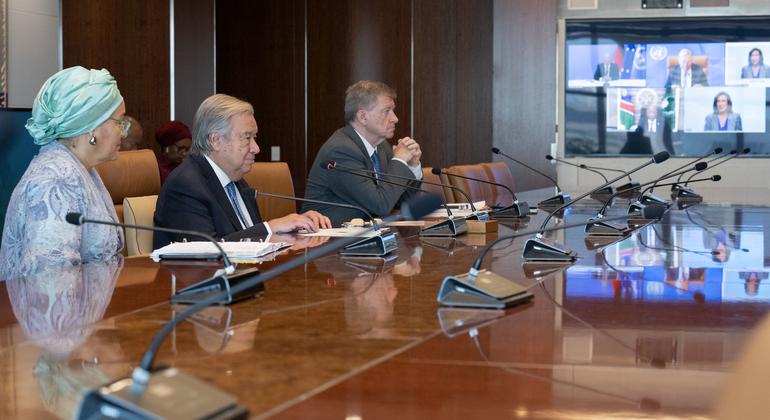
Summit of the Future: ‘Critical’ opportunity for safer, more sustainable and equitable world

“We need greater global solidarity today and with future generations, better management of critical issues of global concern and an upgraded United Nations that can meet the challenges of a new era,” he said at the Summit of the Future Global Call event, emphasising that current institutions can not keep up with the changing times. […]

Continue Reading

We Called on the Oversight Board to Stop Censoring “From the River to the Sea” — And They Listened

Earlier this year, the Oversight Board announced a review of three cases involving different pieces of content on Facebook that contained the phrase “From the River to the Sea.” EFF submitted to the consultation urging Meta to make individualized moderation decisions on this content rather than a blanket ban as the phrase is a historical […]

Continue Reading

Britain Must Call for Release of British-Egyptian Activist and Coder Alaa Abd El Fattah

As British-Egyptian coder, blogger, and activist Alaa Abd El Fattah enters his fifth year in a maximum security prison outside Cairo, unjustly charged for supporting online free speech and privacy for Egyptians and people across the Middle East and North Africa, we stand with his family and an ever-growing international coalition of supporters in calling […]

Continue Reading

South-south cooperation can help solve ‘complex development context’

Speaking to UN News ahead of the International Day of South-South Cooperation, Dima al-Khatib, Director of the UN Office for South-South Cooperation, explained the transformative power of solidarity among developing countries.  UN News: Why is south-south cooperation so important?   Dima al-Khatib: Nowadays the countries of the South are grappling with a multitude of complex development issues. […]

Continue Reading

Stopping the Harms of Automated Decision Making | EFFector 36.12

Curious about the latest digital rights news? Well, you’re in luck! In our latest newsletter we cover topics including the Department of Homeland Security’s use of AI in the immigration system, the arrest of Telegram’s CEO Pavel Durov, and a victory in California where we helped kill a bill that would have imposed mandatory internet […]

Continue Reading

Weak Human Rights Protections: Why You Should Hate the Proposed UN Cybercrime Treaty

The proposed UN Cybercrime Convention dangerously undermines human rights, opening the door to unchecked cross-border surveillance and government overreach. Despite two and a half years of negotiations, the draft treaty authorizes extensive surveillance powers without robust safeguards, omitting essential data protection principles. This risks turning international efforts to fight cybercrime into tools for human rights […]

Continue Reading