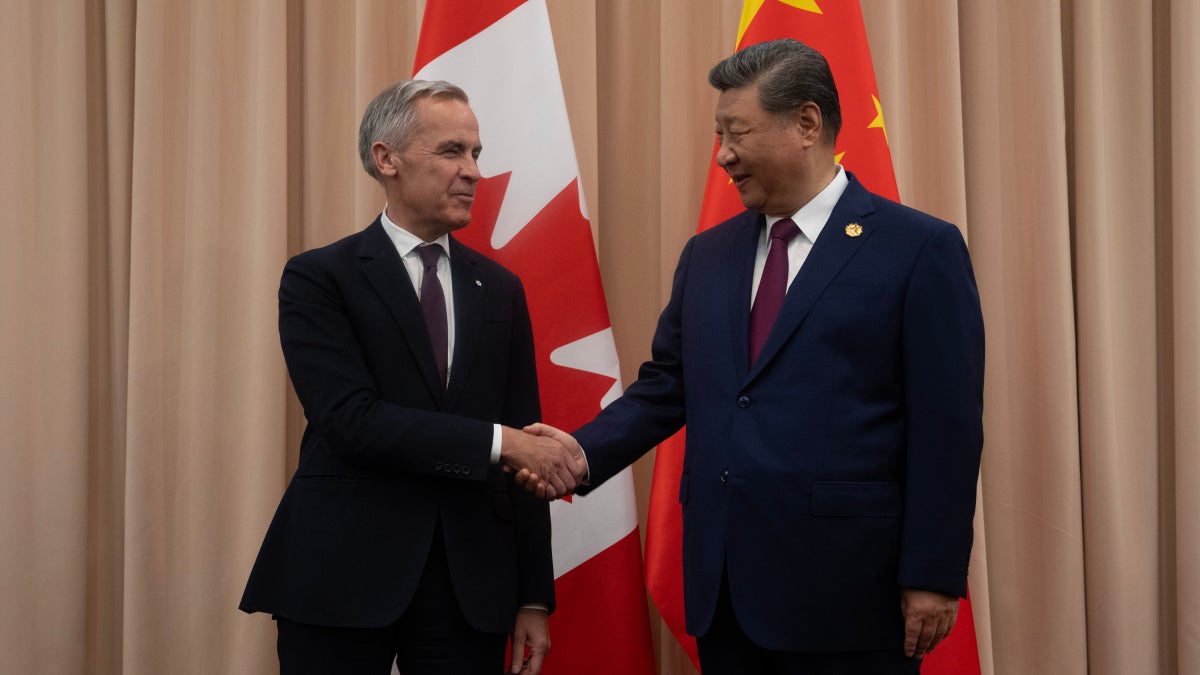
(Ottawa) – Canadian Prime Minister Mark Carney should make human rights a key focus of his visit to China from January 13 to 17, 2026, Human Rights Watch said today. Carney’s trip to China is the first by a Canadian prime minister in more than eight years. Canada-China relations have been strained in recent years as Chinese President Xi Jinping has intensified repression both inside China and abroad. The Chinese government unlawfully detained two Canadians as hostages between 2018 and 2021 to pressure the Canadian government to free an executive of the Chinese tech giant Huawei.
“Prime Minister Carney should recognize that the Chinese government’s deepening repression threatens not just the rights of people in China but, increasingly, Canada’s core interests and values,” said Maya Wang, deputy Asia director at Human Rights Watch. “Carney should ensure that engagements with the Chinese government on trade and security are consistent with Canada’s values, which includes the promotion of human rights.”
Key issues Carney should raise include links between the Chinese government’s forced labor and imports to Canada; the persecution and imprisonment of human rights defenders; and China’s targeting of critics abroad, including in Canada. Carney should also raise concerns about drones produced by China-based companies being sold to Russia and then used to attack civilians in Ukraine.
The Canadian government’s official statement announcing the visit said that it is part of Canada’s efforts to build economic resilience and to diversify from the United States, by “elevating” Canada-China “engagement on trade, energy, agriculture, and international security.” There was no mention of human rights.
The Chinese government’s rights violations have a direct impact on many issues of national interest to Canada, Human Rights Watch said.
Canadian law prohibits importing products produced wholly or in part by forced labor. There is extensive and consistent documentation of Chinese state-imposed forced labor involving ethnic Uyghurs and other Turkic Muslim communities in China’s cotton, automotive, solar, and critical mineral supply chains. There is evidence that some firms linked to forced labor in Xinjiang, a predominantly Muslim Uyghur region, ship products to Canada. The United Nations, Human Rights Watch, and other organizations have for several years reported on crimes against humanity by Chinese authorities in Xinjiang.
Carney should press the Chinese government to end its repression in Xinjiang and ensure full compliance with international labor rights conventions that China recently ratified, including International Labour Organization (ILO) Convention No. 29 on forced labor and ILO Convention No. 105 on state-imposed forced labor.
The Chinese government’s labor rights abuses extend beyond the Uyghur region, Human Rights Watch said. Its laws prohibit independent labor unions, and it detains and imprisons labor activists, cracks down on labor protests, and has shuttered labor monitoring organizations in Hong Kong.
“Canadians shouldn’t have to worry about purchasing products tainted by forced labor,” Wang said. “Pressing Beijing to ensure that businesses respect workers’ rights protects Canadian consumers.”
In Hong Kong, where an estimated 300,000 Canadians live, the Chinese government has largely dismantled freedoms of expression, association, and assembly; free and fair elections; fair trial rights; and judicial independence. In December, 2025, Jimmy Lai, founder of the now-defunct Apple Daily, was found guilty under Hong Kong’s draconian national security laws. He faces a sentence of up to life in prison. Carney should press for Lai’s immediate release.
China has also increasingly carried out cross-border abuses—known as transnational repression—to oppress critics of the government abroad, including residents and citizens in Canada. In one case, the Chinese government harassed a Canadian political candidate and a China critic during an election campaign. While Canadian officials have spoken out about some cross-border abuses, Carney should show that his government is taking transnational repression seriously by raising the issue directly with President Xi.
Human Rights Watch in June documented Russia’s use of commercial drones produced by China-based companies to attack civilians in Kherson, Ukraine. Carney should press the Chinese government to ensure that these drone companies prevent sales to sanctioned entities and cooperate with investigations into unlawful attacks on civilians in Ukraine.
“The Chinese government’s abuses fall hard on the people of China, but they also affect people around the world,” Wang said. “During his visit, Prime Minister Carney shouldn’t squander his opportunity to use diplomatic channels to raise human rights concerns.”