The Toll of Mutual Escalation
LONDON / NEW YORK — As global markets reel from the latest disruptions in the Strait of Hormuz, The Elders—an independent group of global leaders—issued a definitive warning on Wednesday, March 18, 2026, against the erosion of international law. Chaired by Nobel Laureate Juan Manuel Santos, the group described the ongoing military exchanges between the U.S.-Israeli coalition and Iran as a “cycle of unlawful strikes” that threatens to destabilize the global economy and the very foundations of the UN Charter.
The statement highlights a growing crisis of “strategic hypocrisy,” where Western leaders are accused of invoking international rules only when politically convenient.
The “Double Standard” of Conflict
The Elders, including former UN High Commissioner for Human Rights Mary Robinson, pointed to a dangerous inconsistency in how global aggression is categorized.
- Selective Justice: The group criticized the UN Security Council for a recent resolution that condemned Iranian retaliatory strikes while remaining silent on the initial U.S.-led bombardment of Iranian soil.
- The Ukraine Parallel: Western leaders who rightly condemned Russia’s 2022 invasion of Ukraine are now “hesitating” to apply the same legal scrutiny to U.S. and Israeli actions, a move The Elders claim is “eroding trust across the Global South.”
- A “Lawless” Sea: The leaders warned that acquiescing to U.S. demands to assist in military operations in the Strait of Hormuz risks drawing sovereign nations into an “illegal war” without a clear exit strategy.
Nuclear Proliferation: The Risk of “The Wrong Message”
A primary concern raised by the group—including former Prime Minister of Norway Gro Harlem Brundtland—is that the current conflict may inadvertently accelerate nuclear ambitions.
- The Incentive to Arm: The Elders argue that striking a non-nuclear state while negotiations are ongoing sends a clear signal: that only nuclear possession offers true protection from external intervention.
- Stockpile Uncertainty: The group expressed grave concern over the “uncertainty” regarding the location and status of Iran’s stockpiles of highly enriched uranium, warning that military action could trigger a catastrophic proliferation event.
Internal Repression vs. External Aggression
While the statement took a firm stance against the Iranian regime’s history of “systematic violations” and its recent “bloody repression” of peaceful protesters, it was equally clear that these internal human rights failures do not grant a legal mandate for external military aggression.
“Military action will deliver neither peace nor justice,” the statement read. “Those who initiated this war are responsible for its consequences, but all leaders who believe in the rule of law must now put long-term stability above short-term considerations.”
Diplomatic Impact: A Divided Response
The intervention by The Elders—including Graça Machel, Helen Clark, and Denis Mukwege—comes as the U.S. “Saturday Ultimatum” passes and regional energy hubs, such as Fujairah, sustain damage.
While the White House has maintained its “defensive” justification for the strikes, the Elders’ statement has resonated with the BRICS+ nations and several EU member states who are increasingly wary of a protracted, “unlawful” conflict in the Gulf.
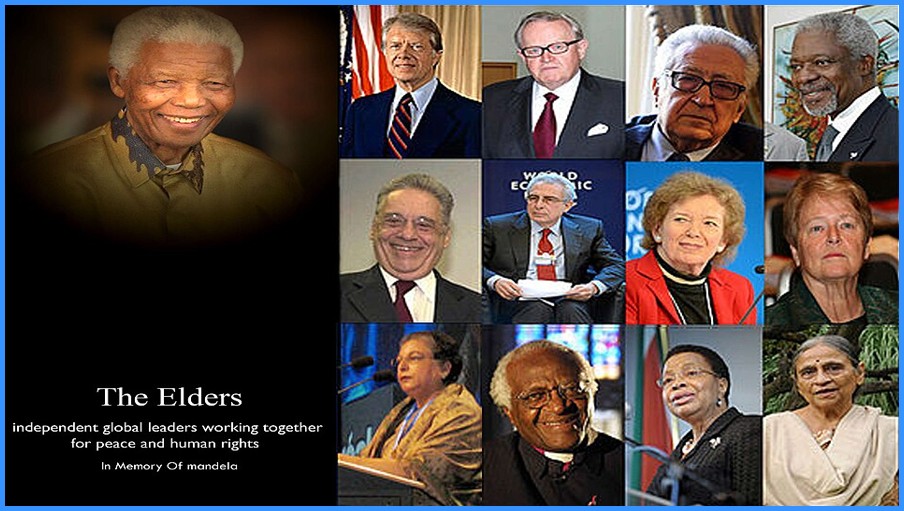
Montage of The Elders Picture by Nejebad on Wikimedia