Author: Ed Turner, Reader in Politics, Co-Director, Aston Centre for Europe, Aston University

  • Friedrich Merz confirmed as Germany’s chancellor – but betrayal by MPs in a secret ballot means he starts from a position of weakness

    Friedrich Merz confirmed as Germany’s chancellor – but betrayal by MPs in a secret ballot means he starts from a position of weakness

    [ad_1]

    Friedrich Merz has been confirmed as Germany’s new chancellor after a close shave left his future in doubt.

    Merz lost a first round of voting among MPs gathered to confirm his role, and may never know who among his own coalition betrayed him. After the shock of the morning vote, a second vote was called and whoever was blocking his path appears to have stood down.

    Merz’s CDU/CSU had struck a coalition deal with the social democratic SPD. Ministers were nominated and ready to take office and Merz’ election as chancellor was scheduled for the morning of May 6. But for much of the morning, this looked uncertain.

    Candidates for chancellor regularly fall short of the number of votes they’d expect to receive (from MPs in their own party and from their coalition partner), and there have been some close-run races, such as Helmut Kohl in 1994, who made it through by just one vote. But this was the first time a candidate has lost the vote.

    Merz fell dramatically short in the first round, receiving only 310 votes. That’s six below the overall majority he needed, and 18 below the number of MPs in his own CDU/CSU/SPD coalition. Germany’s constitution requires this ballot to be secret so we don’t know and may never find out who voted against Merz.

    In the second round of votes, hastily organised after Merz’s failure in the first, 325 votes, more than 316 required. There were 289 votes against, one abstention and three invalid votes.

    Merz will now hope the first vote can be dismissed as “false start” and that life will quickly move on.

    Why did this happen?

    There are four groups of MPs who might have, in secret, voted against Merz in the first round. It’s possible that all four were represented in the group – and we will never know for sure.

    The first is those CDU/CSU parliamentarians who were unhappy with Merz. In particular, just days after his election when he argued for balanced budgets, he pushed through a reform of Germany’s constitutional restrictions on government debt to allow extra defence and infrastructure spending. This irked fiscal hawks, some of whom may have decided to send him a message during the vote.

    The second is those CDU/CSU MPs who had hoped for ministerial office and missed out. The was inevitable, especially since Merz secured fewer cabinet positions than had been expected for his own party. The third group would be made up for SPD MPs who missed out on a ministerial post or were unhappy at choices of ministers.

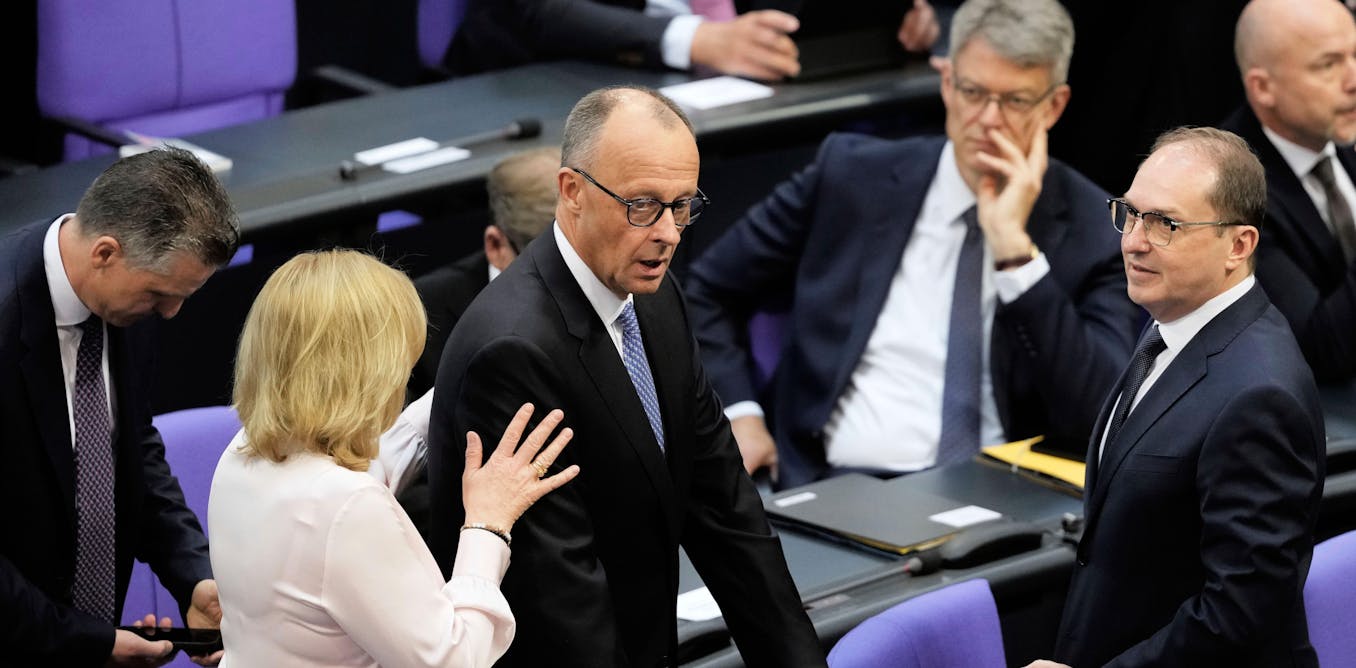
    Merz walks by members of the AfD in parliament during the vote.
    EPA/Clemens Bilan

    Fourth, suspicion will fall on some of the leftwing MPs who have policy disagreements with Merz. His decision to vote with the far-right AfD on immigration policy before the election caused great anger. There are internal SPD critics who feel the coalition agreement makes too many concessions to Merz, particularly on immigration.

    One message about the new government is clear: it had hoped to be more united than its predecessor, the three-party coalition which was frequently consumed by public quarrelling and in the end collapsed over budget policy. Those ambitions have fallen at the first hurdle.

    We should not overstate the risks to government stability. Most votes happen in public, not secret, so MPs are much more likely to tow the government line from here on. And chancellors have often governed with smaller majorities for an extended period.

    However, this debacle is a bad omen. If Merz turns things around quickly, this episode can be forgotten. But if he doesn’t this early blow to his authority will embolden the AfD, which will point to the apparent dysfunction of mainstream parties and capitalise on public dissatisfaction. Nor will this blow to Merz’s authority help him realise his ambition to show leadership in Europe.

    Merz’s poll standing was already weak, and these events risk causing further damage. His first days in the job will now be even more difficult than he expected.


    [ad_2]

    Source link

  • The results explained as Friedrich Merz comes out swinging for Europe

    The results explained as Friedrich Merz comes out swinging for Europe

    [ad_1]

    Friedrich Merz, the presumptive chancellor of Germany, has confirmed he will seek a coalition with the social democratic SPD after the Christian Democrats (CDU/CSU) won the February 23 election, topping the poll with 28.5%. Although the SPD has gone from winning the last election to a record low result of 16.4% of the vote, it remains the only credible coalition partner for presumptive chancellor and CDU leader Friedrich Merz.

    Among Merz’s first acts was a bold statement that his first priority is “to strengthen Europe as quickly as possible so that, step by step, we can really achieve independence from the USA”.

    Things might have looked different for Merz. Had a small party, (the Sahra Wagenknecht Alliance, or BSW) won just 0.03% less of the vote, Merz would have needed to find a third coalition partner. That would have most likely meant trying to work with the Greens. This would have been a much more difficult circle to square for the centre right and an option that would have come with a far greater risk of early government collapse, if a deal could even have been reached in the first place.

    The far right Alternative for Germany (AfD) had a record result, coming second with a 20.8% share of the vote. Mainstream parties including the CDU/CSU have ruled out any sort of deal with the far right, which the AfD will now be viewing as an opportunity. A further period of CDU/CSU-SPD government at a time of economic challenges will leave the party feeling it has a good opportunity to capitalise on discontent and grow further.

    The 2025 election saw a record low vote share for the CDU/CSU and SPD. It’s notable that none of the leaders of the one-time Volksparteien (“people’s parties” – with a cross-class, cross-society appeal) were popular. Merz fared best among them but on a scale of -5 to +5 for popularity, he achieved an average of precisely 0.

    Worse still was the situation of the centre-right FDP, which crashed out of the parliament on a grand scale, getting just 4.3%, down 7.1 points. Its leader, Christian Lindner, who had brought about the downfall of the previous “traffic light” coalition between his own party, the SPD and the Greens, announced his retirement from politics. The Greens, with a respectable result (11.6%, down 3.1 points), will prepare for a spell in opposition.

    The election shows a country disunited, a long way from being at ease with itself. Observers are immediately struck by the difference between eastern and western Germany. In the east, the far right Alternative for Germany (AfD) came first in all five states (excluding Berlin, which is a mix of east and west). In the west, with some exceptions, the CDU/CSU was dominant.


    Read more:
    These maps of support for Germany’s far-right AfD lay bare the depth of the urban-rural divide


    It has been evident for some time that concerns about migration as well as a feeling of being treated as second class citizens is driving up support for the far right in the east. Now, opposition to military support for Ukraine and general pessimism are also playing into the trend.

    Age proved another very significant divide. Among those aged 18 to 24, the Left party got 25%, ahead of the AfD (21%). The CDU/CSU took just 13% and the SPD 12% . Among the over 60s, the picture is reversed. The CDU/CSU took 37% and the SPD 23%, while the AfD took 15% and the Left just 5%.

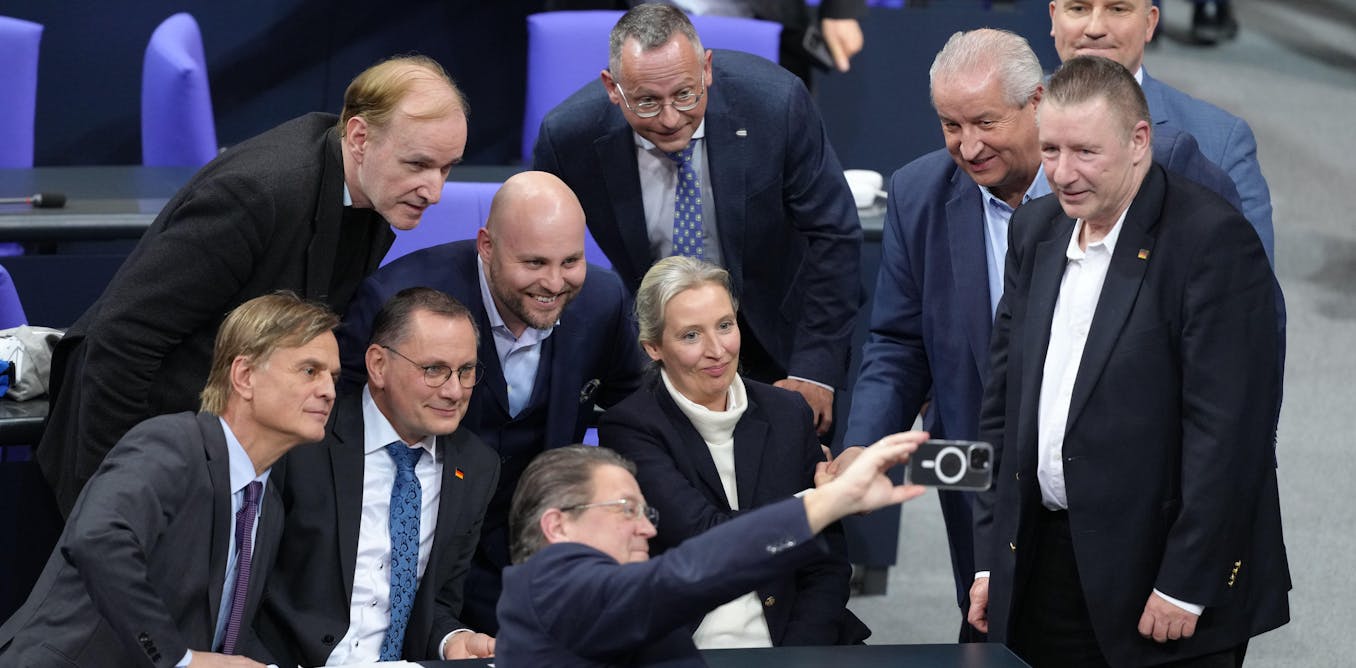
    The AfD is celebrating its best ever result and the chance to capitalise on being excluded from government.
    EPA/Christopher Neundorf

    The Left’s success, at least among the young, was the one big surprise of the election. After a torrid period which saw the departure of leading figure Sahra Wagenknecht and her followers to form a separate party, the Left looked unlikely to meet the 5% vote share threshold needed to enter parliament until very recently. An internal split over Israel and Gaza was also causing difficulties.

    However, the Left profited from the polarisation caused by Friedrich Merz’s decision to press ahead with a vote on hardline policies towards asylum seekers, including more border checks and turning away irregular migrants without processing an asylum claim. A savvy social media campaign spearheaded by the party’s youthful joint parliamentary leader Heidi Reichinnek also helped.

    Meanwhile, the BSW took just 4.97% of the national vote and will therefore not have any seats in parliament. It is however worth noting that the BSW’s popularity was also extremely uneven across the country and another example of geographical division. While it tanked nationally, its anti-migration, “anti-woke” and pro-welfare policies, mixed with its criticism of support for Ukraine, was a more popular offering in the east with results around the 10% mark, double the national average.

    What now for Europe?

    The SPD has claimed it will not enter government at any price. It has hinted it will put any coalition proposals to a vote among party members as a way of trying to exercise leverage over Merz. But, in truth, the party has nowhere else to go. There is no alternative to a CDU/CSU-SPD coalition apart from early elections or a fundamental rethink of the former’s approach to the AfD. Neither is an attractive prospect.

    All parties are also acutely aware of the tremendous pressure from other European countries for Germany to get its act together in the context of US president Trump’s assertiveness and the need to support Ukraine. But there are huge challenges to address on the domestic front. Merz has pledged tax cuts and higher defence expenditure, but there is no clarity at all how these will be paid for. Drastic reductions in welfare and other social expenditure would likely be a “no go” area for the SPD. An option might be to loosen Germany’s “debt brake” – constitutional restrictions on government borrowing. This is something Merz has been reluctant to do, but he has hinted he might consider it in the aftermath of the vote. This fundamental reform would need a two-thirds majority in both chambers of parliament, and if extra funds were only for defence, it is possible the Left and the AfD would combine to defeat it.

    So Germany’s election gives us a paradox: in some ways the outcome is rather familiar, with an old-school Christian democrat leading a coalition with the SPD, another party with a long track record in government – and indeed with some prospect of German leadership in Europe. But it is also a deeply uncertain result. Germany is a country facing huge challenges: sluggish growth, war in Europe and a US president questioning key tenets of the post-war transatlantic relationship. It’s not clear how to put together a governing coalition that can agree on how to face these challenges, and which can satisfy a starkly divided electorate. Turbulent times, in the country and across the continent, may well be ahead.

    [ad_2]

    Source link

  • What happened in the German parliament and why is the far right hailing it as a ‘historic’ moment?

    What happened in the German parliament and why is the far right hailing it as a ‘historic’ moment?

    [ad_1]

    A vote in Germany’s national parliament (Bundestag) has led to fears that the firewall supposedly separating mainstream political parties and the far-right Alternative for Germany (AfD) has been blown apart.

    Until now, Germany’s largest parties, including the union of Christian democratic parties the CDU and CSU, and the social democrat SPD, have ruled out any form of cooperation with the AfD. Friedrich Merz, CDU leader and most likely chancellor following the election to be held on February 23, had previously said that decisions in the Bundestag should not be passed if they relied on AfD votes.

    And while Merz’s commitment to the firewall had occasionally wavered in some interviews, the CDU had resisted any temptation to do deals with the AfD nationally or in state parliaments. There is some cooperation on a local level, but beyond a vote on local taxation in Thuringia in 2023, mainstream parties have eschewed any hint of state or national level cooperation.

    That has now changed. Apparently in response to the AfD’s promising polling ahead of the election on February 23, the CDU has tacked dramatically to the right on immigration policy. Merz introduced a five-point plan into the Bundestag proposing a significant tightening of Germany’s immigration system.

    Most radical among the proposals is the reintroduction of border controls at German borders and for migrants without permission to reside in Germany to be turned back. These measures would be questionable, at best, in their conformity with European law.

    Merz made it plain he would put this plan to a vote, even if it could pass only with AfD support. This it did, by 348 to 345. The CDU and its sister party the CSU voted in favour, alongside the AfD and the Free Democratic Party (barring a handful of rebels). The SPD, Greens and Left party voted against while the anti-immigration “left populist” Sarah Wagenknecht Alliance abstained.

    This was not a binding vote but Merz can now push for a more formal process to make his five-point plan law. It is also highly symbolic.

    The AfD was gleeful, hailing a “turning point”, or Zeitenwende, in migration policy. It celebrated the “fall of the firewall” and a “great day for democracy”. The SPD and Greens were furious, with outgoing chancellor Olaf Scholz accusing Merz of breaking his word – and breaking with the tradition of former chancellors from Konrad Adenauer to Angela Merkel by relying on votes from the far right. Merkel subsequently underlined Scholz’s point by criticising Merz’s move.

    The Greens talked of a “dark day for our democracy”. A Left Party parliamentarian called out “to the barricades”, and some spontaneous demonstrations occurred around the country. Merz said he “regretted” that the vote had only been possible with AfD support but added that “doing the right thing does not become wrong when the wrong people – the AfD – vote for it”.

    An election ahead

    Merz’s changed position on immigration and the AfD has come a few weeks ahead of an election that had initially got off to a slow start. The campaign is now suddenly polarised and angry on all sides.

    The election is being held because the three-party governing coalition of social democratic SPD, Greens and liberal FDP collapsed in November over disputes on fiscal policy. Opinion polls have been quite stable, showing the CDU/CSU leading. However, Merz’s party would need a coalition partner.

    The AfD has been consistently in second place but the firewall would prevent a coalition. This helps explain why reactions to the Bundestag vote have been so fierce.

    Chancellor Olaf Scholz looks on while Friedrich Merz speaks during the Bundestag debate.
    Alamy/dpa picture alliance

    And while the government collapsed because of disagreements over the economy, several high-profile stabbings by migrants have turned this into an election about immigration. Indeed, migration, asylum and security questions are now right at the top of the list of voters’ concerns.

    The AfD has the wind in its sails and is basking in the glow of Elon Musk’s noisy endorsements. It has adopted an even more hardline manifesto than its previous offerings, proposing “remigration” as a policy – code for removing legal migrants who are no longer welcome.

    However, it is important to note that with this vote, Merz has not declared open season for a coalition with the AfD. And if a coalition was formed with the SPD or Greens, there is no way it would survive Merz turning to the AfD for support on issues where the coalition partner disagreed.

    Scholz has warned of the risk of events similar to Austria, where the CDU/CSU’s sister party, the ÖVP, initially ruled out going into government with the far-right FPÖ but changed its stance when negotiations with mainstream parties failed. Merz insists this won’t happen but moderate CDU/CSU voters may heed Scholz’s warnings and look elsewhere. Merz’s gamble is that such losses would be offset by voters who support a harder line on migration – and even that he will win voters back from the AfD.

    These events highlight the debate being had ever more often across Europe. Are far-right parties weakened if their positions are, to a degree, accommodated by the political mainstream? Or does this in fact strengthen and embolden them?

    That debate will continue but there are more immediate consequences in the wake of the Bundestag vote. Germany’s neighbours will look on uneasily, both because of the febrile political atmosphere in the largest EU member state at a time of substantial geopolitical pressure and because, if Germany were to be found to have set aside European law, that could trigger a total unravelling.

    [ad_2]

    Source link

  • Olaf Scholz could face pre-Christmas confidence vote after collapse of his coalition

    Olaf Scholz could face pre-Christmas confidence vote after collapse of his coalition

    [ad_1]

    Germany could be heading into an election even sooner than expected after chancellor Olaf Scholz indicated that he may be willing to make concessions to bring forward a confidence vote already scheduled for January 15.

    The vote, which is presumed to become a trigger for an election, was called for the new year after Scholz’s coalition government collapsed. But he has now indicated that he may concede to pressure from other parties to hold the confidence vote before Christmas. In a TV interview on November 10, he said: “If everyone sees it that way, it’s not a problem”.

    When Scholz, as expected, loses the confidence vote, parliament would almost certainly be dissolved within 21 days and elections held within a further 60 days. If the original timetable held, the expectation is Germany would vote in late March. If the vote takes place before Christmas, the election will take place even sooner, possibly mid-February.

    Friedrich Merz, the leader of the Christian democratic (CDU/CSU) opposition, is leading the charge for an earlier vote. The CDU/CSU is comfortably ahead in the polls and has promised to enable key legislation to pass in exchange for an immediate vote. Scholz has so far resisted and seems keen to have time to gear up for the election campaign. But he may be heading towards compromise.

    How the government fell apart

    The three-party German coalition between Scholz’s social democratic SPD, the Greens and the market-liberal FDP has had an unhappy time. Events served to accentuate policy differences: in particular, the war in Ukraine and resulting energy crisis heightened tensions between the fiscally hawkish FDP pressing for balanced budgets and the pro-investment SPD and Greens. Disagreements were also evident over climate, transport and energy policy. The FDP is the only one of the three parties that is pro-nuclear.

    Matters got worse after a federal constitutional court verdict set major restrictions on government borrowing by imposing a rigid interpretation of constitutional debt restrictions. A downward revision of tax revenue forecasts last month then made things instantly worse.

    These challenges have led to an unhealthy cycle of political bickering. Germany has regular state elections, and for the most part the three coalition partners have done badly in these since coming to power. Most recently, three eastern states delivered record election results for the far right Alternative for Germany (AfD). After each such defeat, party leaders have felt compelled to raise their own profile by making policy demands in line with their priorities. But in doing so, they have added to the impression of a chaotic, disunited government. A recent Deutschlandtrend poll showed just 14% of citizens satisfied with the government against 85% who were dissatisfied.

    Friedrich Merz is the one to watch for now.
    EPA

    Things came to a head when FDP leader and finance minister Christian Lindner tabled a list of demands of his coalition partners – with major tax and spending cuts – that he knew were certain to be rejected. Coalition leaders met on Wednesday but there was no agreement, leading Scholz to dismiss Lindner, effectively bringing the coalition to a close. There was a bitter exchange of views, with Scholz calling Lindner “petty” and “irresponsible”. The timing of the FDP’s exit, just after Donald Trump’s US election victory, when stability would have been preferred, came in for particular criticism.

    For the interim period between now and the anticipated election, Scholz has reshuffled his cabinet, appointing a new finance minister, Jörg Kukies, from his own party. One of the FDP’s ministers, Volker Wissing, refused to follow Lindner’s lead and has remained in the cabinet. He will continue as transport minister and will add justice to his brief. The Green agriculture minister will also look after education.

    In these circumstances, it is possible that the parliament cannot agree a budget for the 2025 calendar year, and would roll over existing spending plans, which is not unusual (indeed, it happened at the start of this year after the constitutional court verdict meant the 2024 budget had to be rewritten), but normally for a shorter time. It would be possible to make available additional funds for Ukraine and it is unlikely the other parties in parliament would block these – although the CDU/CSU has indicated it wouldn’t support the SPD’s proposal to suspend constitutional debt restrictions to make extra defence funding available.

    How the election could unfold

    A snap poll has indicated strong support for early elections. As things stand, the most likely outcome is a CDU/CSU led government under CDU leader Friedrich Merz with the SPD as junior coalition partner.

    The AfD is currently second in the polls but all parties have ruled out any sort of coalition deal with them. Back in 2021, it seemed possible there would be a CDU/CSU-Green coalition (as has been quite widely practised at a state level). But, under Merz, the CDU has shifted rightwards and engaged in such a lot of green-bashing that such a move seems unlikely, even if it commanded a majority (which, according to current polls it will not). The FDP is in a battle for survival, with current polls not even giving it the 5% of votes needed to qualify for representation in parliament. The left populist Sahra Wagenknecht Alliance (BSW) looks set to enter the parliament for the first time.

    It is remarkable that the EU’s largest member state chose to collapse its government just hours after the continent was given the huge challenge of a Trump presidency. But constitutional mechanisms exist to keep German politics ticking over. The most likely outcome of the elections – a CDU/CSU coalition with the SPD – is a tried and tested model that will offer at least some stability.

    [ad_2]

    Source link