Author: Geoff Beattie, Professor of Psychology, Edge Hill University

  • Why Trump blames decisions on others – a psychologist explains

    Why Trump blames decisions on others – a psychologist explains

    [ad_1]

    It was US president Harry S. Truman who, in the years just after the second world war, kept a little wooden sign on his desk which read: “The buck stops here!”. It emphasised his willingness to accept ultimate responsibility for his decisions and actions as president, even the ones that didn’t quite work out.

    This phrase has since become emblematic of presidential accountability and leadership. Truman wasn’t interested in trying to pass the buck, not as a man and certainly not as president.

    Interestingly, the sign was made in the Federal Reformatory (prison) at El Reno, Oklahoma, suggesting an implicit moral dimension to this issue of responsibility and accountability. We’re all accountable for our actions, whoever we are, but the president above all.

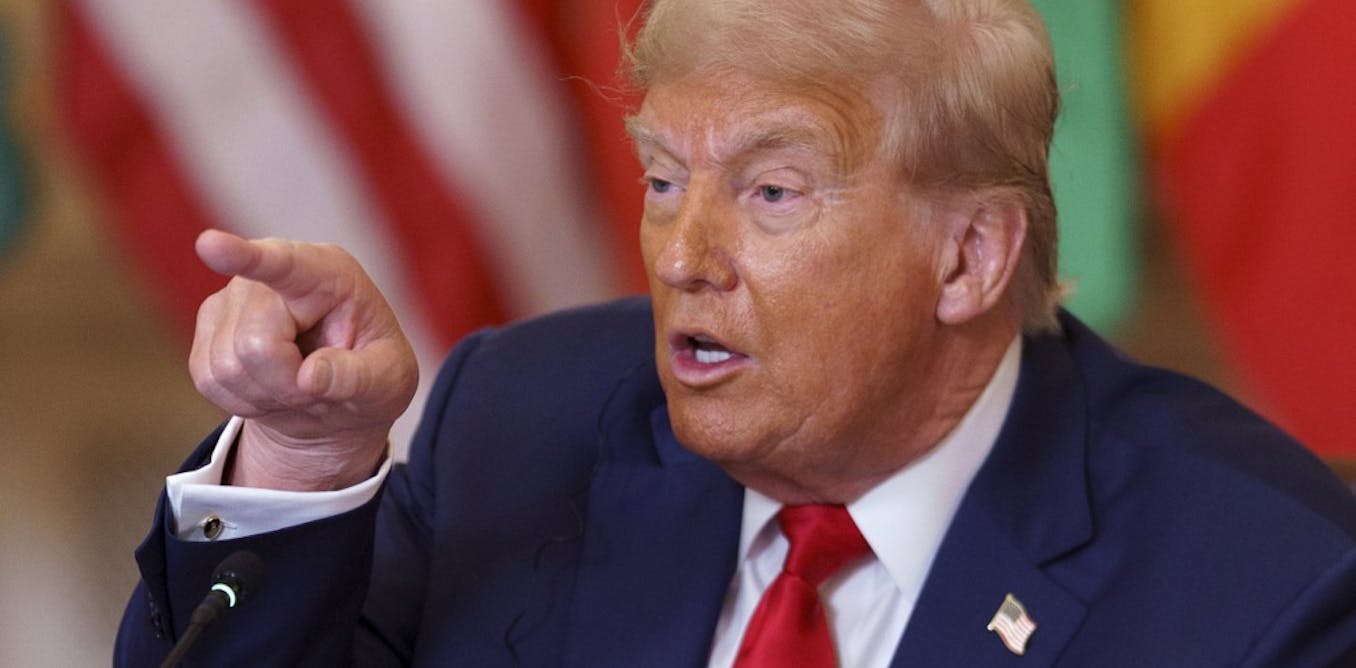
    But how things seem to have changed with Donald Trump in the White House.


    Get your news from actual experts, straight to your inbox. Sign up to our daily newsletter to receive all The Conversation UK’s latest coverage of news and research, from politics and business to the arts and sciences.


    Trump continually takes personal credit for any perceived successes as president – fixing global tariffs, Nato members paying more, the Middle East (even taking credit for things that were completed before he took office). But he makes sure that any failures are immediately attributed elsewhere.

    He frequently positions himself as surprised or “blindsided” by unpopular decisions, which are always somebody else’s doing, somebody else’s fault. Subordinates are held responsible. He is not averse to pointing the finger directly at them, and often in public, high-profile settings.

    That great loyal Trump supporter, defense secretary Pete Hegseth, for example, has recently been in the firing line for being personally responsible for pausing the delivery of missile shipments to Ukraine. US defence officials had apparently become concerned that weapons stockpiles were becoming low, as they needed to divert arms to Israel to help in the war with Iran.

    But the pause in supplying some weapons to Ukraine announced by the Pentagon on July 2 was a hugely unpopular decision that resonated around the world. Hegseth was blamed.

    Some have suggested that having loyalists such as Hegseth in critical positions like secretary of defense is highly strategic, and not just for the more obvious reasons. You could argue that having loyal supporters with delegated but overlapping authority is highly advantageous when it comes to the blame game.

    Trump can publicly distance himself when things go wrong (as he did here), claim a degree of surprise, and swiftly change course. That way he is publicly reasserting his role as leader without admitting fault.

    It is also noteworthy that Trump often reverses these decisions made by his subordinates in high-visibility environments, which suggests a determined pattern of strategic image management.

    It’s a simple set of moves – you allow a subordinate to initiate a controversial decision, then you rein it in publicly and reassert your authority, thus showcasing your resolve. In other words, delegation to loyal insiders like Hegseth becomes a useful buffer against political fallout.

    Loyal insiders still stay loyal (for the foreseeable future at least). They won’t sling mud, like some might in their position. So Trump can appear masterful.

    Are you going to send weapons to Ukraine? President Trump reverses a policy and decides he will.

    But of course, there’s more to this than everyday political shenanigans. Personality plays a major role. Some psychologists have argued that not internalising failure is psychologically beneficial.

    If you take credit for success but externalise failure, that makes you resilient (and happy). But there are clearly limits to this, and there’s a darker side.

    People with high levels of narcissism (“I like to be the centre of attention”; “I am an extraordinary person” – both items on the narcissism personality inventory, a method of measuring personalities) often avoid accountability because they perceive themselves as superior to others. But only, it should be noted, in certain “key” aspects of life.

    In the words of Jean Twenge and W. Keith Campbell, authors of The Narcissism Epidemic: “Narcissists think that they are smarter, better looking and more important than others, but not necessarily more moral, more caring or more compassionate.”

    Narcissistic individuals tend to externalise blame to protect their fragile self-esteem and maintain their self-image. They may refuse to admit fault because doing so threatens their grandiose concept of self.

    Individuals exhibiting Machiavellian traits, characterised by manipulativeness and a lack of empathy, are also more prone to shifting blame. They may deflect responsibility to serve their self-interest, which is clearly a highly manipulative manoeuvre. You just do whatever is required.

    Research also indicates that individuals with low conscientiousness, one of what are considered the “big five” personality traits, are less likely to accept responsibility for their actions. They may be somewhat careless or irresponsible in their work or actions, and when mistakes do occur – which they will – they blame external factors or other people.

    In other words, certain personality traits are associated with a tendency to avoid accountability and responsibility.

    It has been said that Trump’s inner circle consists of loyal sycophants who, even when it’s cringeworthy for outsiders, publicly praise him to amplify and protect his self-image. He needs this from them.

    But they have another use as well. When things don’t go so well, they take it on the chin for him. That’s almost part of the job description. When things go wrong, his inner circle all understand the buck really stops with them.

    The Conversation

    Geoff Beattie does not work for, consult, own shares in or receive funding from any company or organisation that would benefit from this article, and has disclosed no relevant affiliations beyond their academic appointment.

    [ad_2]

    Source link

  • Why some countries are more likely to believe nuclear war won’t happen to them

    Why some countries are more likely to believe nuclear war won’t happen to them

    [ad_1]

    The war in Ukraine has just edged up another notch. It has not been going well for Ukraine in recent months, and this week Joe Biden’s administration made the decision to allow Ukraine to fire US-supplied army tactical missile systems (Atacms) long-range missiles deep into Russia for the first time.

    The US policy reversal also put Ukrainian weapons supplied by the UK and France into play. The UK and France had previously indicated they would allow this, once the US had.

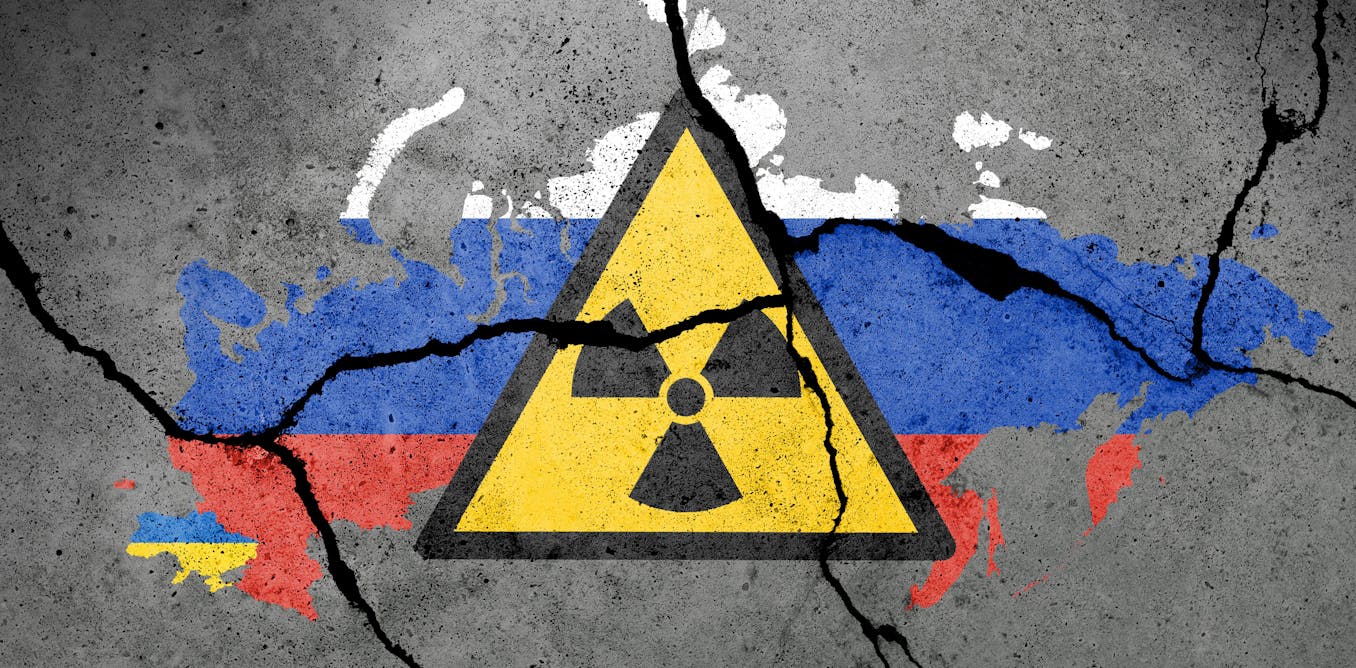
    This prompted an immediate threat from Vladimir Putin, who signed a decree lowering the threshold for a nuclear strike in response to a conventional attack on Russia or its ally Belarus that “created a critical threat to their sovereignty and (or) their territorial integrity”. On Thursday, reports suggested that Russia might have launched an intercontinental ballistic missile (ICBM) into Ukraine. This suggested to some that some kind of nuclear war was edging closer.

    We have been here before, but perhaps not for a very long time. Some may remember the Cuban missile crisis and the tangible felt threat of a nuclear war between the US and the Soviet Union in October 1962. There was considerable public concern over this. And there was enormous relief when it was resolved by means of a secret deal where the US withdrew its nuclear missiles from Turkey (the public understanding at the time was that the Soviet Union had simply backed down).

    Amid fears of a possible nuclear war in 2024, some countries close to Russia, ( Sweden, Norway and Finland), have updated their civil preparedness guidelines to help citizens prepare for war, from how to stop bleeding and deal with anxiety (“restrict your news intake” was one piece of advice), to stockpiling bottled water and sanitary products. Germans have been warned to ready themselves for a possible war. While other European countries such as the UK have not yet done anything similar.

    Why are some nations more optimistic?

    So why are some nations worried and some apparently much less so? Optimism bias is the tendency to overestimate the probability of good things happening in your life and underestimating the probability of bad things occurring. According to one study around 80% of people suffer from some form of optimism bias (the data tends to be western based, primarily from the US and UK).

    Those people tend to believe that their marriages will work (it’s only other marriages that fail), and that they will have a long and fulfilling life compared to everyone else. Global crises are not immune to optimism bias. Optimists tend to think, for instance, that it’s other people and future generations that will suffer from the effects of climate change, not them personally.

    People in the west do seem particularly susceptible to optimism bias, according to psychologists’ research. Steven Heine and Darrin Lehman, professors at the University of British Columbia, found that Canadians showed more unrealistic optimism than the Japanese. While other research demonstrated a similar result with Americans versus Japanese.

    Optimism bias can affect risk perception of both natural disasters and terrorist events and one study found significant cross-cultural differences in perception of risk that did not correspond to actual exposure rates. The Japanese had the highest risk perceptions, North Americans and Argentinians had the lowest risk perception for terrorist events. Another study found that mainland Chinese were more pessimistic than Chinese Americans who were more pessimistic than white Americans.

    Russia says nuclear war is edging closer.

    There seems to be something distinctive about the American character. A study measured level of general and geopolitical optimism and global and personal worry in Russian and US schoolchildren and adolescents. The researchers found that, in the US, young people were more optimistic about their future and showed less global and personal worry.

    Avoiding bad news

    So how does optimism bias work? It appears to be associated with specific biases in what people look at and read, and how they process that information. Optimists avoid negative images and negative information to maintain their mood. They avoid seeing bad news. Their brains also process bad news differently. Functional magnetic resonance imaging (FMRI) shows that the processing of negative information is accompanied by a reduced level of neural coding in a critical region of the frontal cortex of their brains (right inferior prefrontal gyrus).

    In other words, optimism bias derives from both an attentional bias (we choose to ignore some things, while paying attention to others) and a failure to learn systematically from new undesirable information.

    But surely optimism is a good thing? There is clear evidence of this. Optimists live significantly longer and are much less likely to die from cardiac arrest. Optimism also increases the survival time after a diagnosis of cancer. It does this this by reducing stress and anxiety about the future, and optimists consequently have better immune functioning. Belief in a positive future also encourages individuals to behave in ways that can actually contribute to this positive future – so optimism becomes a self-fulfilling prophecy.

    That is why people have been trained to become more optimistic using cognitive behavioural therapy. There is also a whole self-help industry devoted to it and with this, a profound cultural shift, critiqued by author and activist Barbara Ehrenreich in her book Smile or Die. She has argued that these high levels of optimism have “undermined preparedness” to deal with real threats. She wrote: “The truth is that Americans had been working hard for decades to school themselves in the techniques of positive thinking, and these included the reflexive capacity for dismissing disturbing news.” The economic crisis of 2008, she argued, was a case in point, there was simply no ability or inclination to imagine the worst. A world war might be a starker example.

    It’s possible to take an optimistic view on what is currently going on. The US non-profit organisation, the Brookings Institure, for instance, thinks that Putin is bluffing, and that he is not about to unleash nuclear weapons.

    The downside of optimism is, however, that people may not notice the warning signs – and being prepared for the worst is actually an important aspect of human survival.

    The Conversation

    Geoff Beattie received funding from the British Academy for research on optimism bias in processing climate change messages.

    [ad_2]

    Source link