Author: Scott Lucas, Professor of International Politics, Clinton Institute, University College Dublin

  • Israel and Hamas agree ceasefire deal – what we know so far: expert Q&A

    Israel and Hamas agree ceasefire deal – what we know so far: expert Q&A

    [ad_1]

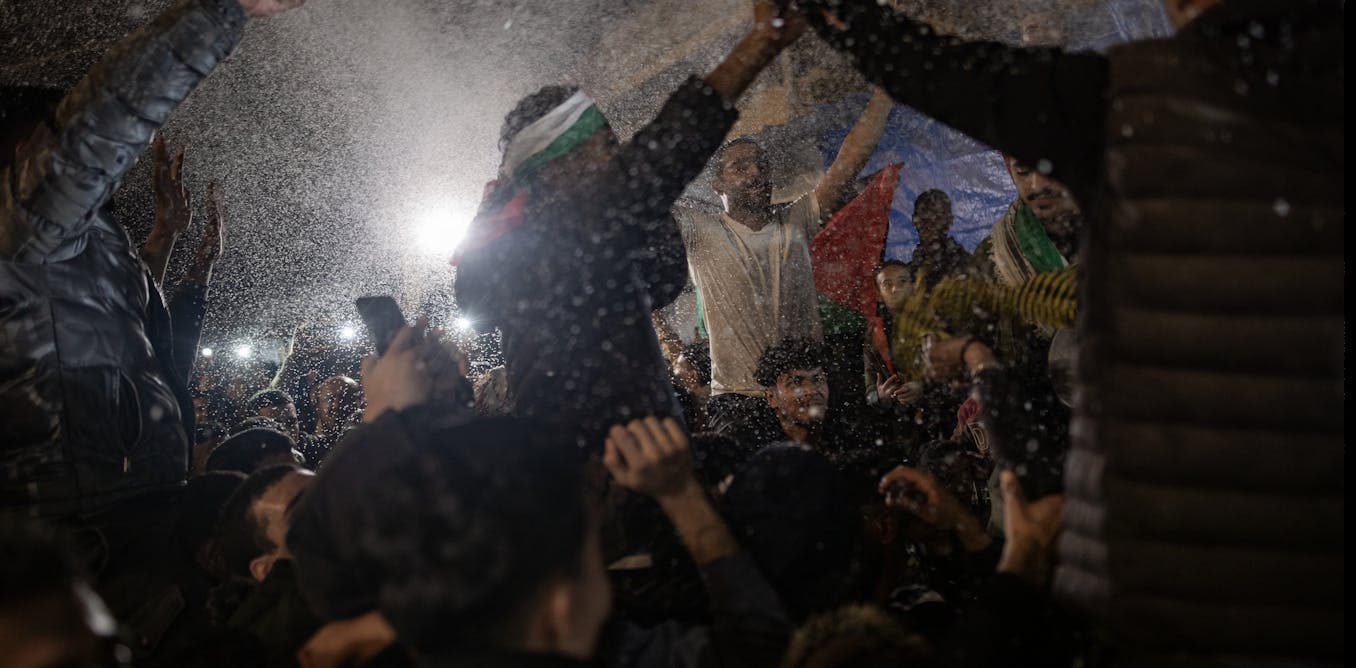
    After two years of violence and the deaths of 68,000 Palestinians and more than 1,200 Israelis, most of them civilians, it has been reported that Hamas and the Netanyahu government will sign a phase 1 ceasefire agreement. This is the first part of a 20-point plan promoted by the US president, Donald Trump, and supported by the major Arab power brokers in the region.

    What we know so far is that Israel will cease its military assault in Gaza. Hamas, meanwhile, has agreed to free the remaining 20 Israeli hostages still alive in Gaza.

    The Conversation’s international affairs editor Jonathan Este spoke with Scott Lucas, a Middle East expert at University College Dublin, who addressed several key issues.

    How is this different to previous ceasefire agreements?

    Until we have details, this agreement is similar to the phase 1 60-day ceasefire at the start of 2025. There is a pause in the killing, particularly from the Israeli side, but lasting arrangements remain to be confirmed.

    The key difference is that Hamas released only some hostages and bodies in the previous ceasefire. This time they are freeing all hostages and the bodies which can be collected, in return for a still unannounced number of Palestinian detainees released from Israeli prisons.

    That gives up Hamas’s main leverage against not only Israeli attacks but also the Netanyahu government’s occupation and veto on aid to Gaza.

    So key elements of a lasting deal – the extent of the Israeli military’s withdrawal, the restoration of aid, the establishment of governance and security in the Strip – will rest on guarantees and who provides them.

    What are the possible sticking points for the rest of the deal?

    The immediate “sticking points” are whether central provisions will be agreed in further discussions.

    The Israelis will demand complete disarmament by Hamas and possibly the expulsion of some of its officials. Hamas is likely to respond with rejection of any forced removals and its retention of “defensive” weapons.

    The make-up of the international “board” overseeing the strip is vague beyond Donald Trump declaring himself the chair and no provision for any Palestinian representation. Hamas will probably seek some Palestinian membership.

    At this point, the International Stabilization Force for the Strip is a wish rather than a plan. Israeli agreement to a force replacing its military in Gaza is far from assured, especially as it is not clear who will contribute personnel. The Italian foreign minister, Antonio Tajani, has offered to send troops to contribute to the force.

    The plan for a day-to-day government to administer the Strip is equally sketchy. While the presence of Palestinian technocrats is mentioned in Trump’s “plan”, we do not know who these will be. We know that Hamas is excluded. Israel is also likely to veto the Palestinian Authority in the short-term. And the release from imprisonment of potential Palestinian leaders – such as Marwan Barghouti, who has been held by Israel for more than 20 years – is not confirmed.

    And before consideration of all of these, there is the question of the far-right in the Netanyahu cabinet. The finance minister, Bezalel Smotrich, and national security minister, Itamar Ben-Gvir, have yet to comment on the latest news, but have previously opposed any deal short of the “total” defeat of Hamas and a long-term Israeli occupation. Neither have threatened to block the agreement – so far – but they have expressed opposition.

    Jubilation: relatives and supporters of Israeli hostages celebrate in Hostage Square, Tel Aviv after the ceasefire announcement.
    AP Photo/Ohad Zwigenberg

    How much of this is due to pressure from Arab states?

    While many headlines are likely to give the credit to Trump and his envoys, son-in-law Jared Kushner and real estate developer Steve Witkoff, the role of Arab states has been vital.

    A month after Israel shattered Qatar’s sovereignty with the airstrike trying to assassinate Hamas’s negotiators, the Gulf state and Egypt were the brokers of this Phase 1 agreement. Behind the scenes, other Arab states and Turkey were urging Hamas to accept the Trump “plan” in principle and to reach a deal to release the hostages.

    Those states will be needed for the next phase, particularly if Trump threatens to return to his previous position of a blank cheque for Israeli military operations and cut-off of aid.


    Read more:
    Middle East leaders condemn Israel’s attack on Qatar as Netanyahu ends all talk of Gaza ceasefire – expert Q&A


    Is there a future for Palestinian civilians in Gaza?

    I hope so. The immediate issue is survival. The Israeli attacks have been paused. The urgent issue is getting essential aid into the Strip. Then it is a matter of being able to return to what is left of homes. The Trump administration has dropped its talk of displacement, stemming the demand of Netanyahu’s far-right ministers for the removal of many Gazans.

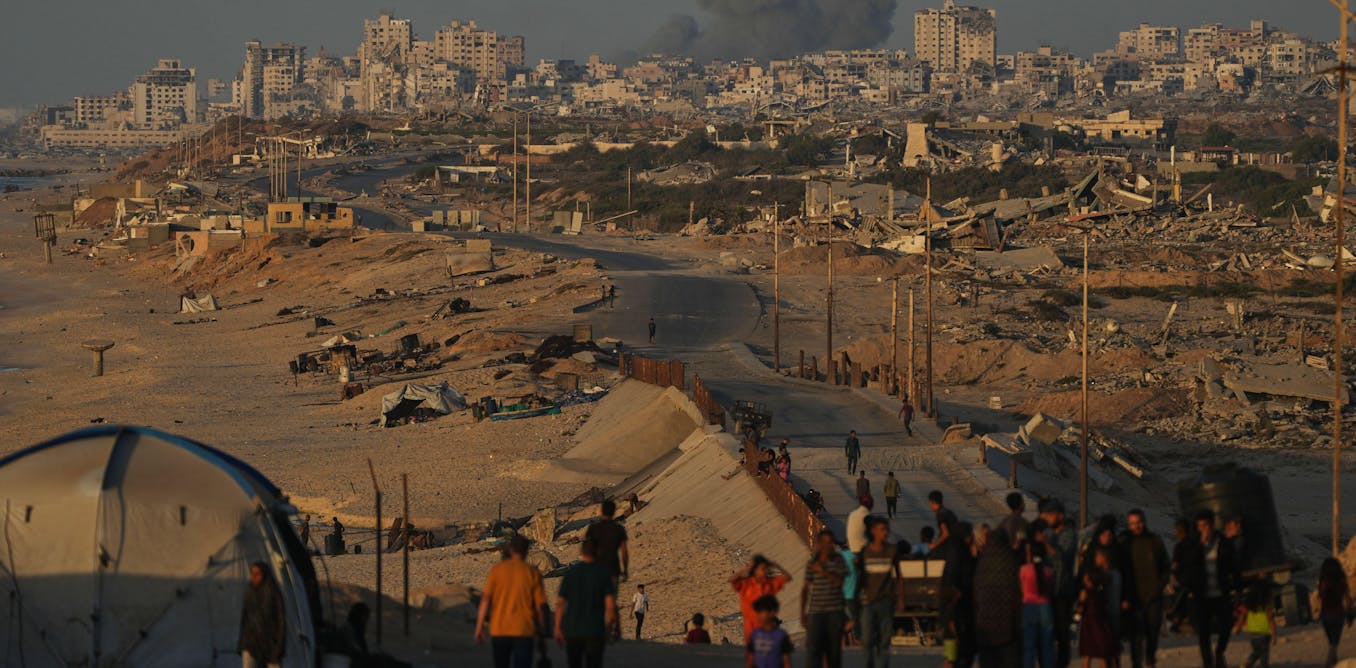
    However, after two years of scorched-earth tactics by Israel, little is left of many of those homes. The majority of the health sector has been destroyed, as have many schools and other public buildings. Rafah has been razed, and Gaza City’s high rises have been blown apart.

    Recovery cannot just focus on the profits to be made – including for Trump, Kushner, and Gulf state business interests – from the “development” of Trump’s “Riviera of the Middle East”. It has to begin with day-to-day subsistence for the civilians who have paid the heaviest price in this mass killing.

    Does Trump get his Nobel peace prize now?

    I don’t care. Sometimes good things happen from a convergence of cynical and self-serving motives. Trump is desperate for the Nobel peace prize because Barack Obama received it in 2009. Kushner, whose investment fund is bankrolled by Saudi Arabia and Qatar, and Gulf state entrepreneurs see the possibility of large profits. US-Gulf relations need to be repaired after the shock of Israel’s airstrike inside Qatar.

    If that means lives are saved, fine. But those lives need to be saved not just for today or tomorrow. They need to be respected and supported with a lasting agreement for security and welfare.

    And that would mean a two-state solution for both Palestinians and Israelis – something which the Netanyahu government and the Trump administration will not countenance. For Netanyahu and his ministers are devoted to expanding Israel’s illegal settlements, with the accompanying threat of violence, in the West Bank.

    Celebrate phase 1 on the behalf of the Israeli hostages, their families, and Gaza’s civilians. And be clear about what is needed for phase 2, phase 3 and beyond.

    [ad_2]

    Source link

  • what it means for peace in the Middle East – expert Q&A

    what it means for peace in the Middle East – expert Q&A

    [ad_1]

    After 15 months of bitter conflict on the Gaza Strip, a ceasefire deal has been agreed which promises an end to the fighting and will allow for the access of food and other desperately needed humanitarian aid to the civilian population. Since the Israel Defense Forces launched their ground operation in Gaza in October 2023 in response to the Hamas terror attack of October 7, more than 46,000 Palestinians are reported to have been killed, including 17,492 children. More than 1.9 million of the Gaza Strip’s 2.2 million inhabitants have been displaced and much of the infrastructure and housing has been destroyed or badly damaged.

    We asked Scott Lucas, an expert in the Middle East conflict at University College Dublin, to explain the key issues that have led to the agreement and what it means for the future of the region.

    What do we know about this ceasefire deal?

    Despite hopes for several days that a ceasefire might finally be agreed, there are still twists, turns, and uncertainty. Even as Qatar was announcing that its prime minister, Sheikh Mohammed al-Thani – who is also the country’s foreign minister – would hold a press conference, the Associated Press announced that the talks had hit a last-minute snag with Israel blaming Hamas.

    Just after 5pm GMT, Israeli as well as Hamas and Qatari officials said Israel and Hamas had accepted a three-stage deal. But an hour later, Israeli prime minister Benjamin Netanyahu’s office said the agreement was still not confirmed.

    Under the agreement, in the first, six-week stage around 1,650 Palestinians will be released from Israeli prisoners. Meanwhile 33 of around 95 hostages – some alive, some dead – will be freed by Hamas and other groups such as Palestinian Islamic Jihad. Israeli forces will withdraw from population centres, Palestinians will be allowed to start returning to their homes in northern Gaza. And there will be a surge of humanitarian aid, with around 600 trucks entering each day.

    In the second stage, Hamas has pledged to release the remaining living captives, most of them male soldiers, in exchange for release of more Palestinians and the “complete withdrawal” of Israeli forces from Gaza. In the third phase, the bodies of remaining hostages would be returned in exchange for a three to five-year reconstruction plan in Gaza under international supervision.

    At 5.02pm GMT, Donald Trump posted on his Truth Social website confirming that a deal had been agreed:


    The Guardian

    But if Israel’s prime minister, Benjamin Netanyahu — the long-time obstacle to a final agreement — dropped his objections, he could face unrest within his cabinet from hard-right members. National security minister Itamar Ben Gvir has called on finance minister Bezalel Smotrich to join him again in thwarting an agreement.

    So the important caveat to any celebration is that the deal still has to be approved by Israel’s ministers.

    We’ve been here before – what has changed?

    The three-stage proposal was put forward last May and discussed through the summer. In September, one of Israel’s lead negotiators, Mossad head David Barnea, returned to Qatar amid hopes for a resolution. But Netanyahu then publicly imposed the condition that Israeli troops continue their occupation of two areas in Gaza, the Philadelphi Corridor along the Egypt border, and the Netzarim Corridor across the centre of the Strip.

    It is unclear why Netanyahu appears to have now decided to accept a ceasefire. Some reports cite a meeting with Steve Witkoff, the envoy of incoming US president Donald Trump. But Trump effectively gave Netanyahu a blank cheque in October, saying: “Bibi, do what you have to do”.

    The Israeli political environment is far more likely to be instrumental. Netanyahu has been under pressure for months from former members of his war cabinet, Benny Gantz and the now-dismissed defence minister, Yoav Gallant as well as from opposition parties and from sections of Israeli society, notably the families of hostages.

    Netanyahu had long resisted that pressure, preferring the “open-ended” war with the quest to “absolutely destroy” Hamas. He may now calculate that his agreement to stop, with Hamas far from destroyed now does not look like a capitulation to Hamas, the Biden administration, or his domestic foes. He may present the agreement as a pragmatic step, given the change of power in the US with a new president who will sing his praises.

    Still, he faces the risk that a ceasefire could mean early elections as his government fractures. That could mean a return of focus to his trial on bribery charges. And so, up to the last minute, he will hesitate, waver, and confuse.

    Israeli and Arab officials may be flattering Trump’s ego with the portrayal of Witkoff’s intervention swaying the prime minister. There has been no indication of what pressure or incentive that the envoy brought Netanyahu.

    One possibility is that the incoming Trump administration has signalled that it will accept an expansion of Israeli settlements in the occupied Palestinian West Bank. This would reinforce the position taken by Trump in his first term, and the hard-right Israeli ministers Ben Gvir and Smotrich could drop any ceasefire objections in return for an assurance of Washington’s support.

    Can Netanyahu make this deal stick at home?

    If Netanyahu’s cabinet votes to accept the agreement, the Israeli prime minister should be able to ride out the immediate opposition from the right-wingers. Opposition leaders have already backed the deal, and much of the Israeli population is weary of the military campaign and just wants the violence to end.

    Protesters outside the Knesset call for the release of the Israeli hostages, January 13 2025.

    Most Israelis just want the fighting to stop and the hostages to be released.
    EPA-EFE/Abir Sultan

    Although Netanyahu cannot claim “absolute victory” over Hamas, which is his long-stated goal, he can point to the decimation of the organisation’s top ranks. Since the latest round of the conflict began in October 2023, Hamas has lost its military leader, Yahya Sinwar, its political leader, Ismail Haniyeh, and Mohammad Deif, the planner of Hamas’ mass killings inside Israel on October 7, 2023.

    Most importantly, Netanyahu can present the return of all of the hostages. He’ll hope for a boost, but just from the celebrations of the families of those still alive, but also from the families of the dead, who will have a chance at closure.

    How about the future of Hamas and Gaza?

    Hamas will have to rebuild, probably with Yahya Sinwar’s brother Mohammed as the new leader. Its political and military commands will have to reestablish themselves. But the group has survived inside Gaza. Not only has it not been expelled, but at this point there is no apparent alternative to its governance. So it will have to be involved at some level not only in the maintenance of the ceasefire but in the reconstruction operations.

    As for Gaza’s civilians, they have long been the expendable pawns in this conflict. They are the large majority of the more than 46,000 killed – which is a conservative figure. At least 1.9 million, out of a population of around around 2.2 million, are now displaced and in dire humanitarian conditions.

    While the ceasefire would halt Israeli attacks and allow some people to return to their homes, the situation is likely to be precarious. The Netanyahu government could always threaten a resumption of airstrikes, if not ground assaults, or obstruction of humanitarian aid.

    A young boy sits on a pile of rubble. Hundreds of Palestinian civilians stand ikn the background, January 2025.
    Devastation: It will take years and huge amounts of money to rebuild Gaza after 15 months of relentless Israeli bombardment.
    EPA-EFE/Mohammed Saber

    Hamas, which was not enthusiastically supported before October 7 by many civilians because of economic and social issues, appears to have sacrificed most of Gaza’s civilians for its headline moment on October 7, 2023. It is not clear what long-term future they can offer those who have survived.

    Donald Trump’s about to take power – did that change things?

    Whether or not Trump’s envoy Witkoff had a direct role in the move towards a ceasefire, the advent of Trump 2.0 could have mobilised all those involved in the talks to make a final push for a settlement.

    Given the unpredictable and often incoherent approach of Trump, and his propensity to sideline and dismiss senior advisors, there is no assurance over future direction of US policy after January 20. Netanyahu might have benefited from Trump’s blank cheque, but all others – Hamas and other groups in Gaza as well as the Arab States – would likely be operating in a sphere of uncertainty.

    Meanwhile, as headlines swirled about the politics and the personalities, the 15-month reality continued. In the 48 hours leading up to the agreement being signed, at least 123 people have been killed and several hundred others injured by Israeli attacks across Gaza.

    Does the killing finally end? And for how long?

    [ad_2]

    Source link