Progress towards achieving Donald Trump’s 20-point peace plan for Gaza is stalling. Israeli strikes across the territory on January 9 killed 13 Palestinians, with new raids days later claiming three more lives. The situation has now reached a critical juncture, with both Israel and Hamas reportedly preparing for a resumption in fighting.
The first phase of the US-brokered ceasefire, which came into effect in October, has mostly been completed. Israel’s military has withdrawn to the eastern half of the Gaza Strip, as required by the agreement. And dozens of Israeli hostages, living and dead, have been exchanged with hundreds of Palestinian prisoners.
However, some elements still need to be finalised. This includes the return of the remaining Israeli hostage, Ran Gvili, whose remains are still unaccounted for. And while humanitarian aid has been allowed into Gaza, the southern Rafah border crossing has yet to be opened fully.
This is restricting the flow of goods at a time when the inhabitants of Gaza face an acute humanitarian crisis. Harsh weather conditions, limited shelter, severe food shortages and continued military actions continue to exacerbate the situation. The UN said on January 12 that at least 1.1 million people in Gaza still urgently need assistance.
Advancement towards a permanent end to the war and the reconstruction of Gaza is thus urgent. However, later phases of the peace plan will need to address thorny issues such as Gaza’s post-war governance, Palestinian calls for a state and Israel’s demand that Hamas disarms. The potential for the negotiations to derail are high.
Haitham Imad / EPA
Trump is reportedly set to announce the Gaza “peace board”, which will be formed of global leaders to administer his post-war plan for the territory. Nickolay Mladenov, a Bulgarian diplomat and former UN envoy to the Middle East, has been named as the board’s director general.
But any progress towards realising Trump’s vision for Gaza, and permanently ending Israeli military action, hinges on the issue of the disarmament of Hamas.
The Israeli prime minister, Benjamin Netanyahu, has conditioned any progress in the peace plan on the demilitarisation of the Gaza Strip. This requires Hamas to relinquish all of its arms and hand over its governance of Gaza. These are non-negotiable demands from Israel for maintaining the ceasefire.
Hamas has said it will dissolve its existing government in Gaza once a committee of Palestinian technocrats takes over the territory. This committee will be headed by Ali Shaath, who previously served as the Palestinian Authority’s deputy transportation minister in the West Bank, and also includes Gaza chamber of commerce chairman Ayad Abu Ramadan.
But Hamas has so far publicly rejected giving up its arms. Some reports suggest that Hamas is ready to discuss “freezing or storing” its arsenal, while others have reported that Hamas would be willing to decommission its short- and long-range missiles. However, the group is not willing to give up its small arms and light weapons.
This is because Hamas believes it has a right to armed resistance as long as Israel is occupying Palestinian territory, with complete disarmament representing what the New York Times calls an “existential unravelling”. Unless resolved, the issue of disarmament will most likely lead to a resumption in fighting in the near future.
Plans for renewed hostilities
According to an unnamed Israeli official interviewed by the Wall Street Journal, if Hamas “doesn’t willingly give up its weapons, Israel would force it to do so”. Trump, following a meeting with Netanyahu at his Mar-a-Lago resort in December, has also said “there will be hell to pay” if Hamas does not agree to disarm.
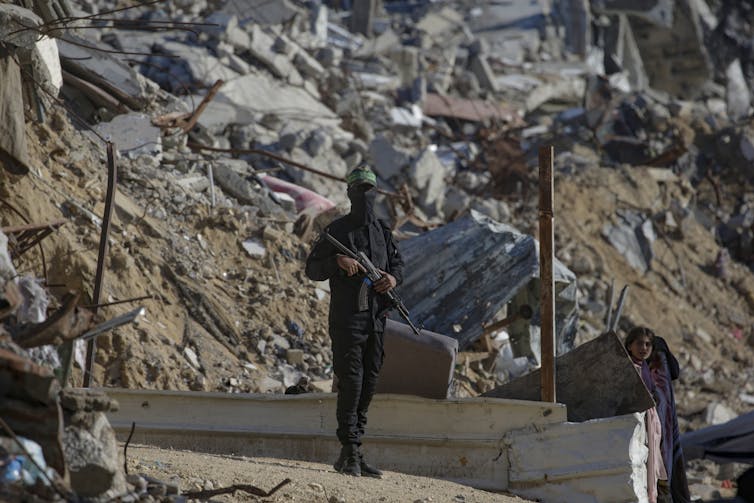
But contrary to these directives, reports suggest that Hamas is focusing on rebuilding the infrastructure that was destroyed in Gaza during the past two years of war. This includes rebuilding its military capabilities and maze of tunnels, as well as replenishing its cash reserves through revenues generated by taxing goods and services coming into Gaza.
In early January, the Israel National News media network reported that Israeli intelligence has identified three main channels through which Hamas is attempting to rebuild its military capabilities. The first channel is the local production of weaponry, second is cooperation with the Iranian “axis of resistance” to leverage aid channels for military purposes, and third is using drones from Egypt to transfer weapons.
Mohammed Saber / EPA
Further evidence of this is limited. However, Hamas was quick to reassert its power in Gaza after the ceasefire. And the New York Times reported in December that more than half of the group’s underground tunnel network is still intact and at least 20,000 Hamas fighters remain. This highlights the potential capacity for the group to reengage in fighting.
Expecting Hamas to refuse full disarmament, Israel has now reportedly drawn up plans to launch a renewed intensive military operation in Gaza in the spring. The focus of this operation would be on Gaza City, which remains largely under the control of Hamas.
Unless both sides engage in some pragmatism, or significant pressure is imposed on them to show restraint, the resumption of fighting seems inevitable. It will once again be the 2 million inhabitants of the Gaza Strip, who have already faced unimaginable loss and destruction and are struggling through a harsh winter, that will suffer.