He wasted no time getting out into the field. Within days of taking office on 1 January, he had already left the conference rooms of his Geneva headquarters for the dust of refugee camps in Kenya and Chad, a signal of how he intends to lead an agency stretched by crises that are multiplying faster than the system built to respond to them.
“The responsibility in every sense of the word is awesome,” he said in a recent interview, his voice catching slightly on the enormity of the task.
For Mr. Salih, in his mid-sixties, the role is anything but abstract. The new High Commissioner for Refugees knows displacement not as a statistic but as a lived experience.
‘Behind every statistic is a life’
Born in Iraqi Kurdistan in 1960, he became a refugee himself as a teenager and spent years in exile, part of a generation shaped by repression and war under Saddam Hussein’s rule. He studied in the United Kingdom, built a political career and eventually returned home, rising to become Iraq’s eighth president in 2018, a trajectory that now informs how he sees the millions still trapped in limbo.
“Behind every statistic is a life,” he said, “a person with aspiration, with a right to dignity, with the right to a better future.”
That insistence on individual dignity, like a refrain, runs through his first months on the job. But, so is a harder truth: the global system built to respond to displacement is under strain. Even as displacement rises, humanitarian funding is tightening, forcing agencies like his to stretch already limited resources across expanding needs.
A crisis that no longer ends
For decades, the architecture of refugee protection rested on the assumption that displacement was a stopgap. People fled, received protection and eventually returned home when it was safe to do so.
“Being a refugee is not meant to be a fate,” Mr. Salih said. “It is meant to be a temporary condition.”
But, as conflicts drag on and political settlements stall, that premise has quietly collapsed. Today, nearly two thirds of refugees live in what humanitarian agencies call “protracted displacement”: five, 10, even 20 years or more without a durable solution. Entire childhoods unfold in camps. Generations grow up without ever seeing the homes their families fled.
The UN refugee chief does not soften the diagnosis.
“That is not an acceptable situation,” he said. “This is a violation of the basic human rights to dignity.”
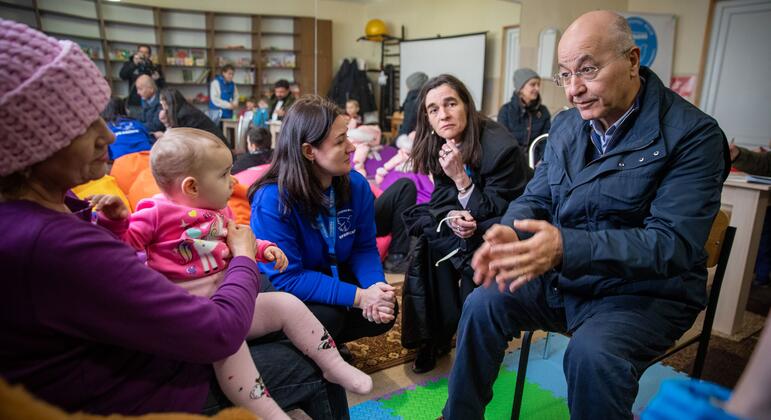
UN High Commissioner for Refugees, Barham Salih, on a visit to refugees in the Zaatari camp in Jordan.
Ambitious plan
His plan is ambitious. He has set a goal of reducing by half, within a decade, the number of people in long-term displacement dependent on humanitarian assistance, a target that far exceeds the ability or resources of his agency alone.
“I know, and I understand full well, that this is far beyond the means and the capabilities of [UNHCR] today,” he acknowledged.
The strategy hinges on something the humanitarian system has long struggled to achieve: moving beyond emergency aid toward economic inclusion. Refugees, he argues, must be able to work and contribute to the societies that host them rather than remain dependent on assistance.
This would require a broad coalition, including development banks, private investors, donor governments and host countries, many of which are themselves under economic strain. It would also require a shift in political will at a time when many wealthier nations are tightening borders rather than expanding opportunity.
The weight of hosting
One of the enduring paradoxes of the refugee crisis is that it is largely borne by countries least equipped to handle it.
“We need to help host nations who are mostly, by the way, low-income, middle-income countries,” Mr. Salih said.
From Colombia to Uganda, from Chad to Bangladesh, these countries absorb the vast majority of displaced people, often with insufficient international support. Their schools, hospitals and labour markets stretch to accommodate newcomers even as their own citizens face economic hardship.
The UN refugee chief speaks of these host communities with a mix of admiration and urgency.
“I am humbled by the generosity of many of these host nations and communities,” he said.
But, generosity can only go so far. Without sustained investment and inclusion, the system risks hardening into permanent crisis, with a global underclass of the displaced being warehoused rather than welcomed.
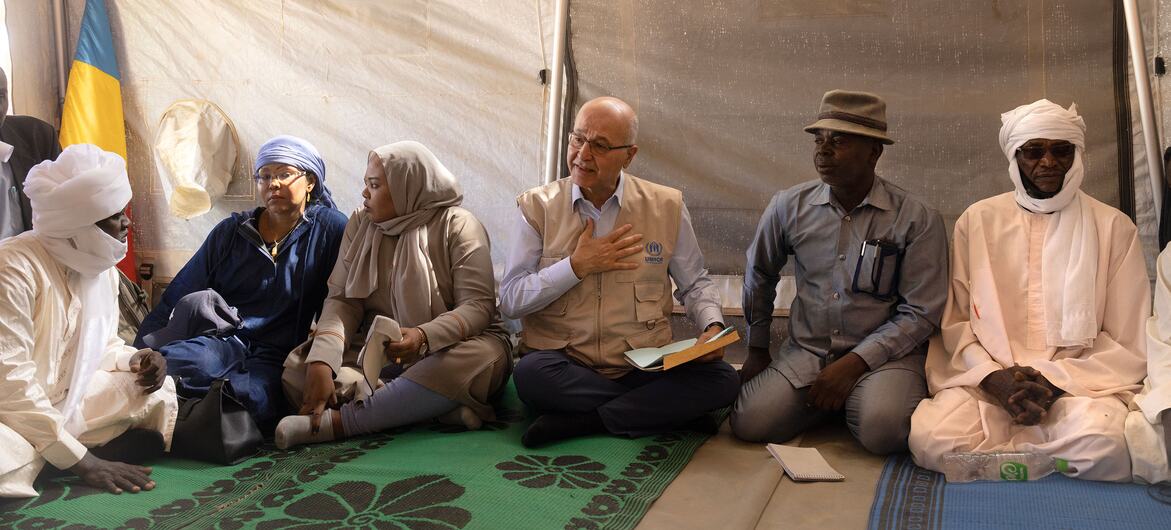
The UN Refugees chief, Barham Salih (centre), speaks with Sudanese refugees at a women’s centre in Farchana, Chad.
A message to the displaced and the world
In Kakuma, a refugee camp in northern Kenya, one of the world’s largest and home to around 300,000 people, and across Turkish cities hosting Syrians more than a decade after their exodus, Mr. Salih says he has seen something that resists the language of despair.
“The story of resilience with every refugee I have met is genuine and is real,” he said.
It is this resilience that shapes his message, particularly to young refugees growing up in uncertainty.
“To the young people, I say we are going to be working to help you with your agency,” he said, emphasising not just protection but possibility.
The word “agency” is deliberate. It signals a departure from seeing refugees solely as victims, toward recognising them as actors in their own futures. But, it also places a responsibility on the international community to create the conditions in which that agency can be exercised.
“A refugee is meant to be a temporary situation, not a permanent pain.”
For now, those conditions remain uneven at best.
Conflicts continue to erupt, including the latest escalation in the Middle East. Humanitarian budgets are shrinking. Political consensus is fraying and the number of displaced people keeps climbing, each figure representing, as Mr. Salih insists, a life interrupted.
At the end of his early travels, what stayed with him was not only the scale of the crisis, but its persistence.
“Once again,” he said, returning to the idea that frames his mission, “a refugee is meant to be a temporary situation, not a permanent pain.”
For millions of people living in camps like Kakuma, that distinction has already blurred.