Dyslexia is far more than a simple difficulty with reading and writing. As a lifelong, neurodevelopmental variation, it affects how the brain processes language, impactfully shaping how individuals navigate their education, careers, relationships, and broader societal roles. Often misunderstood as a cognitive deficit, modern neuroscience recognizes dyslexia as a unique cognitive profile—one that presents both intense operational challenges and remarkable creative strengths.
A crucial aspect of understanding dyslexia is recognizing that it rarely travels alone. In clinical settings, the term “comorbidity” (or co-occurring conditions) refers to how dyslexia frequently intersects with other neurodivergent traits.
“Dyslexia Rarely Travels Alone”: The Overlapping Cognitive Landscape
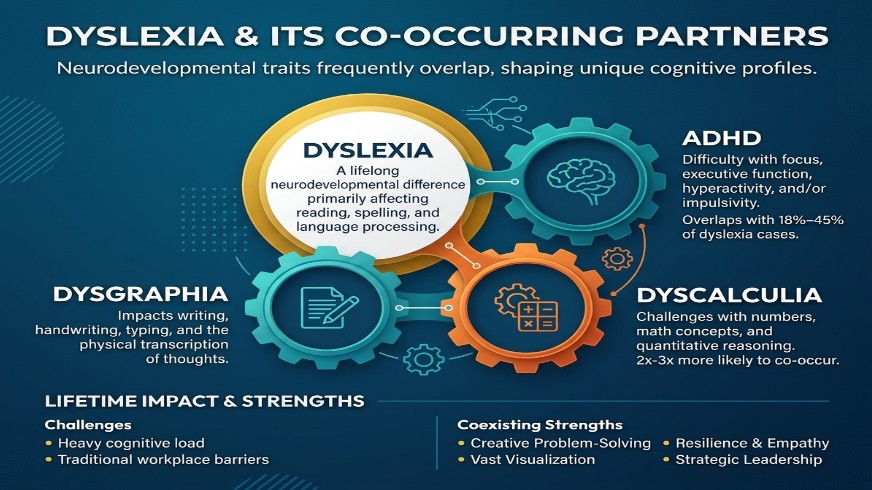
The experience of dyslexia is deeply influenced by co-occurring neurodivergent conditions. Research indicates that a majority of neurodivergent individuals have overlapping traits, making a single-condition diagnosis more the exception than the rule:
- ADHD (Attention-Deficit/Hyperactivity Disorder): Affecting focus, hyperactivity, and impulsivity, ADHD is a frequent companion. Studies show that between 18% and 45% of individuals with ADHD also have dyslexia, and vice versa.
- Dyscalculia: Characterized by severe, persistent difficulties with math, numbers, and quantitative reasoning. Historically, it was estimated to occur alongside reading difficulties at a rate much higher than chance; modern research indicates that individuals with dyslexia are 2.1 to 3.1 times more likely to struggle with dyscalculia.
- Dysgraphia: This affects fine-motor skills required for handwriting, spelling, typing, and the rapid physical transcription of thoughts.
When these conditions overlap, the complexity of diagnosing and supporting individuals increases exponentially, requiring a personalized, multidimensional approach rather than “one-size-fits-all” teaching or workplace strategies.
How Dyslexia Impacts the Lifespan: Career, Business, and Relationships
1. The Professional Arena: Employment & Business
In the workplace, adults with dyslexia often face a “double-edged sword.” Up to 20% of the workforce may be neurodivergent, yet traditional corporate processes often fail them. Many encounter barriers right from the start, such as AI-powered candidate screening systems that filter out unconventional spelling or non-linear resume structures.
However, when supported, “dyslexic thinking” is an extraordinary asset. In business, individuals with dyslexia often excel in high-value, future-proof skills such as:
- Complex problem-solving and visualization.
- Creative and original thinking.
- Strong leadership, social influence, and resilience.
To attract and retain this talent, forward-thinking organizations—such as Microsoft and EY—are adapting their practices, offering adjustments like voice-to-text tools, visual aids, and verbal application options.
2. Intimate & Social Relationships
The cognitive load of dyslexia often spills into interpersonal connections. Misunderstandings can arise from word-finding difficulties, misinterpreting written tone, or struggling with working memory (like forgetting dates or spoken instructions). However, many adults with dyslexia develop deep empathy, exceptional listening skills, and creative ways of connecting, often because they have spent a lifetime navigating complex environments.
3. Societal and Economic Impact
When left undiagnosed or unsupported, the societal costs are high. Individuals with untreated learning differences face higher risks of underemployment, anxiety, and social exclusion. Bridging this gap requires universal screening, early intervention in schools, and accessible adult diagnostics to ensure no one is sidelined by how their brain is wired.
Moving Toward Neuro-Inclusivity
True progress relies on a shift from a “deficit” view of dyslexia to an inclusive, person-centered model. By understanding dyslexia’s co-occurring traits and accommodating these differences in schools, offices, and communities, society can transform a struggle into a powerful source of innovation and resilience.
Dyslexia The Multifaceted Realities of a Neurodivergent Mind, Image Created with Gemini AI