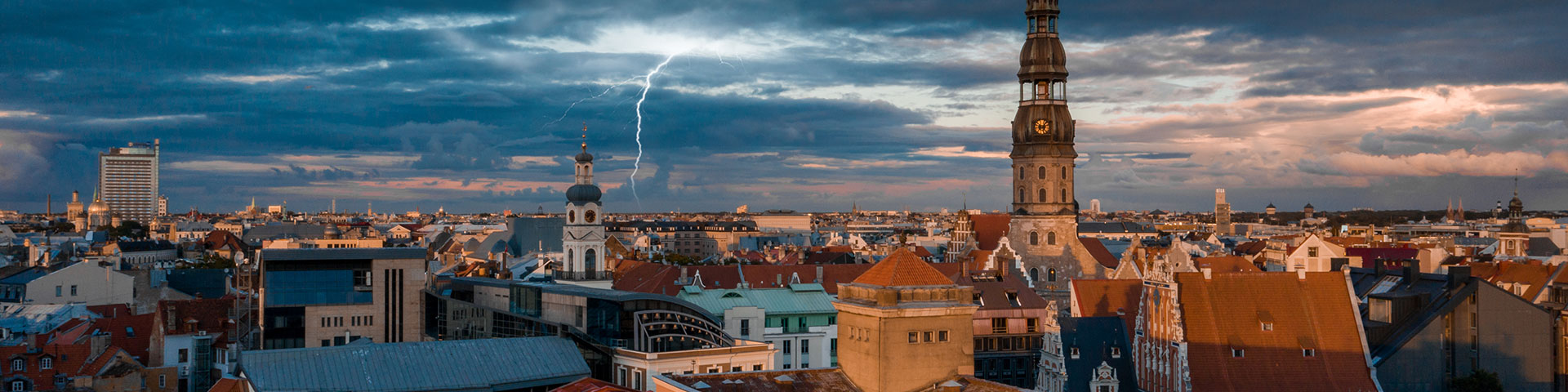
Climate change is forcing many European cities to rethink how they are designed and managed. Infrastructure built for the weather conditions of the past is increasingly being tested by heavier rainfall, hotter summers and more frequent extreme weather. According to a recent global survey, over 80% of cities report facing significant climate hazards.
For Dr Clemente Fuggini, an Italian engineer whose research focuses on the resilience of cities and critical infrastructure, cities and their communities urgently need to work together to face the challenges of a changing climate.
“Resilience relies on an intricate interplay between individuals, communities, institutions and infrastructures,” he said. “In practice, that means understanding not only how buildings respond to climate hazards, but how transport, utilities, public services and the people who rely on them can continue to operate when disruption occurs.”
Fuggini is coordinating an EU-funded research initiative, MULTICLIMACT (2023–2027), exploring practical ways to help cities understand their vulnerabilities, prepare for multiple climate hazards and decide where adaptation efforts are most needed.
No one-size-fits-all solution
The MULTICLIMACT team brings together researchers, engineers and local authorities from nine European countries to assess the range of challenges facing European cities.
Rather than proposing a one-size-fits-all solution, the researchers are developing flexible methods that cities can adapt to their own geography and infrastructure, and to the specific climate risks that they face.
To see how this works in practice, they have set up four pilot sites across Europe, each representing a different climate challenge.
“
Resilience relies on an intricate interplay between individuals, communities, institutions and infrastructures.
“We chose these locations because they embody certain common European complexities and particular climate and environmental living conditions,” Fuggini said.
In the Netherlands, the work has focused on flood risk and on how to best predict increasingly extreme events.
“We have developed a digital monitoring system that uses multiple sensors to detect water stress, temperature changes and leaks, giving authorities earlier warning of potential weaknesses in flood defences,” said Dr Juan Pablo Aguilar López, an assistant professor at Delft University of Technology.
Barcelona presented a different challenge. As temperatures rise, densely built city streets trap heat, making summer conditions increasingly uncomfortable and potentially dangerous for vulnerable people. Flash floods are also a growing risk when heavy rainfall overwhelms urban drainage systems.
Working with the city’s authorities, the researchers are testing nature-based solutions to cool urban areas, reduce flood risk and improve quality of life during heatwaves.
Solutions could include drainage channels made of grasses and shrubs that absorb rainwater and filter pollutants, as well as islands of trees and green vegetation that could help to cool the surrounding streets.
Special care for special buildings
Climate resilience presents a particular challenge for Europe’s historic buildings, where improving safety and energy performance must go hand in hand with preserving centuries of cultural heritage.
In Camerino, central Italy, the researchers are helping to guide the reconstruction of historic buildings damaged by the 2016 earthquakes. Rather than simply restoring what was lost, they are exploring how these buildings can be strengthened against future hazards while maintaining their original character.
“The idea is not just to repair damage,” said Fuggini. “We want to understand how to improve resilience while preserving the identity of these historic places.”
A similar challenge is being addressed in Latvia’s capital, Riga, whose historic centre is recognised as a UNESCO World Heritage Site for its exceptional collection of art nouveau architecture. Here, every alteration must strike a delicate balance between adapting buildings for a changing climate and protecting the architectural heritage that makes the city unique.
For Nika Podziņa, an urban planning expert and project coordinator at the Riga Energy Agency, that balance is central to the project’s work.
“In a UNESCO site, every intervention is a challenge. We are assessing climate resilience with strict requirements,” she said. “We can’t simply install conventional solar panels or technological solutions. We must find ways to enhance performance without compromising the buildings’ cultural and architectural value.”
Camerino and Riga show a challenge that many historic European cities are likely to face in the coming decades: how to make treasured buildings safer, more energy-efficient and better able to withstand future climate risks – all while preserving the character and heritage that define them.
Helping cities make better decisions
The research’s biggest contribution may be the evidence it collects to build a common framework that cities elsewhere in Europe can adapt to their own circumstances.
Public authorities rarely have enough resources to upgrade every vulnerable building or piece of infrastructure at once, so the researchers aim to help planners identify where limited investment will have the greatest impact.
By combining information from buildings, infrastructure, environmental monitoring and climate models, the MULICLIMACT team is building a clearer picture of how disruptions in one part of a city can cascade through essential services elsewhere.
“
We must find ways to enhance performance without compromising the buildings’ cultural and architectural value.
This systemic approach reflects a broader shift in thinking about urban resilience. A city can have plenty of well-designed buildings, but if transport networks fail, hospitals lose power or communication systems break down, communities remain vulnerable.
“We have to think beyond individual assets,” said Fuggini. “The objective is to understand how entire urban systems behave under stress and how we can improve their ability to recover.”
Podziņa agrees. “We need to see things from a systemic perspective. We are combining the data we already have with knowledge generated through our research and sharing it with partners. This collaborative approach helps us make better-informed decisions.”
Designing cities for an uncertain future
Across Europe, policymakers increasingly recognise that resilience cannot rely solely on larger flood barriers or stronger buildings. It also depends on creating healthier public spaces, integrating nature into cities, improving energy performance and designing neighbourhoods that can keep functioning during crises.
This echoes the wider ambitions of the EU Missions on Adaptation to Climate Change and on Climate-Neutral and Smart Cities, which aim to help communities become more sustainable and better prepared for the impacts of climate change.
Fuggini believes resilience is becoming one of the defining questions for Europe’s cities.
“Ultimately, what matters is not the resilience of individual buildings, but the resilience of the people and communities that depend on them,” he said.
As climate change accelerates, the question facing Europe’s cities is no longer whether they will see more frequent shocks, but how well prepared they will be.
By helping authorities understand where vulnerabilities lie and where limited resources can have the greatest impact, the MULTICLIMACT research is helping Europe design cities that are more sustainable and more resilient.
Research in this article was funded by the EU’s Horizon Programme. The views of the interviewees don’t necessarily reflect those of the European Commission. If you liked this article, please consider sharing it on social media.