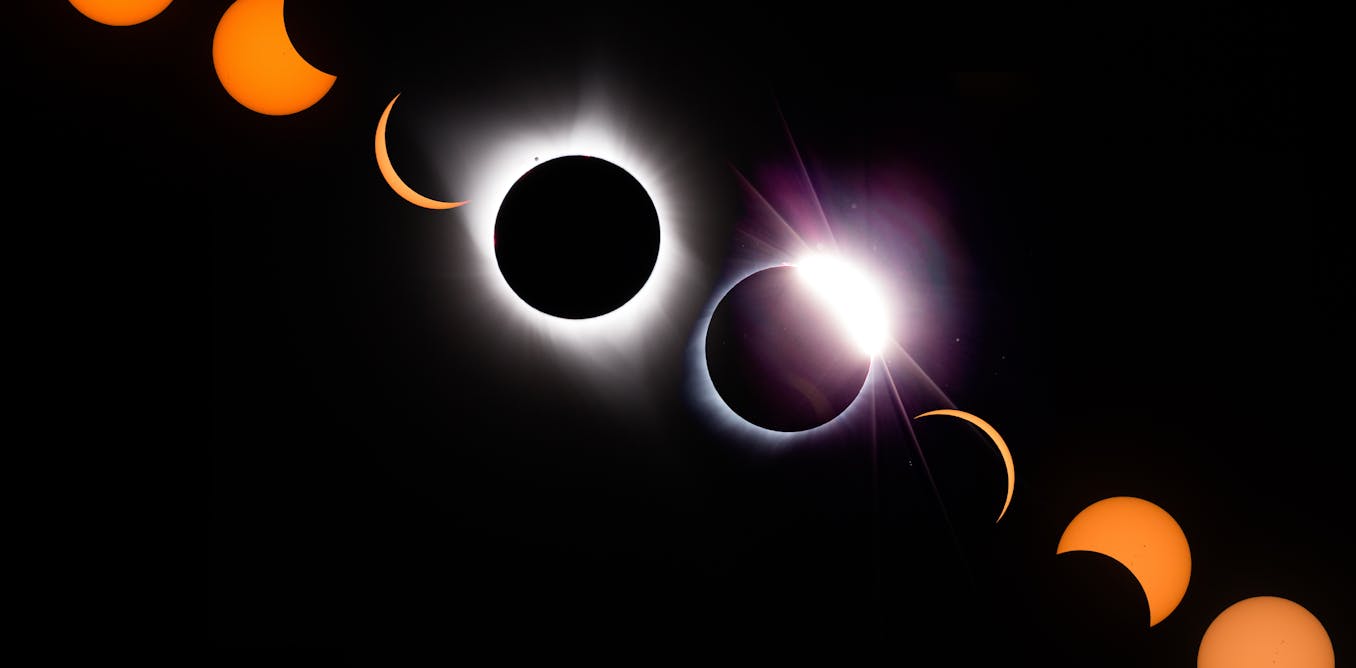
A solar eclipse is a rare, visually striking phenomenon. The Moon
passes between Earth and the Sun, temporarily hiding our star – a geometrical alignment spanning millions of miles.
A partial solar eclipse occurs when the Moon doesn’t fully block the Sun, resulting in a gentle dimming of the sky. A total solar eclipse, however, dramatically plunges a daytime sky into blackness.
Everything has to be perfect for this to happen. An astonishing cosmic coincidence means that solar eclipses as viewed from Earth are spectacular – and unlike those anywhere else in the solar system.
For a given place on Earth, a total solar eclipse will only occur once in a few hundred years. The next total solar eclipse takes place on Wednesday, August 12 2026. The path of totality (the area where a full eclipse can be seen) will pass through parts of Greenland, Iceland, northern Russia, Spain, and a small portion of Portugal.
In Britain and Ireland, between 90% and 97.5% of the Sun will be obscured by the Moon, depending on where a person is.
The eclipse starts at 6.08pm (BST) in Glasgow and Edinburgh, 6.12pm in Galway and Dublin, 6.13pm in Manchester and Liverpool, 6.15pm in Norwich and Birmingham, 6.17pm in London, Bristol and Cardiff and 6.18pm in Truro.
The UK Health Security Agency warned that looking directly at an eclipse can cause permanent eye damage. There are two safe ways to view an eclipse: specialist eclipse glasses (or handheld solar viewers) and indirect methods.

Nasa
Eclipse glasses or solar viewers must be genuine and sold by a reputable retailer. They should have specially designed filters that meet the international safety standard ISO 12312-2:2015(E). Indirect methods include projecting the Sun’s image onto a sheet of paper using a simple pinhole projector.
A solar eclipse’s appearance is wrapped up in the geometry of the bodies involved; it depends on the apparent sizes. This apparent size depends on the sizes and distances involved. The total solar eclipse we see from Earth is particularly special.
The Sun is around 400 times wider than the Moon, but also about 400 times further away, hence they appear approximately the same size in our sky. During totality, the Moon fits over the Sun like a puzzle piece slotting into place.
People are incredibly fortunate to be able to fly around our planet chasing such events, allowing eclipse watchers to gather under the Moon’s shadow. So how would solar eclipses look if we were able to travel to other planets?

Designua
Mars has two moons; the larger is Phobos, at around 14 miles across, and the smaller, Deimos, is only about 7.5 miles in diameter. Both moons are rather lumpy and irregularly shaped.
Neither moon has an apparent size large enough to produce a total solar eclipse on Mars. Phobos, being closer and larger, produces an eclipse that lasts only around 30 seconds. It’s very different from what we’re used to. Phobos appears as an oddly shaped silhouette that can cover just over one-third of the Sun.
Deimos, being smaller, and further away from Mars, appears as a small dot crossing the Sun. The eclipses of Phobos and Deimos are events we’ve seen, thanks to Nasa’s
Perseverance and Curiosity rovers allowing us to see eclipses on another planet.
A view from Jupiter
Jupiter has 101 moons, which includes the four large Galilean satellites. These moons can completely obscure the Sun from Jupiter, casting vast shadows across its cloud tops.
Jupiter, unfortunately, doesn’t have a solid surface, hence an observer would need to float on top of its clouds. From there, the moons would appear much larger than the Sun.
Although dramatic, this lacks the satisfying alignment we see from Earth of the Moon and Sun almost matching each other in size. The Galilean moons orbit so fast around Jupiter that such eclipses happen almost every day.

Nasa
Their shadows are visible from Earth through amateur telescopes as small, distinct black dots moving across the colour bands of Jupiter. The orbits of the moons can even sometimes align such that double, or even triple, solar eclipses are visible.
Saturn has even more moons, with 274 confirmed. Similar vast shadows are seen on
Saturn’s clouds during eclipses, with larger moons such as Titan causing the most dramatic displays. Saturn itself has seasons, similar to the Earth. Depending on the season, solar eclipses can happen daily on Saturn.
The limits of solar eclipses
There are parts of the solar system that will never, or very rarely, see a solar eclipse. Mercury and Venus have no moons, so unfortunately miss out on the spectacle entirely. As we go farther from the Sun, it appears smaller in the sky.
Comparatively small moons can therefore completely obscure it. From Pluto, the Sun would look like a very bright point in the sky. Pluto’s largest moon, Charon, would appear far larger and completely cover it up.
These would definitely class as total solar eclipses, but would be very different from the exquisitely balanced spectacle we see from Earth. Far out in the solar system, the moons don’t delicately fit over the Sun. Instead, they would utterly swallow it.
Throughout the solar system, solar eclipses are possible and, from some planets, frequent. From Earth, the occasional alignment of size, distance and time allows for total solar eclipses that make the Moon look as if it was made to fit perfectly over the Sun.
For a few transcendent moments, we are cast into a shadow that allows us to glimpse the solar corona peeking out from behind the Moon. There are many small, chance events that have made our planet habitable. This fleeting geometrical balance that produces our solar eclipses is a chance alignment that isn’t something functional. It’s just beautiful.

Alix Violet Freckelton does not work for, consult, own shares in or receive funding from any company or organisation that would benefit from this article, and has disclosed no relevant affiliations beyond their academic appointment.