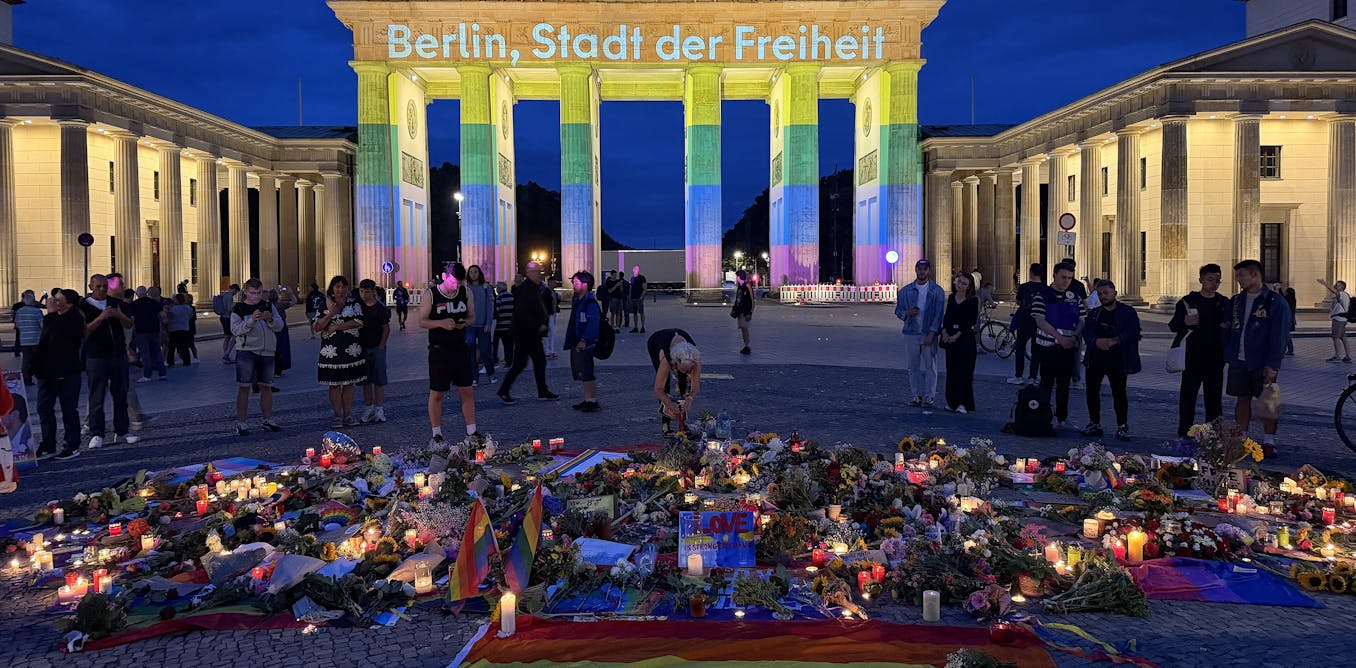
On Sunday, July 26, German police shot dead the suspected perpetrator of a car-ramming attack on Berlin’s Pride march, which had left one dead and 20 injured the day before. The suspect already had a police record due to his previous attempt to join the Islamic State in Syria and Iraq (ISIS).
In the 2010s, ISIS claimed multiple attacks on cultural events, mostly concerts. Some of its deadliest attacks on European soil were the 2015 Paris Bataclan attack and the 2017 bombing of an Ariana Grande concert at the Manchester Arena. More recently, in summer 2024, there was a failed ISIS-inspired plot to attack a Taylor Swift concert in Vienna.
There have also been previous directly homophobic ISIS-inspired attacks – the group also claimed responsibility for the 2016 attack on Pulse, a gay nightclub in Orlando, Florida.
As of 2018, ISIS no longer exists as a physical state, and without a political entity to inspire further attacks in Europe, its violence has slowed drastically over the last decade.
Yet the toxic ideology of “ISISism” – which seeks to resurrect a pre-modern Caliphate through modern, Western means, including social media – has continued to present the ultimate form of counter-hegemonic rebellion for a certain segment of young Muslims. Even stripped of its physical territory, the Islamic State still profoundly challenges and violates the sovereignty and safety of the US and Europe.
Many people believed that the foiled 2024 Vienna attack marked the end of the already dwindling trend of European-born Muslims launching ISIS-inspired attacks. While there has been relatively little Islamist violence since then, the Berlin attack indicates that radicalisation and violence are certainly not a thing of the past.
Read more:
Violent extremists wield words as weapons. New study reveals 6 tactics they use
The ‘new Jihadis’
In early August 2024, three Austrian youth allegedly sought to target “Swifties”, the fans of the American singer Taylor Swift, before her concert in Vienna in early August. The Austrian plotters had specifically declared their allegiance to ISIS.
The plotters of the Swift concert attack included two Austrians, one with North Macedonian roots and the other with Turkish roots, both second-generation Muslims. The attacker behind the Pride parade in Berlin had a similar background – he was born in Germany to Lebanese Muslim parents.
This trend backs up an argument made by Olivier Roy in a 2017 Guardian article entitled “Who Are the New Jihadis?” He argues that there are two demographics that usually join ISIS to conduct attacks in the West: second-generation European Muslims (often recruiting their brothers and sisters), and European converts.
According to Roy, the children of Muslim immigrants born in European states typically live a secular life. They grow up in not-so-religious households, and may go to nightclubs and consume alcohol and drugs. Those from poorer socioeconomic backgrounds may end up involved in petty crime.
At some point – often if they are incarcerated – they became “born-again” Muslims, embracing not just faith, but a more austere, radical version than their parents. They tend to meet in smaller religious groups, rather than the large mosques frequented by their families.
It must be stressed that this is a small segment of “second-generation” European Muslims. What this trend reflects is that the children of immigrant families may engage in a generational revolt against their parents, seeking to prove that they are more devout than their parents.
ISIS had little appeal for first-generation immigrants, who usually sacrificed everything for their children to have a better life in Europe. There are also very few “third-generation” European recruits, as by this juncture they are either well integrated into their society or have found ways to reconcile both dimensions of their identity.
Read more:
Islamic State: despite the fall of its caliphate, the group is still influencing terrorism
A political flashpoint
Political debates surrounding the attack have already begun, with German minister Alexander Dobrindt labelling the attack “Islamic terror” after the attacker’s past came to light.
His use of the word “Islamic” as opposed to “Islamist” may prove inflammatory. “Islamist” refers specifically to political Islam – which includes the beliefs of extremist groups like ISIS – while “Islamic” refers to the entire Muslim faith. Whether deliberate or not, Dobrindt’s wording could be interpreted as suggesting a link between Islam and terrorist violence.
Right-wing parties and public figures across Europe will undoubtedly use the attack on the Pride parade as another reason to restrict immigration, even as they themselves work to actively dismantle and undermine LGBTQIA+ rights.
But the US and EU members can confront extremist terror attacks. Instead of being pulled into Islamophobic finger-pointing, they can instead take steps to address the socio-economic conditions that lead people towards terrorism. Despair, hopelessness and anger are why the allure of ISISism still persists a decade after the declaration of the Islamic State.
Marginalised, desperate communities provide fertile ground for ISIS’ doctrine – and other forms of violent extremism across the political spectrum – to spread.
A weekly e-mail in English featuring expertise from scholars and researchers. It provides an introduction to the diversity of research coming out of the continent and considers some of the key issues facing European countries. Get the newsletter!