With around 3 000 hours of sunshine a year, Malta is ideally placed to harness the sun’s energy. But its scorching summers, salty sea air and occasional Saharan dust storms also make it one of Europe’s toughest environments for solar panels.
For Dr Brian Azzopardi, a renewable energy researcher from Malta, those challenging conditions present a unique opportunity. If solar panels can withstand the island’s climate, they should perform well almost anywhere in Europe.
Azzopardi is the chair of the Foundation for Innovation and Research – Malta, an organisation he helped establish to bridge the gap between academic research and industry.
For the past three years, he has been leading an EU-funded research initiative called PROMISE that looked at new ways to improve the monitoring, maintenance and reliability of photovoltaic (PV) systems in Malta, with potential lessons for the rest of Europe.
Malta’s solar expansion
Over the past decade, government grants and community schemes have helped solar power spread rapidly across the island, which is home to around 580 000 residents: a number that swells each summer with tourists.
“Since around 2010, we’ve gone from almost zero solar power uptake to around 20–22%,” said Azzopardi.
As solar power has expanded, however, a new challenge has emerged. Faults in PV systems often go unnoticed until electricity production has already fallen. By that point, the damage to the panels may already be significant.
To catch problems earlier, the researchers developed digital twins: digital replicas of real solar installations that allow different scenarios to be tested and potential faults to be identified before they affect the panels.
“
These systems are being tested in very harsh conditions in Malta. If they survive here, they should survive anywhere in Europe.
They also developed AI tools that scan incoming data around the clock, flagging faults automatically rather than waiting for someone to notice a fall in performance.
The research also focused on developing the next generation of solar specialists. Malta’s rapidly growing solar sector still lacks enough technicians and researchers with the expertise needed to keep systems operating efficiently.
By training people locally and sharing what they learn internationally, the team hopes Malta’s experience can benefit the rest of Europe.
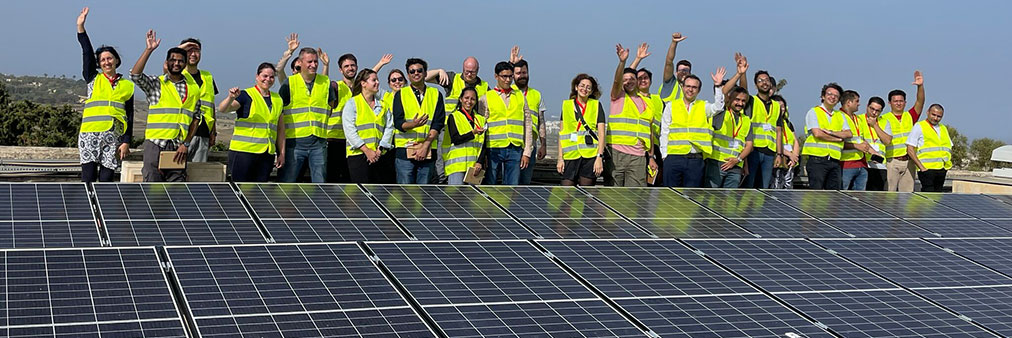
To achieve this, the researchers combined high-tech monitoring across 10 Living Labs – real-world test sites – with new approaches to PV reliability, education and training, including international summer schools that attract students from around the world.
Maintenance matters
Solar uptake, Azzopardi warned, is only half the story. “You see solar panels on rooftops, but whether they are working properly is still a question mark. Maintenance matters too.”
Most solar systems in Malta are small and privately owned, so their owners cannot rely on large maintenance contracts or sophisticated monitoring systems. Many assumed that once the panels were installed, little further attention would be needed.
“It’s true there are few moving parts, but maintenance is still needed. Bird droppings and environmental conditions such as shade from new buildings or damage to the panels can all affect performance,” he said.
The researchers installed commercially available sensors to measure electricity production, sunlight, wind and temperature.
The data fed into monitoring software capable of predicting when maintenance was likely to be needed, allowing repairs to be planned before faults caused significant losses in performance. Along the way, the team built valuable expertise that can now be applied in future research.
“Technically speaking, these systems are being tested in very harsh conditions in Malta,” said Azzopardi. “If they survive here, they should survive anywhere in Europe.”
Sharpening skills
The Living Labs became even more valuable once their data started feeding directly into the training schools, giving students hands-on experience with real solar installations.
Participants visited the sites and worked alongside researchers using advanced diagnostic techniques such as electroluminescence testing, where electricity is fed back into a solar panel, causing the cells to emit faint infrared light invisible to the human eye.
Specialised cameras then reveal tiny cracks and hidden defects that would otherwise remain undetected.
Students also developed practical inspection skills, learning how to assess panels visually and document faults using photographs and structured inspection checklists, a straightforward process that can still identify a surprising number of problems.
Learning by playing
Teaching these diverse skills effectively, however, is no simple task, said Melodie de l’Epine, who leads research and innovation activities at the Becquerel Institute in France – a specialist PV research and consulting centre and a key member of the PROMISE team.
“Operations and maintenance for photovoltaics is a huge subject,” she said. To keep such a mixed group of trainees engaged, the team turned to games and role play.
“
We need a strong, well-trained workforce that knows how to carry out maintenance and ensure longer system lifetimes.
“In the real world, operations and maintenance isn’t something you do in isolation. You’re receiving data, analysing problems, discussing budgets with management, and coordinating with maintenance teams – so I thought, let’s make them play the role,” de l’Epine said.
The researchers developed three board games, matching exercises and simulation challenges, including a Monopoly-style game in which students take on the role of a technician troubleshooting a solar installation. Each activity focuses on different skills, from diagnosing faults to managing maintenance budgets.
For younger audiences, they also created Dance of the Photon, a live performance in which dancers demonstrate how sunlight is converted into electricity inside a solar cell, bringing an invisible process vividly to life.
The lessons could prove valuable far beyond Malta. Small-scale installations account for around half of Europe’s total PV capacity, and many face exactly the same maintenance challenges.
Training the fixers
Developing smarter technology is only part of the challenge. Ensuring there are enough people with the skills to install, monitor and maintain solar systems will be just as important if Europe is to make the most of its growing investment in renewable energy.
“We need a strong, well-trained workforce that knows how to carry out maintenance and ensure longer system lifetimes,” said de l’Epine. “This requires a lot of training, but also for individual owners to acknowledge that maintenance is something they need to invest in.”
The research has shown that improving solar power is about much more than installing new panels. For Malta, one of Europe’s sunniest countries, harsh conditions have become an unexpected advantage.
By testing technologies in some of Europe’s most demanding environments, the researchers are helping to develop solutions that could keep solar panels performing reliably across the continent for years to come.
Research in this article was funded by the EU’s Horizon Programme. The views of the interviewees don’t necessarily reflect those of the European Commission. If you liked this article, please consider sharing it on social media.