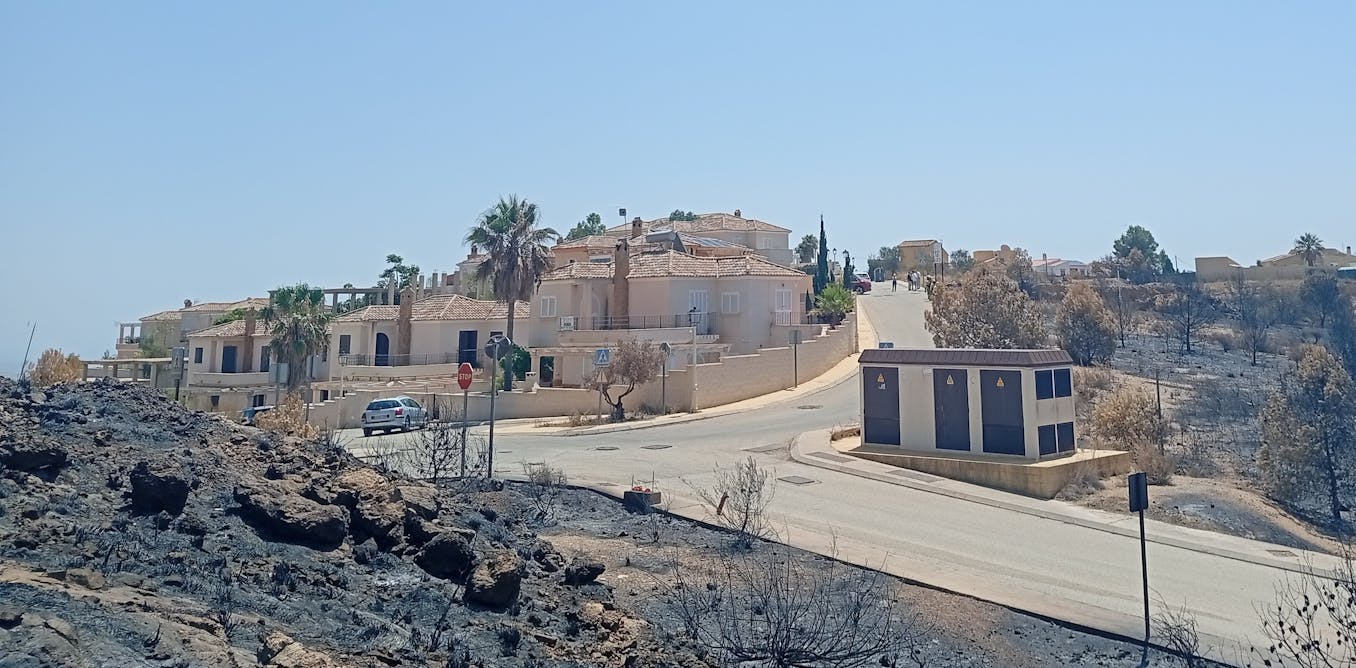
As the flames advanced towards the village of Bédar, in the Almería province of Andalusia, the mayor gave a desperate order to ring the church bells to warn residents. It was not enough. The July 9 Los Gallardos fire, which claimed 13 lives and burnt 7,000 hectares, was Spain’s third deadliest on record.
Most of the victims were retired foreigners living in isolated homes, who died trapped in their vehicles or fleeing on foot along dead-end paths in a landscape dominated by scrubland and rugged terrain, most of which is difficult to access.
High temperatures and extremely dry weather turn scrub, grasslands and bushes into highly flammable fuel. This, combined with complex terrain that makes fire spread faster and unpredictably, poses an enormous challenge for firefighting efforts.
Andalusian legislation requires local emergency plans for forest fires in high-risk areas, and self-protection plans for detached buildings and housing estates. However, there is a widespread problem with compliance and implementation of these measures.
Fires are changing
The disaster in Los Gallardos shows that this problem will only get worse, unless we take decisive and effective action that goes beyond the current dominant paradigm of simply extinguishing and resisting fire.
Where, when and how fires occur is changing. Highly destructive fires are on the rise, housing is expanding into the urban-forest interface. This exposes more homes to fire, and the the risk is increasing most quickly in scrubland and grassland areas, which are not typically associated with fire risk.
This is a major problem for communities that do not know how to respond to a risk they have not often been exposed to. We therefore need to urgently rethink how fire risk is managed.
Read more:
Spain wildfires: with 13 dead, we need to start measuring fire damage in lives – not just hectares
Improving fire resilience
It is unsustainable to respond only after a disaster has happened. What we need are strategies based on preparedness, mitigation and adaptation. The following eight points are particularly important in achieving this.
1. Manage social vulnerability
Wildfires exacerbate the existing social vulnerabilities that affect people’s ability to anticipate, cope with, withstand and recover from them. In high-risk areas the population may consist of elderly people, people living alone in isolated homes, with financial constraints, or who do not know the local area well.
Fires also pose a risk to local economies. Businesses – including those that provide public services and infrastructure – can be vulnerable for a range of reasons, including flammable facilities, their location, or disruptions to supply chains, essential services and staff mobility.
Targeted planning can identify and address all of these vulnerabilities.
2. Adopt nature-based solutions
Nature-based solutions have not been fully integrated into fire risk management, even though they are widely recognised as essential parts of climate change adaptation and nature restoration.
Nature-based solutions include controlled grazing, the creation of less flammable habitats, green firebreaks, and the restoration of water networks to increase ambient humidity and create areas that slow the spread of fire. These measures also bring many additional benefits for the local population and economy.
3. Create (and update) emergency, self-protection and training plans
Local authorities must draw up emergency plans that the public can access. Isolated dwellings and housing estates must have their own coordinated plans. The plans should include fire hydrants and water supply points, accessible warning systems, access and evacuation routes, and protocols for vulnerable people.
But plans alone are not enough without training. There is also a need for ongoing programmes, tailored to each community, that train people to safely maintain their homes and surroundings, familiarise them with meeting points and shelter areas, and teach them to distinguish between lockdown and evacuation.
Drills are essential. Evacuation is not the same as fleeing, and emergency response must be planned and practised.
4. Promote collective action
Risk reduction is most effective when it is community-based, as this increases overall collective resilience. This means public authorities, community organisations, and the public and private sector must all work alongside one another.
The public should also be actively involved in the design of emergency plans. This builds legitimacy, improves the capacity to respond to fires, and fosters trust and a sense of shared responsibility for preventing fires.
5. Promote integrated and coordinated governance
Fire risk management cannot be the sole responsibility of forestry or firefighting services – it needs an integrated system. All agencies that act in the area must take fire risk into account when making decisions.
In practice, this means avoiding new construction and establishing specific building regulations in high-risk areas, creating buffer zones between different land uses, and promoting uses that help to maintain fire-resilient landscapes.
6. Incentivise risk management
Economic tools and behavioural insights can be leveraged to make self-protection measures and land management the easiest and most rewarding options. This includes nudges: interventions that are designed to encourage but not force people to make certain decisions.
One example of this is payments for environmental services, which financially incentivise land management practices that reduce wildfire risk.
The role of insurance is also evolving in the face of natural and climate-related risks. Instruments are being designed based on a proactive model that incentivises individual and collective risk-reduction behaviour.
7. Improve monitoring and advance warning systems
Up-to-date information on a fire’s development is essential. Real-time monitoring systems, sensors, satellite imagery, predictive models of fire behaviour and alert applications providing detailed information can all improve response capabilities and enable safer evacuations. Integrating these tools into local management plans is a necessary investment.
8. Encourage public and private investment in long-term preparedness
Investments in prevention and preparedness provide significant returns. Growing requirements – both regulatory and voluntary – for the private sector to disclose information on nature-related risks and dependencies are generating new demand for investment products (carbon and biodiversity credits, habitat banks, environmental impact bonds, and so on).
This growing private investment must now be channelled towards measures that strengthen both people’s and the landscape’s wildfire resilience. This is to supplement, not replace public investment.
The Los Gallardos blaze serves as a reminder that we need to fundamentally change the way we understand and manage fire risk. Investment in preparedness and coordinated planning between public authorities, the private sector and the general public could be the key to ensuring that, should the alarm bells ring again, the population is ready to respond.
A weekly e-mail in English featuring expertise from scholars and researchers. It provides an introduction to the diversity of research coming out of the continent and considers some of the key issues facing European countries. Get the newsletter!