Long-term monitoring shows that Amazonian floodplain forests (várzea) can support high jaguar densities, but apparent stability may mask underlying population decline, highlighting the need for sustained conservation efforts under increasing climate extremes.
Jaguars are the largest felid in the Americas and play a key role in maintaining ecosystem function. Across much of their range, populations have declined due to habitat loss, hunting, and human–wildlife conflict. In the Amazon, despite extensive remaining habitat, long-term demographic data remain scarce. This gap is particularly concerning as climate change is increasing the frequency and intensity of extreme floods and droughts, which strongly influence várzea ecosystems. These floodplain systems depend on seasonal inundation to sustain productivity but are sensitive to changes in hydrology and human access.
Here, we present a 17-year camera-trap monitoring study of jaguars, comprising 14 sampling sessions from the Mamirauá Sustainable Development Reserve in central Amazonia—one of the longest jaguar studies to date—to assess population dynamics in a flood-pulse ecosystem. We estimated key demographic parameters, including survival, recruitment – the first such estimation in Amazon -, and changes in density over time. Mamirauá is a sustainable-use reserve where local communities are actively involved in resource use and conservation, providing a unique opportunity to evaluate jaguar persistence in a landscape shaped by both seasonal flooding and human activity.
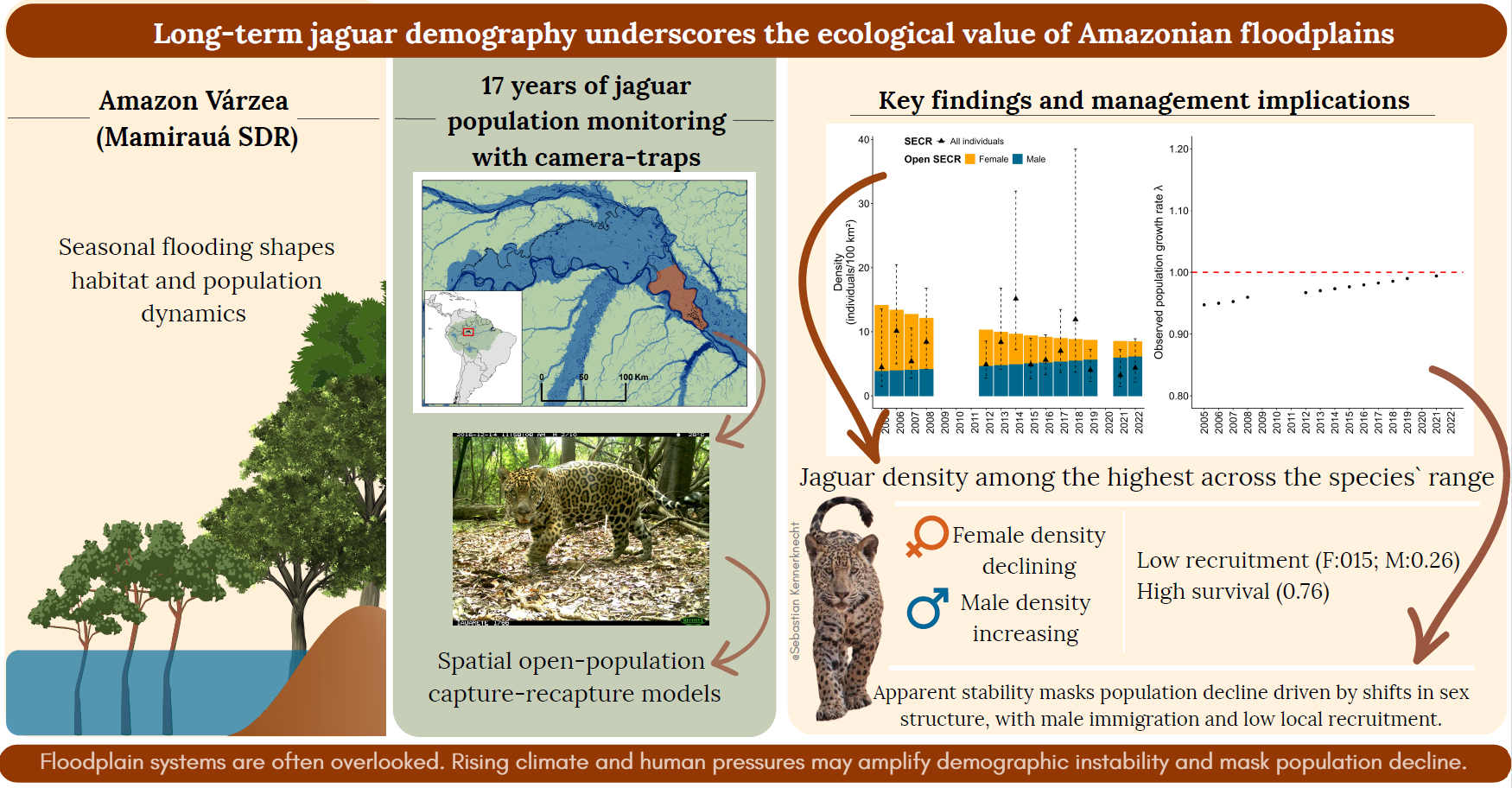
We found that Mamirauá supports some of the highest jaguar densities recorded, comparable to other productive floodplain systems such as the Pantanal and Llanos. However, despite these high densities, multiple lines of evidence indicate a more complex demographic pattern. Recruitment is sex-specific, male density increased over time, likely reflecting immigration from surrounding areas, whereas female density declined. Consistent with this, observed population growth rates were below one (mean=0.97), indicating a gradual decline and slow population turnover. These results suggest that male immigration may compensate for local male removal, likely due to hunting, thereby masking an underlying decline in the breeding segment of the population, potentially driven by increased infanticide (from external males) and reduced reproductive success.
Although we did not detect direct effects of flood pulse on demographic rates, seasonal water levels likely influence accessibility for hunters and connectivity among habitats, thereby shaping movement and immigration dynamics. Together, our findings indicate that high density alone may not reflect population health, and that demographic structure—particularly female survival and recruitment—is critical for long-term persistence.
Our results highlight that effective jaguar conservation in floodplain systems requires not only sustained community-based management but also targeted actions to support local male persistence, female survival and recruitment. They also emphasize the importance of long-term monitoring with consistent sampling intervals to detect subtle demographic changes. As climate extremes intensify, integrating local management with strategies that account for changing hydrological regimes will be essential. Amazonian floodplain forests remain underrepresented in conservation planning, yet they are vital for biodiversity, local livelihoods, and the long-term viability of jaguar populations.
This is a Plain Language Summary discussing a recently-published article in Journal of Applied Ecology. Find the full article here.
It is also available in Portuguese here.