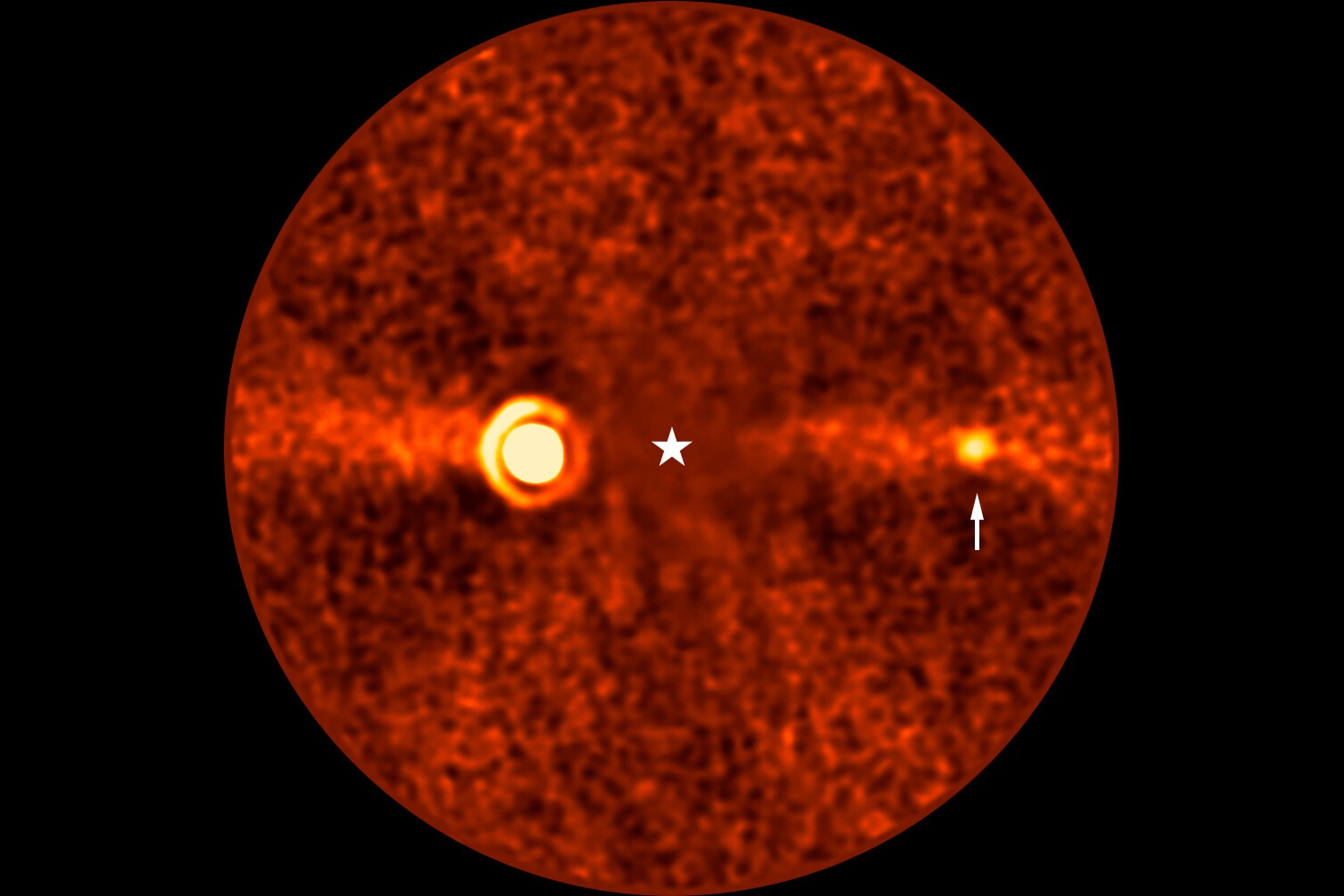
An international team has discovered a third planet orbiting the nearby star Beta Pictoris.
The new planet, Beta Pictoris d, is 100 times fainter than Beta Pictoris b, the first planet discovered in the same system.
It is among the lightest exoplanets ever imaged from the ground.
This first clear detection of Beta Pictoris d was made using the Enhanced Resolution Imager and Spectrograph (ERIS) instrument on the European Southern Observatory’s (ESO) Very Large Telescope in Chile.
A key component of ERIS is the NIX infrared camera.
The camera was developed and built by the Science and Technology Facilities Council’s (STFC) UK Astronomy Technology Centre (UK ATC) in Edinburgh, in collaboration with ETH-Zurich and Leiden University.
The NIX infrared camera. Credit: STFC
Much of the UK research was also supported by STFC.
A serendipitous discovery
Dr Ben Sutlieff, astronomer at the University of Edinburgh and co-lead of this new study published in ‘The Astrophysical Journal Letters’, said:
This was a serendipitous discovery. We initially wanted to look more at a known planet in the system, Beta Pictoris b, to see how it changed over time. However, when we went to analyse our images of the system, we noticed something else that led us down an entirely new path.
Gas giant
The newly discovered planet is 100 times fainter than Beta Pictoris b, making it the faintest exoplanet ever directly imaged from Earth.
Like Jupiter and Saturn, Beta Pictoris d is a gas giant, but at just 2.4 times the mass of Jupiter, it is much lighter than the system’s two previously known planets.
Beth Biller, Professor of Exoplanet Science at the University of Edinburgh and co-author of the study, said:
Planets seem to have friends, many of the famous directly imaged exoplanet systems seem to have multiple giant planets in the same system, and there are likely to be even more lower mass planets hiding in these systems that might be revealed with instruments in the future.
Technical challenge
Direct imaging works by capturing light from the planet itself, rather than detecting its effects on its host star.
Revealing such a faint world alongside a much brighter star pushes this technique to new limits and marks a major observational achievement.
William Taylor, instrument scientist at UK ATC, said:
This discovery demonstrates the remarkable capabilities of the NIX camera. Detecting a planet this faint next to a much brighter star is an immense technical challenge, and it is rewarding to see an instrument we led here in Edinburgh helping astronomers uncover new worlds.
Hide-and-seek
To confirm the discovery, the team searched through more than a decade of archived observations from ESO’s telescopes, finding evidence of the planet in images dating back 11 years.
Jayne Birkby, astronomer at the University of Oxford and co-author of the study said:
Planet d, it seems, has been playing a game of hide-and-seek with us for over a decade and only now can we say ‘found you!’
An independent team led by Aidan Gibbs at the University of California also detected Beta Pictoris d using the James Webb Space Telescope. Their findings are published alongside the ERIS results in ‘The Astrophysical Journal Letters’.
Exoplanetary system
Located 63 light-years from Earth, we now know the Beta Pictoris system features at least three planets.
This makes it only the second system, after HR 8799, where more than two planets have been directly imaged.
Dr Ben Sutlieff, adds:
Systems with multiple directly imaged exoplanets are the ‘holy grails’ of discoveries, because they can teach us a lot about what different exoplanets are like in the same formation environment.
The research highlights how cutting-edge instrumentation, combined with astronomical archives spanning decades, can uncover worlds that have remained hidden in plain sight.