– Advertisement –
Power cuts, fuel shortages, empty shelves: Cuba is in the midst of a dramatic supply crisis. In this interview, political scientist Bert Hoffmann explains why US policy under Trump is drastically exacerbating the situation, what role the Cuban military is playing, and why the country could face a humanitarian disaster in the coming months. Hoffmann warns against a dangerous spiral of escalation: because the US has so far failed to find a way to divide the Cuban leadership along the lines of what happened in Venezuela, the military threat is being ramped up ever further. Initially, limited actions are possible, such as targeted violations of Cuban airspace or territorial waters, as well as attacks on individual infrastructure targets.
Bert Hoffmann
Bert Hoffmann, a political scientist from Berlin born in 1966, is a researcher at the GIGA German Institute of Global and Area Studies in Hamburg. He is in charge of the institute’s Berlin office. He also teaches as an honorary professor at the Free University of Berlin and serves as president of CEISAL, the European Council for Latin American Studies
The situation in Cuba in the summer of 2026: For Trump, Cuba is “next in line”
In January 2026, US President Trump issued an executive order declaring a national emergency and designating Cuba as an extraordinary threat to national security. The order imposes tariffs on imports into the US from countries that supply oil to Cuba, either directly or indirectly. In practice, this has led key suppliers such as Mexico to halt their deliveries. In early May, Donald Trump significantly expanded the sanctions through an Executive Order, thereby making it possible to sanction any foreign company doing business with Cuban entities in the energy, mining or financial sectors.
At the same time, in January 2026, the US government intervened militarily in Venezuela and arrested President Maduro. Trump publicly declared that Cuba would be next. A report by the US news portal Axios in May accused Cuba of having acquired more than 300 military drones from Russia and Iran, and of considering attacks on Guantanamo, US ships and possibly Key West. Cuba dismisses this as a fabricated pretext
Dramatic supply situation: Hardly any food, hardly any electricity or water
Bert Hoffmann, how would you describe Cuba’s current economic situation, and what does it mean in practical terms for people’s everyday lives?
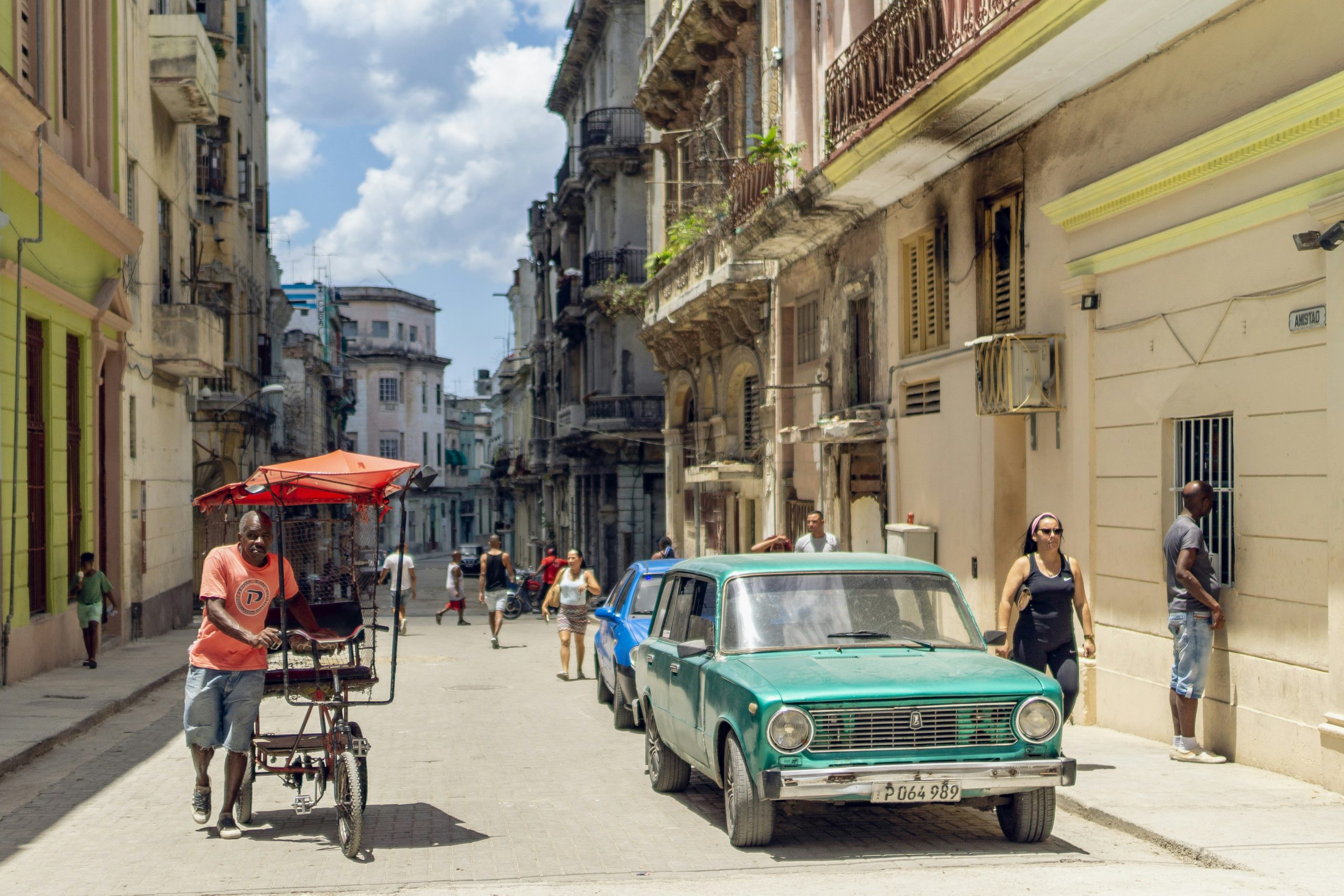
The supply situation has become dramatic. The de facto fuel blockade imposed by the Trump administration has the island in a stranglehold. Since the beginning of January, the US has allowed just one tanker to call at Cuba.
Daily power cuts lasting 18 to 22 hours are now the norm. The island is 100 per cent dependent on imports for petrol and diesel for lorries. Now, many foodstuffs are no longer making it from the fields to the cities, the water supply is failing in many places, and there is a shortage of everything.
Does this situation affect everyone in Cuba equally?
No. For a long time after the 1959 revolution, Cuba was one of the most egalitarian societies in the world. But those days are over. Today, what matters is whether or not you have access to the ‘dollar world’. Those who have relatives in the US who send them money or food can still make ends meet. In Havana, there are still shops where you can buy Spanish ham and Chilean wine – and there are Cubans who shop there. The majority, however, see this as a glaring inequality under the guise of a system that calls itself socialist. And among those benefiting are both the relatives of pro-Trump Cubans in Miami and the current elite in government, the military and the business sector.
Trump’s sanctions are driving Cubans into utter destitution
US sanctions have been in place since the Castros came to power in 1959. What distinguishes the current situation qualitatively from previous periods of sanctions?
With the US military strike against Venezuela in early January, Cuba lost its most important ally. Since then, the South American country has been barred from supplying oil to Cuba. Other countries have also been threatened with sanctions if they attempt to send oil to Cuba. These are no longer ordinary sanctions, where a country prohibits its own companies or citizens from engaging in certain business dealings, but rather an imperial policy of bullying by the US against other countries. For instance, the US also forced the major Canadian mining company Sherritt to leave the country after more than 30 years. Spanish hotel chains have now also terminated their operations in Cuba because they fear that, otherwise, they would be excluded from all US-dominated financial transactions and have their accounts in the US frozen. The major shipping companies Hapag-Lloyd and CMA-CGM have also ceased their operations in Cuba – not because of Cuba, but because of the massive threats from the US. All of this goes far, far beyond ‘sanctions’ or an ‘embargo’ as we usually understand them.
How much of the crisis is down to US pressure, and how much to the system’s own economic failings?
Cuba has been in crisis for a long time. And much of this is home-grown, without a doubt. Investment has gone into luxury hotels rather than food production. They have relied on cheap oil from Venezuela and neglected solar energy for far too long. And on top of that, there are countless inefficiencies and structural flaws in the state-socialist economic system! Over half of the agricultural land lies fallow because it is simply not profitable for farmers and rural cooperatives to grow beans or rice there. None of this should be downplayed. And yet: the current, truly dramatic escalation is a direct consequence of the Trump administration’s policy of strangulation. Five months without oil supplies – even Austria would be in a state of emergency!
How stable is the regime actually at the moment?
Nobody knows for sure. No one looks behind the scenes. But so far, the elite have shown great unity – not least because the threats from the US affect them all collectively. There is a great deal of frustration and despair amongst the population. Time and again, you hear people say: ‘Things cannot go on like this!’ There have been isolated acts of protest or rioting. It is to be expected that these will increase over time. But there are as yet no signs that these will develop into powerful mass demonstrations capable of shaking the regime. This is also down to US policy itself: if the Trump administration is proclaiming far and wide that it is striking a ‘deal’ with those in power in Havana – why should people then take to the streets themselves and risk a prison sentence lasting years? And Venezuela has shown that Trump and Rubio do not reward the opposition, but rather want a regime that has been brought round to their way of thinking, one that is compliant with the US and guarantees internal order and stability, as well as a secure business climate for US companies.
The military is said to control a fortune through its own companies. What role does GAESA play?
GAESA (Group for the Management of the Armed Forces’ Enterprises, ed.) is a large holding company controlled by the Cuban military. It holds major stakes in profitable sectors such as tourism, construction, port logistics and finance. All of this operates outside the regular state budget or parliamentary oversight. The justification given is that this lack of transparency is necessary, as otherwise US sanctions would ruin all business dealings. There is, of course, some truth in that. Nevertheless, this sector has become so independent that it runs counter to the socialist principles of the Cuban state. And in recent years, GAESA has obsessively concentrated the bulk of its investments on ever more luxury hotels – a move met with great bitterness by the population and one that is now coming back to haunt the state in the current crisis.
President Díaz-Canel, the Castros and the military – who really governs Cuba?
How powerful is President Díaz-Canel really? Where does the real decision-making power lie?
Díaz-Canel has been President since 2018, but in practice he is more the country’s chief administrator than the embodiment of state power. The historic leader of the Cuban Revolution, Fidel Castro, died ten years ago. His brother and successor, Raúl Castro, has just turned 95; he holds no formal office, but he remains the government’s most important symbolic figure.
Are Raúl Castro and his grandson the real puppet-pullers?
Any ‘deal’ with the US, should one come about, would need at least his tacit approval to ensure that the military and security forces back it. That is why his grandson, Raúl Guillermo Rodríguez Castro (popularly known as ‘El Cangrejo’, ‘the Crab’), plays a central role in the talks with the US. Ultimately, however, there is probably not just one ‘puppet master’ behind the scenes, but rather an indefinable circle of leading generals and party cadres within which fundamental issues – such as negotiations with the US – are decided.
Do you think a US military attack is likely, perhaps along the lines of what happened in Venezuela? Or is the Cuban regime more united?
The fact that there has not yet been a ‘Venezuelan solution’ in the past five months is, in itself, an answer. Clearly, the Cuban regime is more united; clearly, the US has not yet found a ‘Cuban Delcy Rodríguez’. As a result, they have continued to ramp up their military threats. This, of course, brings with it its own logic of escalation:
To lend credibility to the military threats, the US may well take military action in the foreseeable future. However, I assume this will initially be on a limited scale: targeted violations of Cuban airspace or territorial waters, or air strikes against individual infrastructure targets.
An open intervention, or even an attempt to eliminate the leadership in Havana through a commando operation – the US is likely to shy away from such actions for some time yet, as these involve considerably higher risks than was the case in Venezuela.
Hardline Cuban exiles are waiting with bated breath, whilst Europe lets Trump have his way
What is the Cuban diaspora’s stance on the current conflict? Is it as uniformly anti-regime as is often portrayed?
The spokespeople for the Cuban community in Miami are anti-regime hardliners with extremely aggressive rhetoric. Behind this, however, there are also differences: it is precisely those who have close family members on the island who view with great concern how they are suffering the longer the policy of strangulation continues without yielding rapid results. In Washington, one might think that time is on the US’s side and that one can confidently sit back and wait as conditions on the island become increasingly unbearable. The situation looks very different when it comes to one’s own mother or grandfather, who no longer has a water supply or can no longer get to hospital.
What is Europe doing? How does starving the population square with international law, regardless of one’s stance on the regime?
With a few exceptions – foremost among them Spain – Europe’s governments are reluctant to enter into a conflict with the US over Cuba. That is why there are hardly any protests against US policy. When Brazil’s President Lula was visiting Germany, German Chancellor Merz did at least say that Cuba posed no threat to third countries and that there was no justification for US military intervention. But when it comes to further protest or condemning US policy, hardly anyone is willing to go that far.
Yet there is an obvious parallel: European governments repeatedly point out that Putin used energy as a weapon against the civilian population in Ukraine by attacking the electricity and heating infrastructure in the middle of winter.
In Cuba, the US policy of blocking all oil supplies is nothing other than using ‘energy as a weapon’, causing massive suffering among the civilian population.
Future scenarios for Cuba
If you had to venture a prediction for the coming twelve months, which scenarios do you consider most likely?
-
One possible scenario is, of course, a negotiated agreement between the US and the leadership in Havana.
The bare minimum of such an agreement would be to resume oil supplies to the island in return for a series of concessions. These might include the release of prisoners, greater openness to investment from the US and from Cubans living abroad. In principle, the president’s resignation also seems possible. In return, there would be institutional guarantees for the military and security forces. However, Cuba is far too significant a symbol for the US for such a limited solution to seem realistic to me following the escalation of recent months. The hardliners in the US want to see the symbol fall. And that is what makes negotiations so difficult. When Trump says: “I can do whatever I want with Cuba!” – however bad the situation may be and however pragmatic the leadership in Havana may be – this leap into the unknown is virtually impossible to take.
2. The US intervenes militarily and installs a government to its liking.
Those who advocate this tend to assume that it would go as quickly and smoothly as it did in Venezuela. But that is questionable. Militarily, the US is, of course, vastly superior and could win quickly. But they do not want to send thousands of US soldiers and US police officers to Havana ‘to run the country’ (to govern the country, ed.). They want the existing security forces, once they have switched political allegiance, to do this for them. And this could prove complicated in Cuba. That is also what gives the current Cuban leadership a certain degree of bargaining power, however dire the economic situation may be.
3. No negotiated solution is reached, nor is a military decision taken.
In that case, Washington’s policy of strangulation would continue. And if Cuba fails to bring substantial quantities of oil into the country despite this blockade, the situation will become increasingly unbearable for the majority of Cubans.
The country would then indeed be heading for a humanitarian catastrophe. But perhaps there are other, more peaceful and humane ways out of this situation that I simply cannot yet make out clearly in my crystal ball. I very much hope so.
The rights to the content remain with the original publisher.
Post Views: 9
– Advertisement –