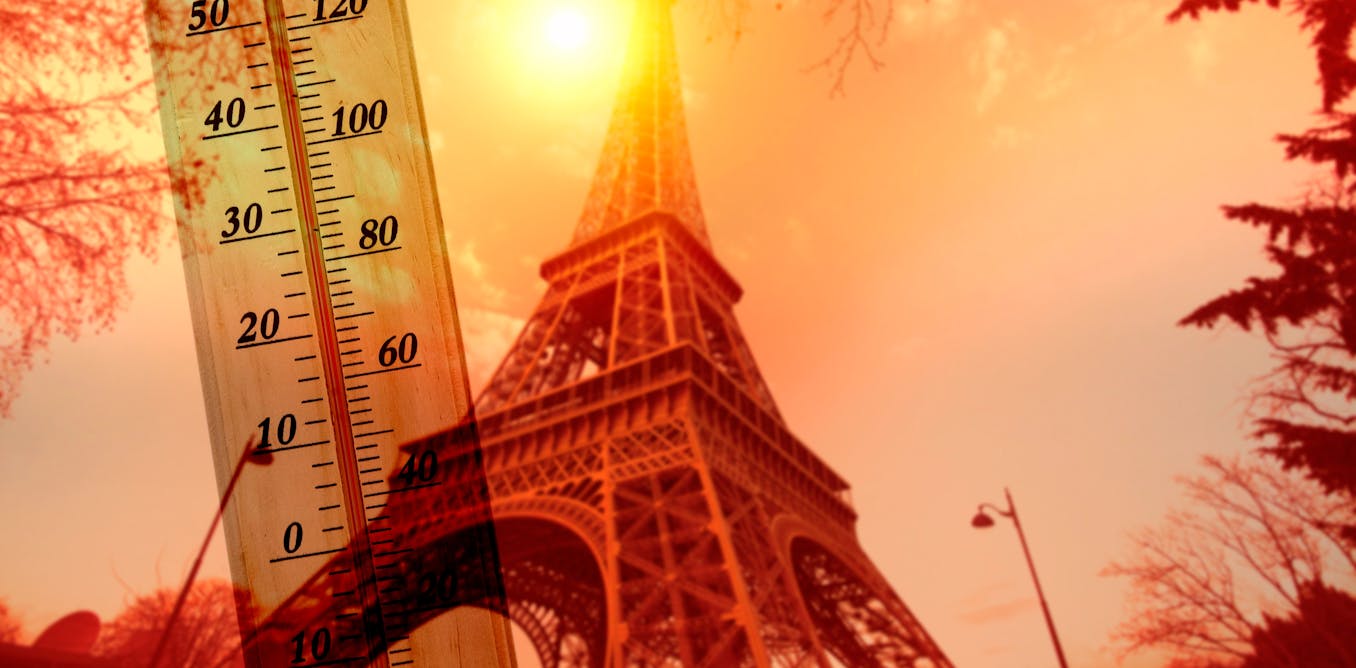
It is only June, and Europe is already baking through its second extreme heatwave in two months. Temperatures have topped 44 degrees Celsius in parts of the continent. Heat alerts are now in place for several countries, with six at the most severe red level.
France placed 72 of its 96 departments under red alert, and at least 40 people have drowned trying to escape the heat.
In Spain, temperatures peaked at 45.1°C, with 101 heat-related deaths in May alone, the highest ever recorded for the month.
The UK broke its all-time June temperature record. Cities are closing schools, power grids are buckling, and hospitals are reporting a surge in heat-related emergencies.
None of this should have been a surprise. Europe is the fastest-warming continent on Earth, heating at roughly twice the global average, and scientists have been warning for decades that human-made climate change would make extreme heat more frequent and more severe. Current projections expect the next five years to shatter even more records, making this the “new normal”.
The summers European residents grew up with no longer exist, and extreme heat is no longer an anomaly, but the new baseline. This means the question now is no longer whether extreme heat will return, but whether European cities can survive it.
A climate disaster that isn’t treated like one
Extreme heat kills more Europeans than any other climate hazard.
According to the World Health Organisation (WHO), over 175,000 people die every year from heat-related causes across the continent.
Despite the numbers, extreme temperatures have not been treated with the same urgency as other disasters, such as storms, wildfires, or floods. Most governments are still improvising, and there is no coordinated response to extreme heat, as it is still treated as a weather inconvenience rather than a life-threatening hazard.
However, this framing is starting to shift. At COP30, the United Nations office for Disaster Risk Reduction (NDRR) launched a new Extreme Heat Risk Governance Framework. It formally recognised extreme heat as one of the most deadly and least managed climate threats. Although this framework is a step forward, decades of fragmented policies, short-term crisis thinking, and chronic underinvestment in public services have left Europe dangerously exposed.
As a result, every summer that passes without meaningful progress is another summer that will cost lives.
Europe is not built for this
A recent report by the UK’s Climate Change Committee argued that the country is built for a climate that no longer exists, warning that temperatures exceeding 40°C are becoming increasingly common. The same could be said of virtually every European country. Cities were designed for a different era with concrete roads, pavements, and buildings that absorb and trap heat rather than deflect it, turning urban areas into furnaces that run four to six degrees warmer than their surroundings.
Some cities are already responding. For instance, Paris has pledged to plant 170,000 trees in public spaces, and Marseille is depaving historic plazas and mapping shaded walking routes.
Other countries are also taking action by replacing standard pavement with cool surfaces and reflective road paint, rethinking building codes, and redesigning public spaces with passive cooling in mind. However, none of it touches the underlying problem. Europe is still largely powered by fossil fuels, and its food systems, housing and transport networks all carry a heavy carbon cost.
The EU’s greenhouse gas footprint amounts to around 9 tonnes of CO₂ equivalent per person per year, well above the global average of roughly 5 tonnes.
Progress is being made, but not fast enough. Train travel is still more expensive than flying on many routes, building codes still allow new construction that will soon be uninhabitable, and cooling centres, shaded public corridors, and proactive outreach to elderly people living alone remain the exception rather than the rule.
Heat action plans exist in some cities, but few are legally binding, and fewer still have the budgets to match their ambitions.
Individual action matters, but it cannot substitute for the systemic changes that only governments and institutions can deliver. Eating less meat or flying less makes a difference at scale, but the clock will not stop running unless emissions are cut at the source.
Adaptation and mitigation need to happen together, and neither can wait.
The window is narrowing
The EU is preparing a climate resilience strategy due at the end of 2026, which is expected to introduce legally binding rules and monitoring tools to coordinate action across member states. It is a step in the right direction. But as this week’s heatwave has made clear, the gap between what is being planned and what is already happening on the ground is widening fast.
The question is not just how to respond to the next heatwave, but how to govern, finance, and rebuild for a continent that is already living in a different future.
A weekly e-mail in English featuring expertise from scholars and researchers. It provides an introduction to the diversity of research coming out of the continent and considers some of the key issues facing European countries. Get the newsletter!