- Cambodia’s government is systematically coercing and publicizing confessions from detained political opposition members and activists to undermine their political standing.
- By compelling the activists to join the ruling party, the authorities seek to discredit them and further cement effective one-party rule.
- The Cambodian government should drop politically motivated charges, quash unjust convictions, and immediately and unconditionally release wrongfully held activists and opposition politicians.
(Bangkok) – Cambodia’s government is systematically coercing and publicizing confessions from detained political opposition members and activists to undermine their political standing, Human Rights Watch said today. This mistreatment is part of a decade-long government campaign against political opponents, enabled by a government-controlled judiciary and state-aligned media outlets.
Cambodian authorities in recent years have frequently filed baseless criminal charges against opposition party members and activists to pressure them to make public apologies and join the ruling Cambodian People’s Party (CPP) in exchange for being released from detention. State-aligned media regularly publish videos or statements of these coerced confessions, discrediting the political activists.
“Cambodia’s ruling party threatens political activists with absurd criminal charges and then coerces them to confess to the bogus crimes to gain their release,” said Bryony Lau, deputy Asia director at Human Rights Watch. “By compelling the activists to join the CPP, the authorities seek to discredit them and further cement effective one-party rule.”
Human Rights Watch reviewed more than 140 videos and news reports of public apologies and confessions by activists over the last decade and interviewed nine people, including activists and political opposition members, detainees’ family members, and defense lawyers. Human Rights Watch did not publicly identify those interviewed for their protection.
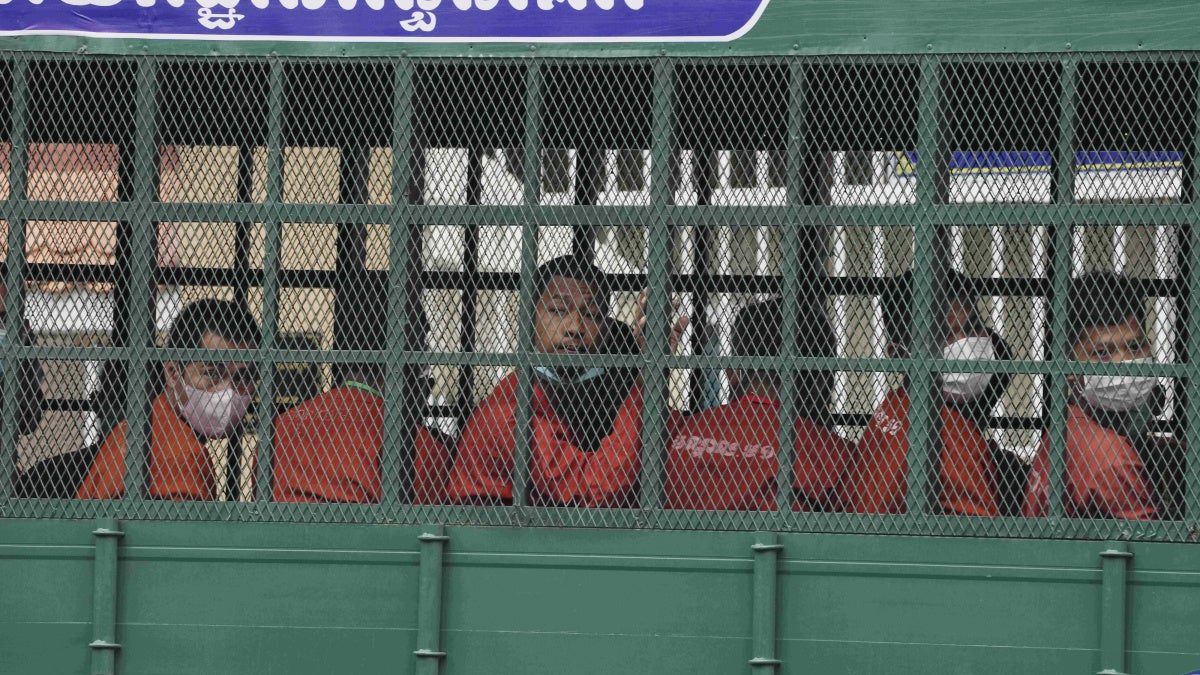
The coerced confessions are often filmed, and in many videos, activists face the camera wearing orange or blue prison uniforms. In several videos, it appears the activists are reading from prepared statements. The confessions are often accompanied by apologies for ostensible crimes related to their political activities, and requests to join the ruling party.
Activists and opposition party members have increasingly faced fabricated charges and pressure to defect since the longtime leader, Hun Sen, stepped down as prime minister and transferred the position to his son, Hun Manet, after the deeply flawed 2023 elections. Under Prime Minister Hun Manet, the government has continued to crack down on the political opposition, environmental and social activists, and all forms of dissent in the country. Forced confessions are frequently addressed to Hun Sen, now Senate president, and Hun Manet.
“They came to me in prison and said, ‘If you join the CPP, they’ll let you out of here,’” one activist said. A lawyer who represents many government critics in detention said: “For my clients who are political activists, 100 percent of them receive pressure to confess and join the ruling party in order to be released.”
The ruling party’s control over the judiciary allows the misuse of criminal charges against political activists, who are often charged with “incitement to commit a felony,” which carries up to two years in prison. In 2022, the United Nations Working Group on Arbitrary Detention found that Cambodian criminal code articles on incitement are “vague and overly broad.” In recent years, the government has also charged opposition activists with “plotting an attack on the state,” a more serious offense that carries between 5 and 10 years in prison.
The lack of judicial independence in Cambodia facilitates coerced confessions, as the courts are never known to have intervened to stop politically motivated prosecutions. The ruling party has controlled Cambodia’s judiciary for decades, with judges and prosecutors holding senior ruling party positions, including the president of Cambodia’s Supreme Court, who is a member of the CPP’s influential Central Committee.
“Judges are high-ranking CPP officials, they are all CPP officials,” one lawyer said. “So, there is no way to guarantee there is justice.”
The UN Human Rights Council recommended in Cambodia’s most recent Universal Periodic Review, in 2024, that the government improve the independence of judges and prosecutors and guarantee fair trial rights, noting that these rights were not being respected. The government accepted a recommendation during the review process to “pursue the implementation of measures aimed at guaranteeing the independence of the judiciary,” but Cambodia’s courts remain subservient to the ruling party.
Once opposition party members and other activists are arrested and charged, they are almost always placed in pretrial detention and denied bail. Cambodia’s prisons are notoriously overcrowded, with prisoners reporting poor conditions including lack of access to food, clean water, and medical care, as well as torture and other ill-treatment.
In May 2022, the UN Human Rights Committee, which monitors compliance with the International Covenant on Civil and Political Rights (ICCPR), recommended that Cambodia “[s]ignificantly reduce overcrowding in prisons” and “[i]ntensify its efforts to improve the conditions of detention.” Since then, prison overcrowding has worsened.
Several activists said that harsh prison conditions added pressure to confess. “We sleep like sardines, there’s no room to lie down,” said one political activist, noting they had to pay between US$200 and $250 in bribes each month for adequate food and sanitation products.
Many coerced apologies and confessions are recorded and later published on Fresh News, a government-aligned media outlet that serves as the CPP’s mouthpiece. Over the past decade, Fresh News has published at least 90 recorded confessions, including many made inside prison with activists in prison uniforms.
One activist who was arrested and later confessed in exchange for release said that publicizing the confession led to mistrust and discrimination from former colleagues and friends: “There is isolation, loneliness, despair… people stop talking with you, interacting with you. You are on the blacklist.”
The Cambodian government should drop politically motivated charges, quash unjust convictions, and immediately and unconditionally release wrongfully held activists and opposition politicians, Human Rights Watch said.
“The Cambodian authorities’ forced confessions have for years made a farce of fair trial rights and political freedoms in the country,” Lau said. “If these made-for-state-TV confessions continue, no one in Cambodia or abroad should take seriously the commune elections in 2027 or the national election in 2028.”
‘Judicialized Lawfare’
Cambodia’s courts play a key role in creating the conditions under which ruling party officials coerce confessions from activists. In 2024, the UN special rapporteur on human rights in Cambodia noted in his report, “Judicialized lawfare, whereby the judiciary uses the law to silence political and human rights actors viewed as inimical to the national authorities, prevails vis-à-vis the civil and political space.”
The authorities have increasingly used charges of “plotting” under article 453 of Cambodia’s Criminal Code to target political and environmental activists. In October 2019, when the exiled opposition leader Sam Rainsy was seeking to return to the country, then-Prime Minister Hun Sen gave a speech highlighting a “new charge” the government would use to target opposition political activists who supported the attempted return.
In his speech, Hun Sen urged opposition members to confess to what he characterized as plotting against the state, saying, “Those who participate will be punished. And if you have already unintentionally participated, you can confess and will be exempt from punishment.” The following month, Hun Sen again urged opposition supporters to confess, saying, “Too many Cambodian people have suffered because of the words ‘democracy’ and ‘human rights.’”
Around this time, there was a surge in prosecutions for alleged plotting. Between August and November 2019 alone, at least 89 people were charged with the offense. Human Rights Watch was unable to find any examples of “plotting” charges filed against political or environmental activists prior to 2019. The courts have continued since then to regularly use the charge against political opposition members, government critics, and environmental activists.
Judges and court officials also play a role in coercing confessions from activists once they have been arrested and charged. One activist said that a court official instructed him to “apologize” to both Hun Sen and Hun Manet if he wanted to be released from prison.
A defense lawyer said that a client who had faced repeated pressure to confess and promises of release were they to do so, was suddenly called to court without the lawyer being informed. The lawyer said that later his client told him that the judge said, “I want to release you, but I have no way to do it. You need to do what they want you to do—I don’t want to keep you detained.”
“It’s not justice,” the lawyer said. “It’s a tactic to use the justice system to drain the activism out of activists.”
‘Stay in prison, or apologize and get out’
By arbitrarily arresting activists, filing baseless charges against them, and ensuring convictions if cases go to trial, the government gives activists two possible paths: publicly confess and join the ruling party, or serve a lengthy prison sentence in an overcrowded and under-resourced prison.
A political opposition member described the impact of this cycle of arrests and coerced confessions on political activity in Cambodia:
The government accuses [critics] of incitement and arrests them, so they are scared. In reality, their hearts don’t want to join the CPP. But they need to leave prison. The ruling party uses this tactic to close the political space and prevent us from criticizing any institutions. They want to break the spirit of people who think differently from them.
One activist described agonizing over the decision: “People have to balance it—what is the cost?” the activist said, describing their experience in an overcrowded prison cell with 90 to 100 inmates sharing two toilets, where other inmates were beaten regularly and a constant haze of cigarette smoke made it difficult to breathe or sleep. “Stay in prison, or apologize and get out of prison?”
Several activists described their experience of being detained and then pressured to apologize, confess, and join the ruling party in exchange for their release. “They visited me in prison and pressured me to do a video,” one said. “They said they’d give me an adviser role, and I’d get out of prison immediately—I’d just have to stop doing opposition politics.” Another activist said that government officials used their family members to pressure them to confess and join the CPP to be released.
“They say they’ll give us a position, they’ll make us ‘excellencies’ [high-ranking officials],” another opposition member said. “In reality, if we join them, it isn’t freedom…. If you join, it’s like your freedom is gone.”
Several activists and family members of detained opposition members said they had resisted attempts to publicly confess. “We [the CPP and I] have different ideas about politics, I can’t lie to myself,” said one activist who had refused pressure to confess.
“They’ve closed the political space, dissolved the opposition party, and now they arrest us for criticizing the government?” said another. “That’s why I can never confess.”
The adult child of an opposition activist who has been imprisoned for more than five years said they were proud of their father’s decision to refuse repeated pressures to confess:
They say if he agrees to join the CPP, he can get pardoned, get positions or jobs, whatever he wants, but my father has been an opposition member for so long, and all that he does is for the benefit of society and democracy. What he said and did wasn’t wrong, so he says he can’t ‘apologize.’ I’m proud of him.
‘They make [coerced confessions] public to stop the activism’
Publicized confessions appear to be an important component of the Cambodian authorities’ broader efforts to splinter opposition political parties and activist networks. By broadcasting videotaped confessions on state-aligned media outlets, the ruling party makes it difficult for these activists to continue their opposition following their release.
“One hundred percent of my clients who confess have to make a video, and nearly 100 percent of those videos end up being published,” a defense lawyer said. “They make it public to stop the activism of those people.”
A political opposition member agreed that coerced confessions have a splintering effect on the opposition movement. “After they confess, I don’t trust them,” the opposition member said. “Some people are brave enough to come back after confessing, to rejoin [the opposition], but it just isn’t the same.”
Most confessions are published on Fresh News, which, though not officially state-owned, operates as a de-facto mouthpiece for the government and the CPP. The outlet regularly publishes videos of coerced confessions taken in Cambodia’s prisons.
One activist who filmed an apology video that was later published by Fresh News described feeling isolated and exhausted after the video’s publication. “There are people who believe [the confession], even international NGOs [nongovernmental organizations] or diplomats, they believe that you are no longer trustworthy,” the activist said. “So, you start to lose hope, and when you lose hope, you change your path.”
Human Rights Watch’s review of the Fresh News website, Facebook page, and YouTube channel shows that the outlet has published videos of more than 90 confessions since 2018. The examples below are taken from those videos, related news reports, and official government documents. Human Rights Watch did not interview the individuals making the confessions because of surveillance concerns and fear of further harassment by the authorities.
- A 14-minute video published by Fresh News in May 2023 shows 10 men in prison uniforms standing in a line in Prey Sar Prison, officially Correctional Center 1, on the outskirts of Phnom Penh. Each of the men, all former members of Cambodia’s political opposition arrested because of their peaceful activism, gives a brief and similarly worded statement. They introduce themselves as former opposition party supporters who are imprisoned because of incitement of the leaders of the former main opposition party, the Cambodia National Rescue Party.
The men express regret and contrition for their political activism, which they say continued even after the Supreme Court dissolved the opposition party in 2017. Each man ends his statement with a plea to Hun Sen to release him and allow him to rejoin his family. At several points in the video, voices can be heard laughing off-camera. At one point, an activist pauses for several seconds as he appears to struggle with what to say, and a man’s voice can be heard feeding him the next word of his confession. The men were released from prison shortly after the video was published, and at least one became a ruling party official and adviser to Hun Sen.
- In 2024, a 19-year-old social activist was arrested and charged with plotting as part of a sweeping crackdown on public criticism of a regional development zone in which more than 94 people were arrested. Just weeks before the arrest, the activist had spoken on a radio program about the importance of youth engagement in politics, saying:
Youth who start to talk about social problems, they always hear, ‘Be careful, we’re afraid you’ll have trouble!’ These words aren’t wrong, but it affects our freedom of expression, especially for youths and students. It makes us consider stopping studying, stopping caring about the problems affecting our country or what is missing from our country.
About a month after being arrested, the activist appeared in a video on Fresh News in a prison uniform. His eyes move as if reading from a script, apologizing and asking both Hun Sen and Hun Manet to allow them to join the CPP. The activist was released on bail shortly afterward, but the charges were not dropped. The activist later publicly denied that the confession was coerced in a video published on Hun Sen’s Facebook page.
- A former opposition Candlelight Party official was threatened by name in a speech by Hun Sen in 2023 for criticizing the government’s handling of the Southeast Asia Games. Within 72 hours, the opposition official was arrested; appeared in a video on Fresh News confessing, apologizing to Hun Sen, and asking to join the ruling party; was released from detention and was appointed as an adviser with the rank of undersecretary of state.
- A longtime political activist who led the opposition’s youth movement among migrant workers in South Korea was arrested in Cambodia in March 2023 over a Facebook post critical of Hun Sen for standing near Cambodia’s king without showing proper deference during a public ceremony. Less than a week later, Fresh News published a video of the activist in Correctional Center 1 wearing a prison uniform and requesting that then-Prime Minister Hun Sen obtain a royal pardon for the activist. Toward the end of the video the activist says, “I inform the public, for this public apology of mine to Hun Sen, it comes from my own true intentions. No one forced or encouraged me to do it.”
The day the confession was published, the activist was released on bail. A month after his arrest, in April, the activist wrote a letter to Hun Sen asking to join the CPP. A day after that letter was published, he was appointed an undersecretary of state at the Labor Ministry. Less than two weeks later, he was appointed an advisor to Hun Sen. Later in 2023, he was promoted again to secretary of state of the ministry.
Coerced confessions are torture or ill-treatment under the ICCPR and the UN Convention against Torture and Other Cruel, Inhuman or Degrading Treatment or Punishment, which Cambodia ratified in 1992. The publication of coerced confessions causes further mental suffering to victims, which is related to but can be considered distinct from the act of coercing the confession, as victims report feeling humiliated, distraught, isolated, and ashamed. This suffering appears to be intentionally inflicted to intimidate those accused into ending their political activity or activism. The suffering is inflicted by or with the consent of public officials, including prison and judicial authorities who provide access to detainees and facilitate the filming of confessions.
The public dissemination of coerced confessions, at a minimum, is a continuation of the ill-treatment or torture under the Convention Against Torture. It may also constitute a separate act of ill-treatment and if this public dissemination inflicts “severe pain or suffering, whether physical or mental” and was “intentionally inflicted on a person” for a specific purpose, including to intimidate or coerce, then it may amount to an act of torture under the convention.