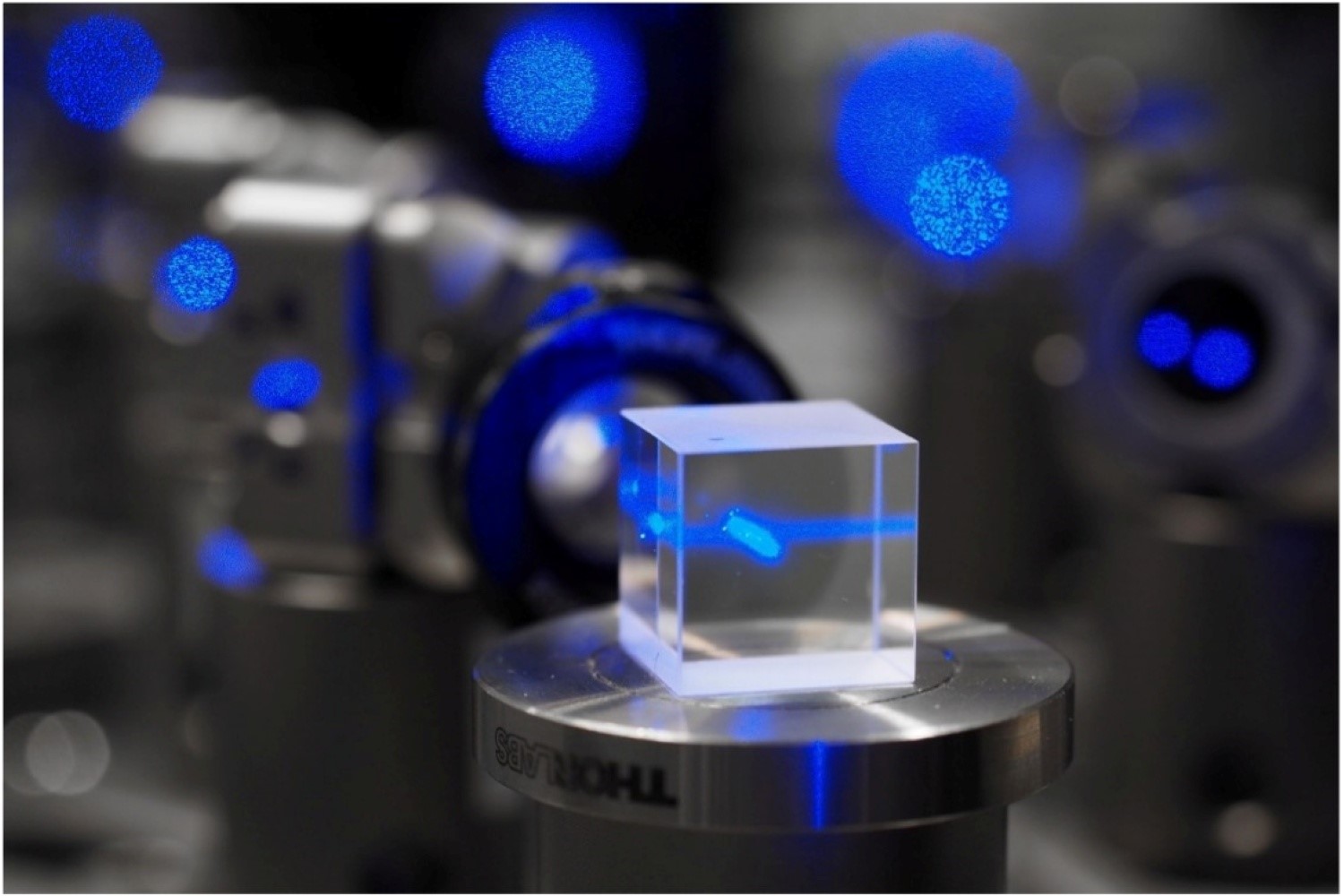
A prototype quantum sensor developed by a UK collaboration has demonstrated, for the first time, that a key principle behind next generation quantum detectors can work under realistic conditions.
The study, published in Nature, shows how comparing two atom interferometers operated along a common baseline allows important experimental noise to be effectively cancelled.
This enables signals to be recovered even when individual measurements are overwhelmed.
This forms part of the Atom Interferometer Observatory and Network (AION) collaboration, funded through UKRI’s Quantum Technologies for Fundamental Physics scheme, managed by the Science and Technology Facilities Council (STFC).
A new quantum detector
Understanding what the universe is made of and identifying new sources of gravitational wave remain major challenges in modern physics.
Both require measuring extremely small signals that can easily be lost in background noise.
The AION experiment will use quantum interference techniques to search for ultralight dark matter and detect gravitational waves in a frequency range not currently covered by existing observatories.
A 10-metre baseline detector (AION-10) is planned for the Beecroft building at the University of Oxford, with data taking targeted before 2030.
How interferometers work
Atom interferometers with long baselines work by using lasers to create a quantum superposition.
This forces atoms to effectively exist in two places at once, before bringing them back together, allowing tiny changes in their motion to be measured with precision.
Any effects caused by differences between the two paths taken by the atoms could point to previously hidden signals, such as the presence of a dark matter field.
However, the laser used to control the experiment produces phase noise far greater than the signals researchers are trying to measure.
To overcome this, scientists have proposed a differential approach, comparing two interferometers so that shared noise cancels out.
This method underpins plans for next generation detectors but had not previously been demonstrated under realistic conditions.
Putting it to the test
In the new study, researchers built a tabletop prototype in the Imperial Ultracold Strontium Laboratory, using two macroscopically separated clouds of ultracold strontium-87 interrogated by a single ultra-stable clock laser.
To push the method to its limits, the team deliberately introduced large amounts of additional phase noise into the system, simulating the conditions expected in detectors with long baselines.
Individually, each interferometer became unusable, its signal obscured by noise.
However, when the two were compared, a clear signal could still be recovered, operating at the fundamental limit set by quantum physics.
The scientists then introduced an additional oscillating signal into the system, like what might be produced by a passing gravitational wave or a dark matter field.
They found it could still be detected clearly, even under conditions where neither interferometer alone contained usable information.
Engineering the detector
STFC’s contribution to AION extends beyond funding administration.
Its Technology Department, working alongside RAL Space and Particle Physics, delivered sidearm prototypes for the AION project.
It is responsible for the design and analysis of the main tower of the interferometer.
The tower is a critical structure, providing support for the central instrument, sidearms and other major modules.
RAL Space’s Quantum Sensors group is developing and optimising the ultracold strontium atom source that AION will rely upon.
Strontium is a solid at room temperature, so it must be heated to around 400 to 500 degrees Celsius to produce a gaseous vapour.
It is then laser-cooled in two stages using blue and then red light, slowing the atoms until they can be trapped inside an ultrahigh vacuum chamber.
Physics and funding
The STFC Particle Physics department is responsible for modelling the magnetic guide field and shielding surrounding the vacuum tube.
This ensures the atoms are protected from interference as they travel through the instrument.
The department also manages the flow of STFC funding across the project, including to the Technology Department and RAL Space.
Together, these contributions represent a cross-departmental approach from STFC to help realise the prototype of the interferometer based on the AION-10 work.
Looking further ahead
The results provide the first experimental validation of a key principle underlying long baseline atom interferometers, helping to resolve a central challenge in their design.
AION also forms part of a wider international programme, with close partnerships with the MAGIS effort at Fermilab and proposals such as the Atom Interferometry CERN Experiment (AICE).
This would apply similar techniques over much longer distances.
Professor Oliver Buchmueller, Principal Investigator of the AION collaboration at Imperial, said:
This work marks an important milestone towards future large scale quantum sensors for fundamental physics.
It demonstrates, under realistic experimental conditions, a key technique relevant for next generation atom interferometer facilities currently under development internationally, including MAGIS at Fermilab and the proposed AICE facility at CERN.
In future, these detectors could explore previously inaccessible gravitational wave frequency bands and search for new forms of matter, opening a previously unexplored window on the universe.
Top image: Credit: Dr Thomas Walker